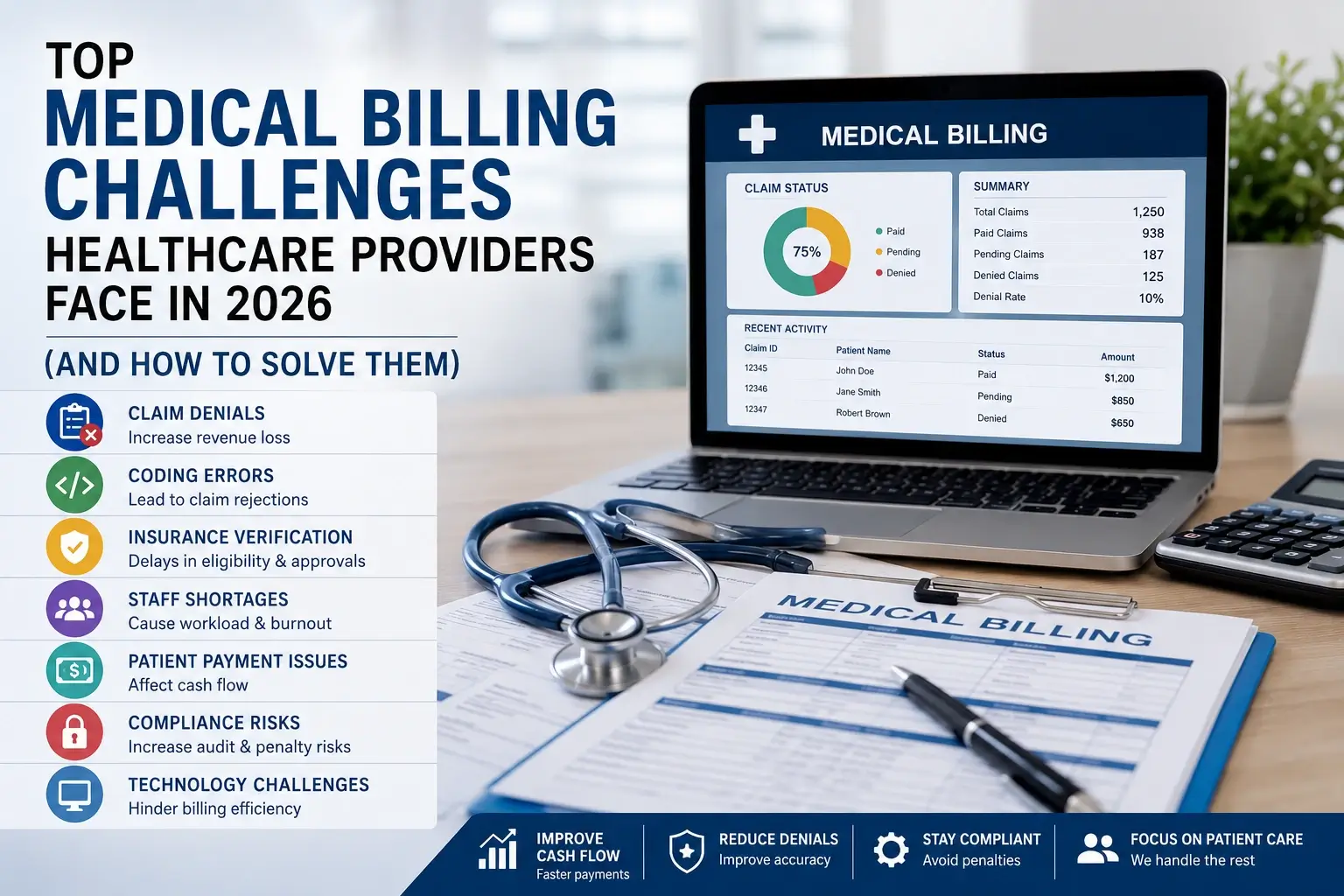

Professional medical billing services reduce claim denials by fixing the exact problems that cause claims to fail in the first place. Claim denials are not random. They happen due to coding errors, eligibility mistakes, missing documentation, payer rule violations, and poor follow up. Most in house billing teams struggle to manage all of this consistently, especially with constant payer updates.
When practices rely on professional medical billing services, denial rates drop because billing becomes systematic, audited, and payer compliant.
Why Claim Denials Are a Serious Revenue Problem
Claim denials directly impact cash flow. A denied claim is delayed revenue, and many denials are never recovered. Industry data shows that practices lose a significant percentage of revenue simply because denied claims are not appealed on time or correctly.
Common causes include:
Incorrect CPT or ICD coding
Missing modifiers
Eligibility not verified before visits
Authorization errors
Timely filing limits missed
Incomplete provider documentation
Professional medical billing services reduce claim denials by addressing each of these issues before the claim is ever submitted.
How Professional Medical Billing Services Reduce Claim Denials at the Front End
The denial prevention process starts before the patient is even seen. Professional medical billing services reduce claim denials by enforcing strict front end workflows.
These include:
Insurance eligibility verification
Benefit and coverage confirmation
Authorization and referral checks
Accurate patient demographic entry
Many denials occur simply because insurance was inactive or a service was not covered. In house staff often skip these steps due to workload. Professional medical billing services follow them without exception.
Accurate Medical Coding Lowers Denial Rates
Coding errors are one of the biggest denial triggers. Professional medical billing services reduce claim denials by using certified coders who stay updated with payer and CMS guidelines.
They ensure:
Correct CPT and ICD pairing
Proper use of modifiers
Compliance with National Correct Coding Initiative edits
Avoidance of unbundling and upcoding errors
This level of accuracy is difficult to maintain internally unless a practice invests heavily in ongoing training.
Documentation Review Improves Claim Acceptance
Even correctly coded claims get denied if documentation does not support medical necessity. Professional medical billing services reduce claim denials by reviewing provider notes for completeness and compliance.
They look for:
Clear assessment and plan
Medical decision making justification
Procedure specific documentation requirements
Time based billing support when applicable
If documentation is weak, billing teams flag it before submission instead of letting the claim get denied later.
Clean Claim Submission Process
Professional medical billing services reduce claim denials by submitting clean claims the first time. Clean claims are complete, accurate, and formatted exactly according to payer requirements.
This includes:
Correct payer specific claim forms
Accurate provider and facility identifiers
Valid diagnosis procedure linkage
Proper place of service codes
Most denials happen because claims fail basic payer edits. Professional billing companies test claims before submission to avoid this.
Payer Rule Knowledge and Updates
Payers constantly change their rules. What was accepted last month may be denied today. Professional medical billing services reduce claim denials by tracking payer policy updates in real time.
This includes:
Local Coverage Determinations
National Coverage Determinations
Commercial payer policy bulletins
State specific Medicaid rules
In house teams usually find out about rule changes only after denials start happening.
Denial Management and Appeals
Even with strong prevention, some denials are unavoidable. Professional medical billing services reduce claim denials long term by aggressively managing denied claims.
Their denial management process includes:
Root cause analysis
Corrected claim resubmission
Formal appeal letters with documentation
Timely follow up until resolution
Most practices lack the time or expertise to appeal effectively, which leads to permanent revenue loss.
Data Tracking and Performance Monitoring
Professional medical billing services reduce claim denials by tracking denial trends and fixing patterns. They do not treat denials as isolated events.
They monitor:
Denial reasons by payer
Denial rates by provider
Coding related denial frequency
Authorization related failures
This data driven approach allows continuous improvement and long term denial reduction.
Why In House Billing Often Fails
Let’s be honest. Most in house billing teams fail not because they are lazy, but because they are overloaded. Staff turnover, limited training budgets, and manual processes lead to mistakes.
Professional medical billing services reduce claim denials because they offer:
Dedicated billing specialists
Standardized workflows
Quality control audits
Scalable resources
This is extremely difficult to replicate internally.
Final Thoughts
Professional medical billing services reduce claim denials because they eliminate guesswork, enforce compliance, and focus on prevention instead of damage control. Lower denial rates mean faster payments, better cash flow, and less administrative stress for providers.
For practices serious about revenue protection, outsourcing billing is not an expense. It is a corrective strategy.