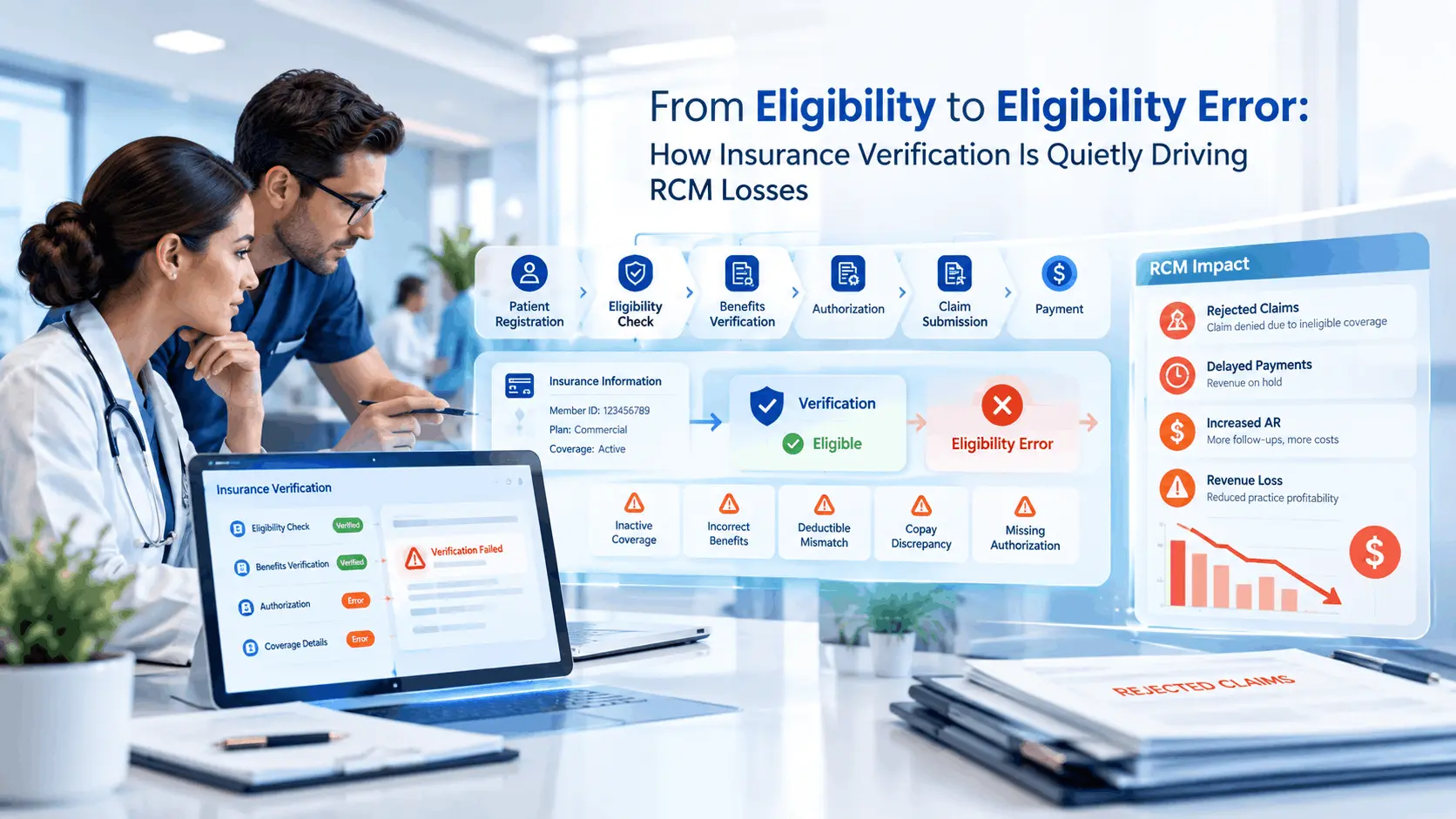
Revenue cycle management (RCM) has gone beyond claims submission and payments collection. As a result of evolving payer policies, increased financial responsibility of patients, and growing claim denials, there is a need for a more organized method for handling revenue among U.S. medical practices. Well-thought-out RCM checklist will enable practices to pinpoint revenue leaks, avoid billing mistakes, and ensure that every part of the revenue cycle operates smoothly.
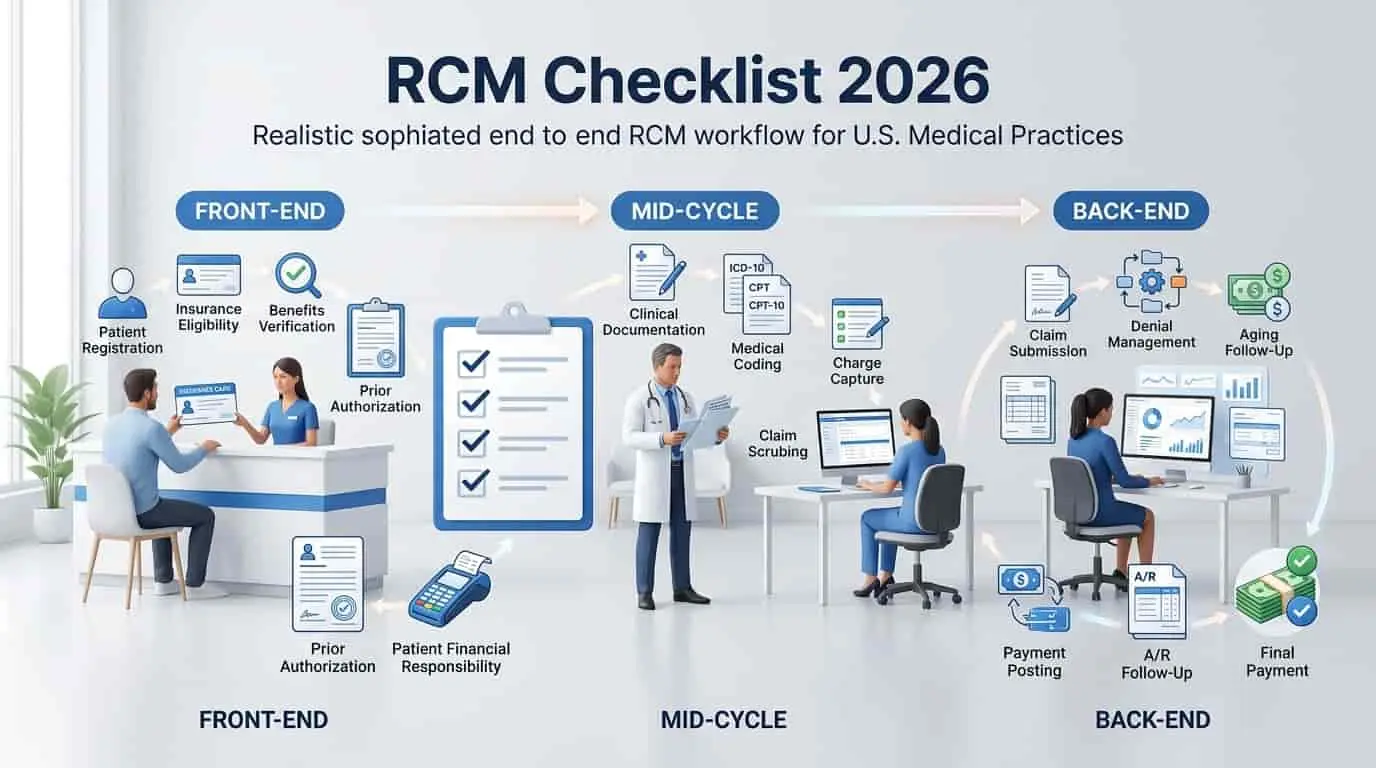
Starting from scheduling, insurance eligibility, and coding all the way to claims submission, denial management, and payment posting, each of these processes can have an impact on the performance of the medical practice. This revenue cycle management checklist for 2026 provides an operational and end-to-end solution that includes the three major phases of revenue cycle management – front-end, mid-cycle, and back-end – as well as performance metrics.
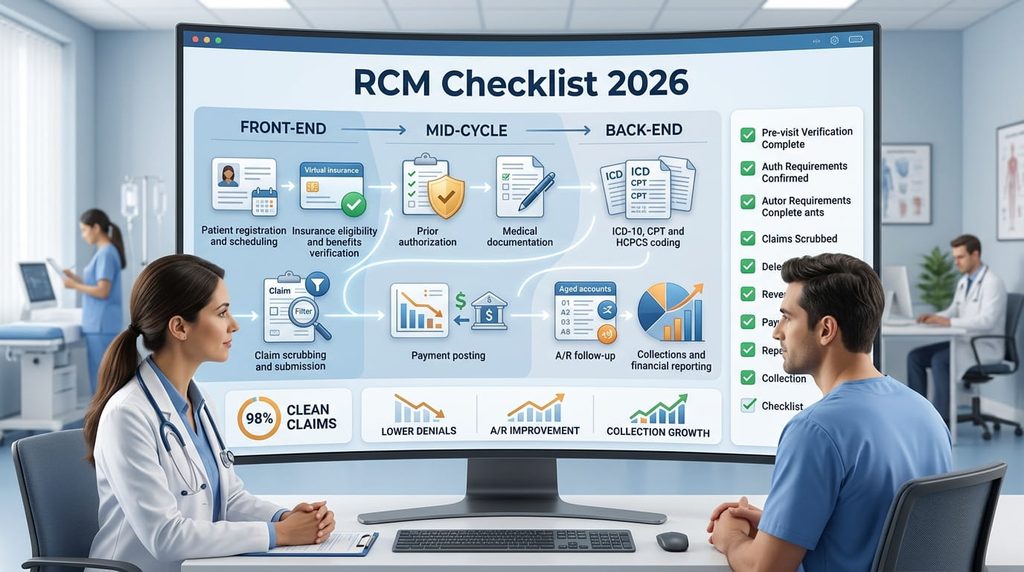
Phase 1: Front End RCM (Prior to the Encounter)
The majority of revenue leakages occur prior to a patient seeing a healthcare professional. It is inexpensive to address front-end issues, but it can become very costly to ignore them.
RCM Checklist:
- Verify insurance eligibility and benefits in real-time and not at check-in
- Establish coverage status, insurance plan type, and network status
- Obtain copays, coinsurances, and outstanding deductibles prior to the visit
- Identify services which require pre-authorization and request them early
- Obtain correct demographic information, confirmed by matching patient ID with their insurance card
- Offer an upfront cost estimate when possible to the patient
- Set the expectation of the practice’s financial policy during the scheduling process
Why it matters: Missing eligibility and pre-authorization is one of the most frequent causes of claims delays and denials, but it is easily avoidable through proper front-end processes.
Phase 2: Mid-Cycle RCM (Coding & Documentation)
This is where clinical care gets translated into billable, defensible data. Errors here don’t just cause denials — they create audit exposure.
Checklist:
- Confirm ICD-10 and CPT code sets are current for the calendar year
- Match every code to specific documentation in the chart, no code without a clinical trail
- Code diagnoses to the highest available specificity
- Apply modifiers correctly for bilateral, multiple, or distinct procedures
- Verify documentation supports the level of E/M service billed
- Confirm provider signatures (and valid e-signature protocols) are complete
- Run coding through an internal or automated scrubber before claims go out
Phase 3: Back-End RCM (Claims, Denials & Collections)
Once a claim is submitted, the work isn’t done — it’s monitored, defended, and, when necessary, appealed.
Checklist:
- Scrub claims for completeness (patient, provider, and payer fields) before submission
- Track payer-specific formatting rules and timely filing deadlines
- Monitor clean claim rate and first-pass resolution rate weekly
- Triage denials by category (eligibility, coding, authorization, medical necessity)
- Appeal correctable denials within payer deadlines — don’t write them off by default
- Reconcile payments against contracted rates to catch underpayments
- Review aging A/R buckets and prioritize accounts nearing timely-filing cutoffs
- Conduct monthly denial-trend audits to catch systemic issues early
RCM Technology & Compliance Checklist
In 2026, practices should also review whether their technology supports efficient information exchange and prior authorization workflows.
- ☐ Confirm EHR and practice-management systems are properly integrated
- ☐ Review clearinghouse connectivity and claim-report workflows
- ☐ Use automated eligibility verification where appropriate
- ☐ Evaluate electronic prior authorization capabilities
- ☐ Monitor payer portal and API changes
- ☐ Maintain appropriate user access controls
- ☐ Protect patient financial and health information
- ☐ Review HIPAA-related administrative and technical safeguards
- ☐ Maintain reliable data backup and recovery processes
- ☐ Monitor system integrations for failed transactions
- ☐ Train staff when new payer or technology workflows are introduced
The Metrics That Tell You the Checklist Is Working
A checklist is only useful if you’re measuring its impact. Track these on a monthly cadence:
| Metric | Healthy Benchmark |
|---|---|
| Clean claim rate | 90%+ |
| Denial rate | Under 5–8% |
| Days in A/R | Under 35–40 days |
| First-pass resolution rate | 85%+ |
| Net collection rate | 95%+ |
If any of these are trending the wrong way, the fix is almost always upstream, usually in eligibility verification or documentation, not in the billing submission step itself.
Quick 2026 RCM Audit
A practice should be able to answer “yes” to these questions:
- ☐ Are we verifying insurance before the patient’s visit?
- ☐ Are we identifying authorization requirements before services?
- ☐ Are we collecting accurate patient financial information?
- ☐ Does documentation support the services billed?
- ☐ Are our coding practices current and accurate?
- ☐ Are claims being scrubbed before submission?
- ☐ Are rejected claims corrected quickly?
- ☐ Are denials being analyzed by root cause?
- ☐ Are appeals submitted before payer deadlines?
- ☐ Are payments reconciled against expected reimbursement?
- ☐ Are aging A/R accounts actively worked?
- ☐ Are we monitoring payer-specific trends?
- ☐ Are we reviewing RCM KPIs every month?
- ☐ Are recurring errors being addressed through staff training?
- ☐ Is our technology keeping pace with payer and interoperability changes?
Final RCM Checklist Goal
The purpose of an RCM checklist isn’t simply to give your billing team more tasks. It is to create a repeatable process that prevents revenue leakage before it occurs. When front-end verification, accurate documentation and coding, clean claim submission, proactive denial management, payment reconciliation, and A/R follow-up work together, practices have greater visibility and control over their revenue cycle.
Building Accountability Into the Process
A checklist fails without ownership. Practical steps:
- Assign specific checklist stages to specific roles (front desk owns eligibility; coders own documentation match; billing owns claim scrubbing)
- Run brief monthly audits and share results with the team, not just leadership
- Update the checklist every January for annual coding changes, and immediately when a payer changes policy
- Treat recurring denial patterns as training opportunities, not just rework
Take Control of Your Revenue Cycle with Allstars Medical Billing
Even the best internal checklist has limits if your team is stretched thin across scheduling, clinical care, and billing all at once. Allstars Medical Billing and IT Solution works as an extension of your practice handling credentialing, coding, claims submission, and denial management so fewer dollars slip through the cracks.
A few things worth knowing about the team behind the work:
- AllStars Medical Billing is a Walnut Creek, California-based company founded in 2019, with 500-1000
- employees serving clients across all U.S. states.
- The team covers professional, institutional, laboratory, DME, IONM, and out-of-network surgeon billing across more than 50 specialties, and every team member brings over a decade of medical billing and client management experience.
- Reported performance benchmarks put their first-time claims acceptance rate at roughly 98%, compared with a healthcare industry average closer to 95%, and their average denial rate at around 8% against an industry average nearer 11%.
- The company positions itself around transparent, low billing rates with no hidden charges and no restrictive client agreements, along with automated appeals support and aggressive AR and appeals follow-up.
Whether you’re a solo practice or a multi-provider group, Allstar Medical Billing plugs into your existing EMR and workflow without forcing a disruptive system change.
Ready to see where your practice is losing revenue? Visit allstarsmb.com to schedule a free RCM audit and get a clear, actionable breakdown of your clean claim rate, denial trends, and collection opportunities.
How often should an RCM checklist be updated?
At minimum, review it every January to account for annual CPT and ICD-10 changes. Beyond that, update it whenever a major payer changes its policies, after an internal audit surfaces a new error pattern, or when new regulatory requirements take effect.
What’s a realistic clean claim rate to aim for?
Most practices operate in the 75–85% range without a structured process. With a disciplined front-end and mid-cycle checklist in place, 90%+ is a realistic and sustainable target, and well-run outsourced RCM operations often exceed 95%.
Should denials be resubmitted or appealed?
It depends on the root cause. Simple data or eligibility errors can usually be corrected and resubmitted quickly. Denials involving medical necessity, authorization disputes, or payer policy disagreements typically need a formal appeal with supporting documentation resubmitting without addressing the underlying issue usually produces the same denial twice.
Can outsourcing RCM actually reduce errors, or does it just shift the problem?
When done well, outsourcing reduces errors because dedicated RCM teams specialize in exactly this work they track payer policy changes full-time, run layered quality checks, and build denial-trend feedback into their process. The key is choosing a partner who integrates with your existing systems rather than forcing a disruptive changeover.
revenue cycle process where errors are structurally unlikely. A well-planned RCM checklist helps medical practices identify potential problems early, assign responsibility to the right team members, and create consistent processes from patient registration through final payment.
A phase-by-phase RCM checklist covering front-end, mid-cycle, and back-end activities can help practices improve insurance verification, strengthen documentation and coding accuracy, reduce claim denials, accelerate A/R recovery, and improve overall collections. When these steps are combined with regular staff training and monthly performance reviews, practices can identify recurring problems before they become costly revenue leaks.
The key is to treat RCM as an ongoing process rather than a one-time billing task. Reviewing metrics such as clean claim rate, denial rate, days in A/R, first-pass resolution rate, and net collection rate gives practices a clear picture of what is working and where improvements are needed.
Ultimately, an effective RCM checklist turns revenue cycle management from a reactive scramble into a predictable, measurable system. By consistently reviewing and improving each stage of the process, U.S. medical practices can reduce avoidable denials, improve cash flow, and create a stronger financial foundation for long-term growth
.