
Commercial Insurance Medical Billing has turned out to be one of the most complex and significant aspects of operating a medical practice in America. While the payment policies, filing limits, coding and authorization rules of governmental programs are standard, every commercial insurance company has its own set of policies and terms for payment and submission of claims, and failure to stay on top of them will lead to delays in payments, denials, and difficulties with patients’ collections.
This article will provide you with insights into what Commercial Insurance Medical Billing includes, how the process takes place, what changes you will face in 2026, and how you can maintain the smoothness of your cash flow.
What Is Commercial Insurance Medical Billing?
Medical Billing for Commercial Insurance is the process of making claims to non-government, or private insurers such as Aetna, Cigna, United HealthCare, Blue Cross Blue Shield plans, or any group plans provided by employers in exchange for payment of services. This process includes everything, from checking out the coverage of the patient prior to his or her appointment, proper coding of the encounter, electronic submission of the claim and follow up till the balance has been reconciled.
The commercial insurance plans have an overwhelming presence in the field of insurance in the United States. Out of the total number of people covered by health insurance plans in the country, 92% are insured and of this percentage 54% are insured under the employer sponsored plans.

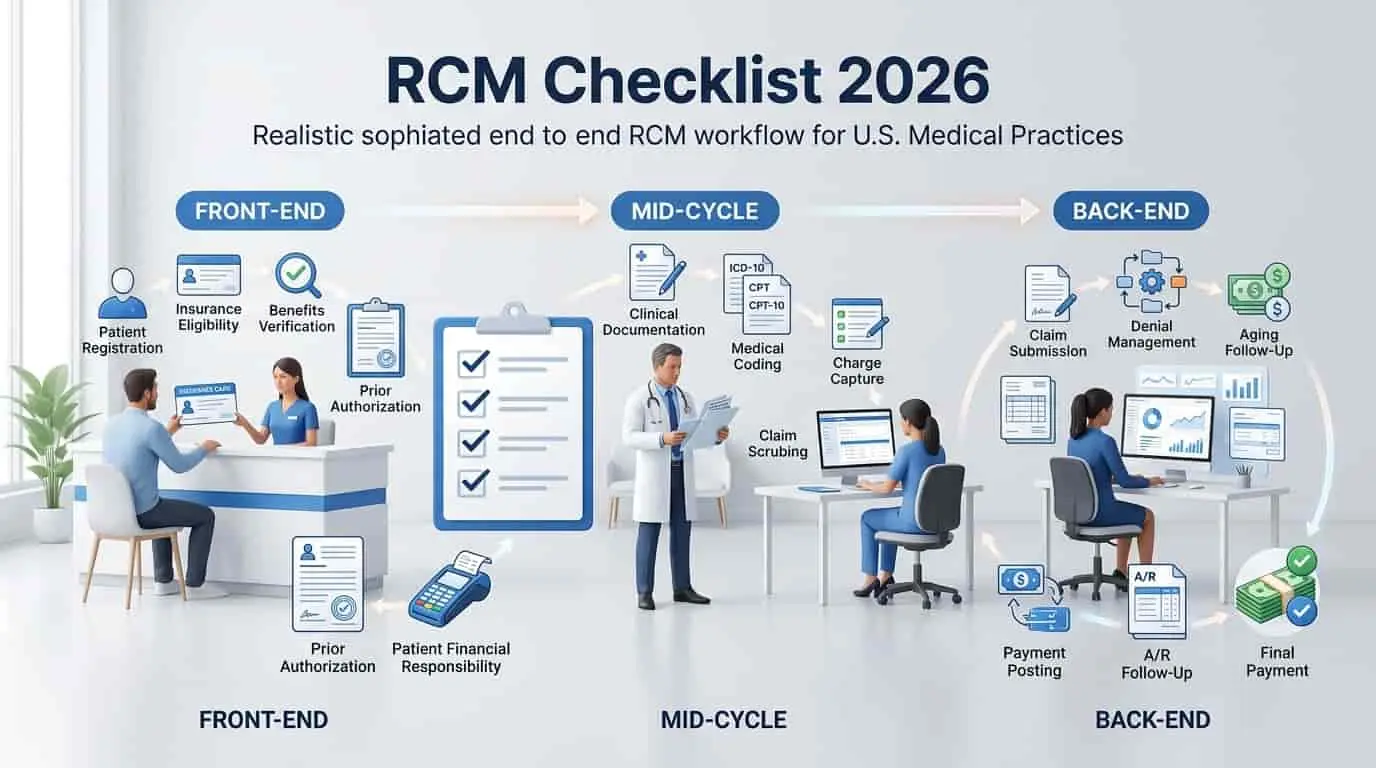
How Commercial Insurance Billing Works: Step by Step
- Patient registration and insurance verification. Insurance information is collected from the front desk and checked for active insurance status, type of insurance plan, deductible, copay, and prior authorization if applicable for the intended service.
- Charge capture and medical coding. Medical documentation is converted into proper medical coding according to CPT, HCPCS, and ICD-10 codes.
- Claim scrubbing. Claims are checked to identify any errors with regard to payer-specific edits that relate to mismatched codes, modifier or lack thereof, incomplete claim etc.
- Electronic claim submission. Claims are submitted through clearinghouse electronically to the commercial payer based on 837 standards format.
- Payer adjudication. The insurer examines the claim according to the patient’s benefit plan, medical necessity, and contract rates.
- Payment posting and EOB reconciliation. The Explanation of Benefits received from the payer after the claim payment is matched to the claim to make sure the payment is for the correct allowed amount.
- Patient billing and collections. The balance which is copay, coinsurance, or deductible is charged to the patient.
- Denial management and appeals. Claims that were denied or not paid properly are worked on by denial management personnel.
Key Differences Between Commercial and Government Payer Billing
- Contract-based rates. Commercial reimbursement is set by negotiated payer contracts rather than a fixed government fee schedule, so the same CPT code can pay differently across plans.
- Variable authorization rules. Prior authorization requirements, timely filing limits, and appeal deadlines differ payer to payer — and even plan to plan within the same insurer.
- Coordination of benefits (COB). When a patient has more than one policy, commercial billing requires correctly sequencing primary and secondary payers to avoid delays or overpayment recoupments.
- Higher patient cost-sharing. Commercial plans, especially high-deductible health plans (HDHPs), shift a larger share of the bill directly onto patients compared with many government programs.
The Latest Commercial Insurance Billing Data (2026)
- It is reported that nearly 80% of medical claims contain at least one error due to various issues, such as coding errors or even mistakes in patient data — one of the main causes of commercial claim delays and denials.
- Initial denial rates across the industry are currently about 12-17% with poorly run billing operations reaching 15-20% while the benchmark for efficient medical practices is 5-7%.
- One-third of all medical claims are initially denied, and 33% of all denials are caused by coding errors alone.
- The annual loss for U.S. providers due to poor billing and administrative inefficiency not fraud – is estimated at $262 billion.
- Minimum deductible for high-deductible health insurance plans in 2026 according to the IRS is $1,700 per individual and $3,400 for a family plan. Many employer-sponsored plans go beyond this minimum level, which means that patients have a significant portion of their medical expenses paid out-of-pocket before the commercial insurance kicks in.
- Patient collections from commercially insured patients remain at a low rate of about 30% due to difficulties in collecting increasing patient responsibility balances.
- Almost 45% of employed insured Americans report being billed for services they expected to be fully covered one
Common Reasons Commercial Insurance Claims Get Denied
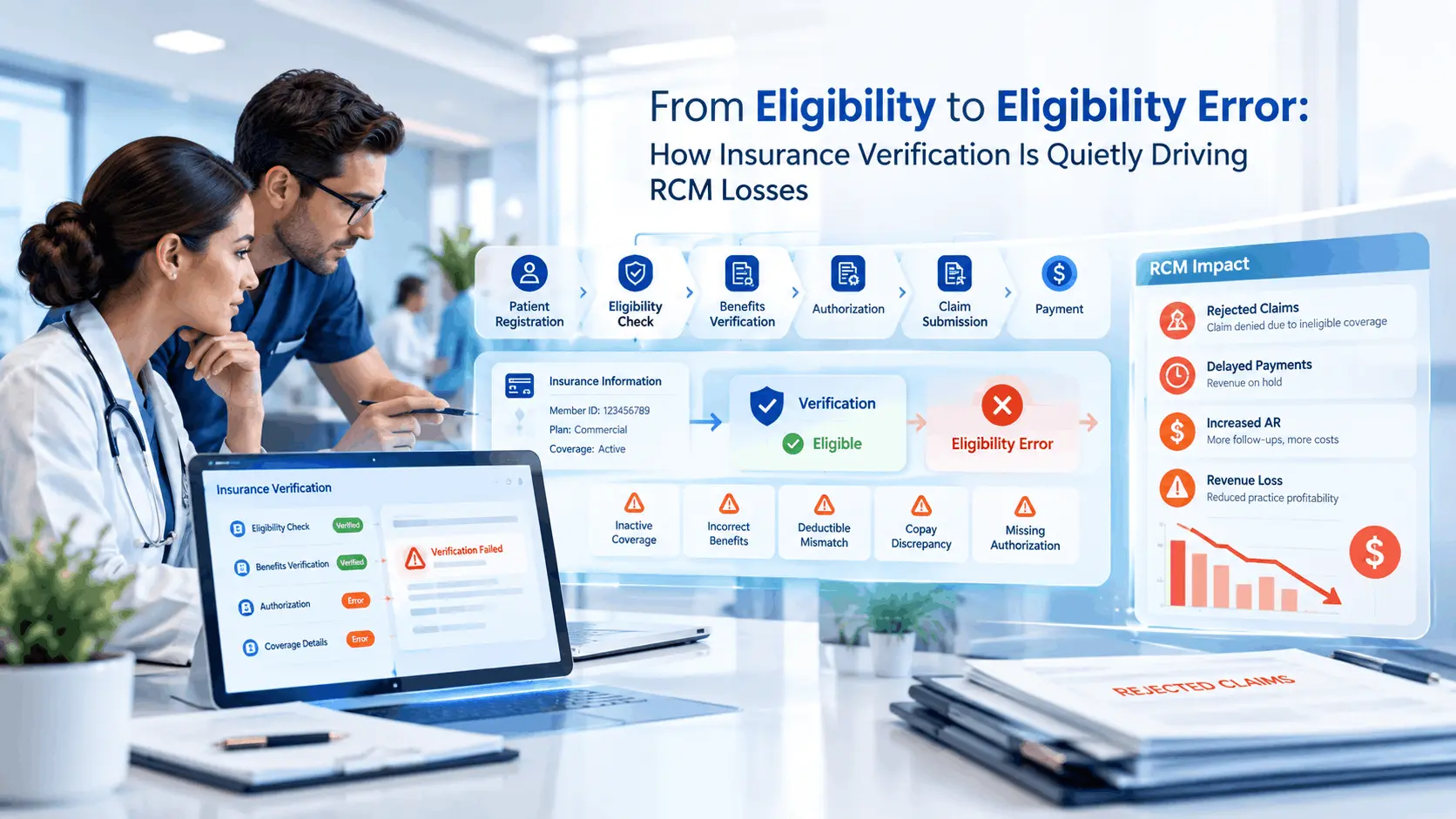
- Ineligible for coverage or coverage mismatches at time of service
- Expired prior authorization
- Wrong or outdated CPT / ICD-10 Codes
- Duplicate claims
- Lapses in timely filing time limits
- Coordinating benefits when the patient has more than one policy
- Service not considered medically necessary according to the payers policy
- Out of network providers/facilities
Best Practices to Improve Commercial Insurance Billing Performance
- Confirm eligibility and benefits prior to every visit Eligibility checking software ensures that the patient still has active insurance, that his policy is deductibile, and that all authorizations are in place prior to the visit.
- Stay on top of commercial payers’ rules Create a list of timely filing periods, list of services requiring authorization and deadlines for appealing for all major commercial payers.
- Use automated claim scrubbing software This will ensure that the coding matches your contract and all other information in your claims is correct prior to the submission, thus eliminating first-pass rejections.
- Reconcile all EOBs Compare payments made by the commercial payer to the agreed upon contracted rates to ensure no underpayments.
- Create denial and appeals flow Ensure that denials are passed on to your appeals team immediately, as commercial payers are very strict about deadlines for appeals.
- Enhance patient financial communication Patients insured by HDHPs will have to pay more out of pocket; therefore, providing estimates and flexible payment options can improve collections and patient experience.
- Monitor key performance indicators on a consistent basis Make sure to track clean claim ratio, denial ratio, DRAA and first-pass resolution rate.
What’s the difference between commercial insurance and government insurance billing?
Commercial insurance billing involves private payers with contract-negotiated rates, plan-specific rules, and varying authorization and appeal timelines. Government payer billing (Medicare, Medicaid) follows standardized federal fee schedules and coverage policies that apply more uniformly nationwide.
How long do commercial insurers typically take to process a claim?
It varies by payer and state prompt-pay laws, but most commercial insurers process clean electronic claims within 15–30 days. Claims requiring additional documentation or manual review can take significantly longer.
What is coordination of benefits, and why does it matter in commercial billing?
Coordination of benefits (COB) determines which insurer pays first when a patient has more than one health plan. Getting the sequencing wrong is a common cause of claim denials and payment delays.
Why are patient collections harder with commercial insurance today?
The growth of high-deductible health plans means patients now owe a much larger share of the bill directly out of pocket before their coverage activates, making upfront estimates and flexible payment plans increasingly important for practices.
What’s the fastest way to reduce commercial claim denials?
Front-loading the process — accurate eligibility verification, correct coding, and pre-submission claim scrubbing — prevents the majority of denials before they happen, rather than relying solely on appeals after the fact.
Should a practice outsource commercial insurance billing?
For practices struggling with denial rates, staff turnover, or growing patient volume, outsourcing to an experienced billing partner often improves clean claim rates, speeds up reimbursement, and frees clinical staff to focus on patient care.
Simplify Your Commercial Insurance Billing with Allstars Medical Billing
Commercial insurance claims need not always be an endless uphill task. The proper verification of eligibility, coding, and denial management procedures can lead to better collections at a much higher speed and with little effort.
Allstars Medical Billing makes your job easy by helping you understand and adhere to commercial payer policies, from verifying eligibility in real time to submitting error-free claims and filing quick and successful appeals.
👉 Work with Allstars Medical Billing to improve your revenue cycle.