Most healthcare practices spend enormous energy fighting claim denials after the fact building appeal workflows, hiring denial specialists, and chasing payers for reconsideration. But the uncomfortable truth is that a huge share of that revenue can be lost before the patient ever sits in the exam room. It often starts at the front desk, with a five-minute step that is sometimes treated as an administrative formality: insurance eligibility verification.
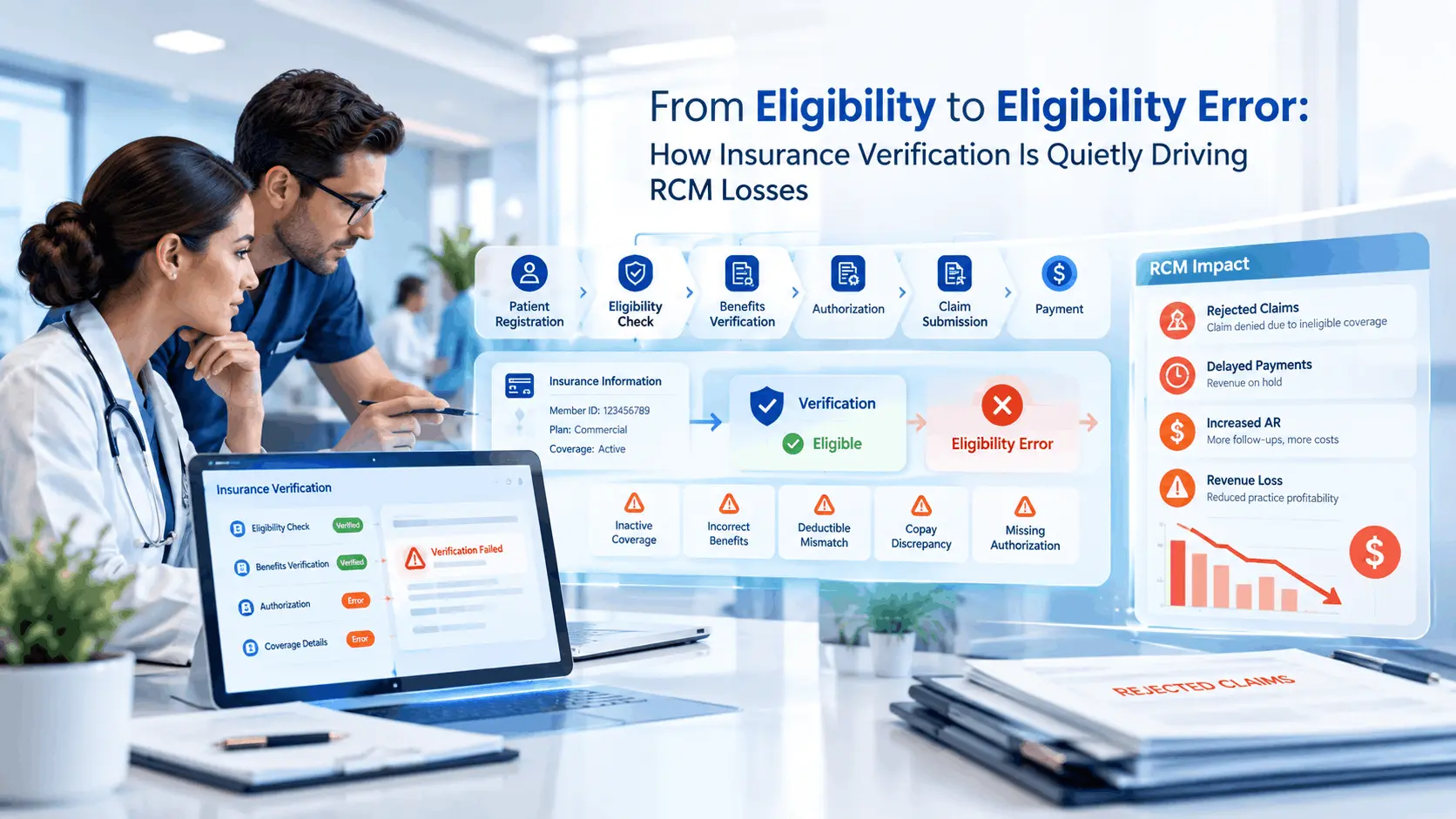
In 2026, the journey From Eligibility to Eligibility Error has become an important concern for U.S. healthcare providers. A simple mistake in verifying coverage, benefits, deductibles, copayments, coinsurance, or authorization requirements can lead to unexpected patient balances, claim denials, delayed payments, and avoidable RCM losses.
This guide explains how practices can move , Eligibility Verification why these mistakes happen, what they can cost providers, and how a proactive eligibility verification process can help prevent them before they affect revenue.
What Is Insurance Eligibility Verification?
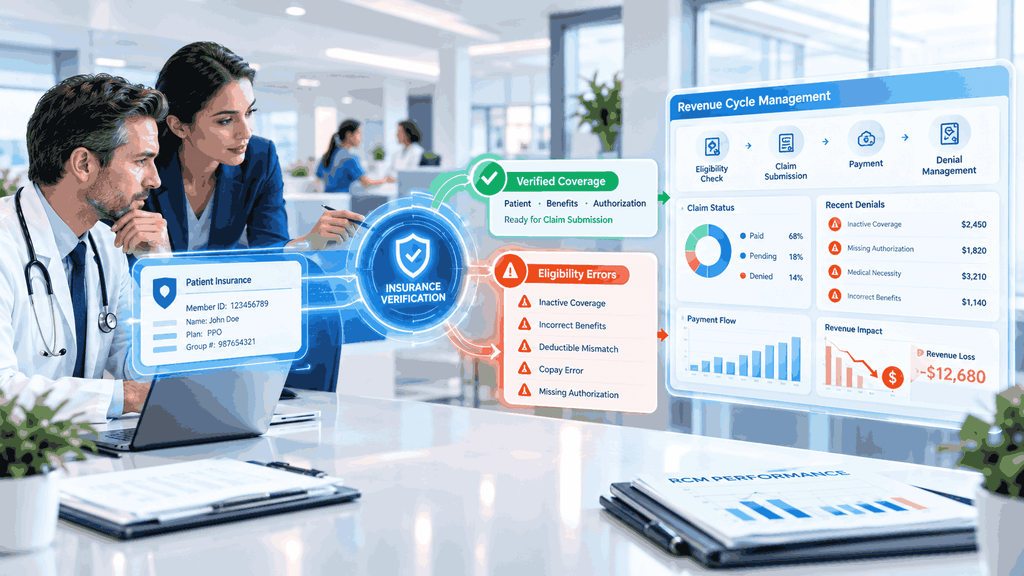
The insurance verification process involves ensuring that the patient’s coverage is current and determining the type of services the coverage covers and the patient’s co-pay and deductibles. When done right, it is the initial and most critical point in the entire revenue cycle; it verifies that the practice will be paid for the services they will be rendering.
When done wrong or ignored, it triggers a ripple effect through almost all downstream RCM processes, including coding, claims filing, payments, and patient billing.
Why Eligibility Verification Quietly Drives RCM Losses
Eligibility mistakes are not eye-catching in themselves. An employee enters an insurance policy number incorrectly, does not realize that the patient’s insurance plan has been updated since January 1st, or fails to verify the secondary insurance due to a full schedule. On their own, these seem like minor mistakes, but when done repeatedly over the span of hundreds of appointments per month, they become one of the greatest silent drains on revenue for any practice.
This is the difference between eligibility mistakes and other issues with billing they go unnoticed until they turn up in denied claims weeks later.
The Latest Data on Eligibility Errors and RCM Losses (2026)
- Eligibility or registration errors are responsible for an estimated 15–30% of all claim denials, making them one of the single largest denial categories in U.S. healthcare billing.
- A separate industry analysis found that up to 20% of initial claims contain eligibility-related errors, ranging from outdated coverage data to missed coordination-of-benefits details.
- One documented case involving a 500-bed hospital found it lost roughly $25 million in a single year from claim denials, with the majority of that loss traced back to basic eligibility mistakes.
- The average cost to rework a single denied claim has been estimated at $25 to over $180, depending on complexity and payer a cost incurred entirely from an error that was preventable at check-in.
- Industry-wide initial claim denial rates have climbed to roughly 12–17% in 2026, with denied inpatient dollar amounts up about 12% year-over-year, according to recent RCM benchmarking data.
- Manual eligibility checks especially for Medicaid, which requires navigating multiple state portals — remain especially error-prone, contributing to inconsistent verification and missed coverage changes.
- Administrative churn is also a growing factor: several million Medicaid enrollees are at risk of losing coverage annually due to missed renewal confirmations, meaning a patient verified as covered last month may not be covered today.
- Providers who automate eligibility verification report meaningfully higher clean-claim rates, since a large share of claim rejections trace directly back to eligibility and registration data issues.
Common Eligibility Verification Errors That Drain Revenue
- Outdated or inactive coverage checking eligibility once and assuming it holds for every future visit .
- Incorrect patient demographic or policy data typos in member ID, date of birth, or group number .
- Missed coordination of benefits (COB) failing to identify or correctly sequence a secondary payer .
- Overlooked authorization or referral requirements — confirming coverage exists without confirming the specific service is authorized .
- Manual, phone-based verification slower, inconsistent, and more prone to human error than electronic checks.
- Verifying too early or too late checking eligibility days before a visit without a same-day recheck, missing last-minute plan changes .
- Assuming self-pay patients need no verification — missing undisclosed secondary coverage or eligibility for assistance programs.
How Eligibility Errors Ripple Through the Entire Revenue Cycle
- Coding and charge capture staff code and bill based on incorrect assumptions about the patient’s plan.
- Claim submission the claim goes out with a policy number, plan type, or payer sequence that no longer matches reality.
- Payer adjudication the claim is denied or delayed for eligibility mismatch .
- Rework and resubmission staff time is spent tracking down the correct information and resubmitting .
- Patient billing conflict patients receive unexpected bills for services they believed were covered, damaging trust and slowing collections .
- Aged accounts receivable the longer the correction takes, the more likely the balance ends up in a slow-pay or write-off bucket.
How to Prevent Eligibility Verification Errors and Protect RCM Performance
- Check eligibility in real-time at each visit Do not do only one check in advance weeks ago – verify patients’ eligibility again right before the visit date because things may change unexpectedly.
- Perform automatic eligibility verification An electronic tool for eligibility verification retrieves information from payer systems which helps to avoid mistakes caused by manual data entry in phone- and portal-based verification.
- Make the process of coordination of benefits standardized Ask your patient about secondary coverage every time during the visit even if the patient does not mention it.
- Train the front-desk staff in payer-specific issues Eligibility responses from different payers differ from each other and the front-desk staff should be able to correctly interpret codes, benefit levels, etc.
- Mark the high-risk visits for manual verification The high-risk visits when the patient has more than one insurer, had recent plan change, wants to schedule an out-of-network visit need to be verified twice prior to the visit and not afterwards.
- Track denial rates related to eligibility separately From the coding- or documentation-driven denials separating the eligibility-driven denials is the way to find out what needs fixing the most.
- Close the loop for eligibility issues
What percentage of claim denials are actually caused by eligibility errors?
Industry estimates put eligibility and registration errors behind roughly 15–30% of all claim denials, making it one of the largest single categories of preventable denials in U.S. healthcare billing.
How often should a practice verify patient eligibility?
Ideally, eligibility should be checked before every visit not just at the patient’s first appointment since coverage, plan details, and authorization requirements can change month to month or even day to day.
Can eligibility verification errors affect patients directly, not just providers?
Yes. When eligibility isn’t verified correctly, patients can receive surprise bills for services they believed were fully covered, which damages trust and often slows down collections even further.
Is manual eligibility verification still reliable in 2026?
Manual, phone- or portal-based verification is increasingly seen as a liability. It’s slower and more error-prone than electronic, real-time verification, especially for payers like Medicaid where rules vary by state and change frequently.
What’s the real cost of an eligibility-driven denial?
Beyond the lost or delayed reimbursement, reworking a single denied claim can cost anywhere from roughly $25 to well over $100 in staff time and administrative overhead a cost that a correct upfront eligibility check would have avoided entirely.
How can outsourcing help reduce eligibility-related revenue loss?
A dedicated billing and RCM partner brings real-time verification technology, payer-specific expertise, and consistent processes that most in-house front-desk teams don’t have the bandwidth to maintain across every patient, every visit.
Stop Losing Revenue Before the Claim Is Even Filed
Eligibility verification is not just an administrative process; it is the financial gatekeeper of your entire revenue cycle. If it goes wrong, the whole subsequent process is compromised: from claim denials and re-work to aged accounts receivable and patient frustration.
Allstars Medical Billing assists medical organizations in solving the eligibility problem via proper verification, better coordination of benefits screening, and a denial management process designed to prevent problems that cost you money.
👉 Get in touch with Allstars Medical Billing to protect your revenue cycle.