
Revenue Cycle Management vs Medical Billing: Key Differences Explained
Revenue Cycle Management vs Medical Billing is a topic many healthcare providers struggle to understand clearly. While both are essential parts of healthcare administration, they serve different roles in managing financial operations within a medical practice.
Many healthcare providers mistakenly assume that medical billing and revenue cycle management are the same. However, confusing these two processes can lead to inefficient operations, delayed reimbursements, and revenue loss. Understanding the difference helps clinics, hospitals, and healthcare organizations choose the right solution for improving their financial performance.
In this article, we’ll break down the key differences between Revenue Cycle Management (RCM) and Medical Billing Services, how each works, and why both are important for healthcare providers.
Understanding Revenue Cycle Management vs Medical Billing is essential for healthcare providers who want to improve operational efficiency and financial performance. When practices clearly understand how Revenue Cycle Management vs Medical Billing differ, they can choose the right strategy to reduce claim denials and increase revenue.
What is Revenue Cycle Management (RCM)?
Revenue Cycle Management (RCM) refers to the complete financial process that healthcare providers use to manage patient service revenue from the first appointment to the final payment.
RCM covers the entire lifecycle of a patient’s financial journey, ensuring that healthcare providers receive accurate and timely payments for their services.
Key Components of Revenue Cycle Management
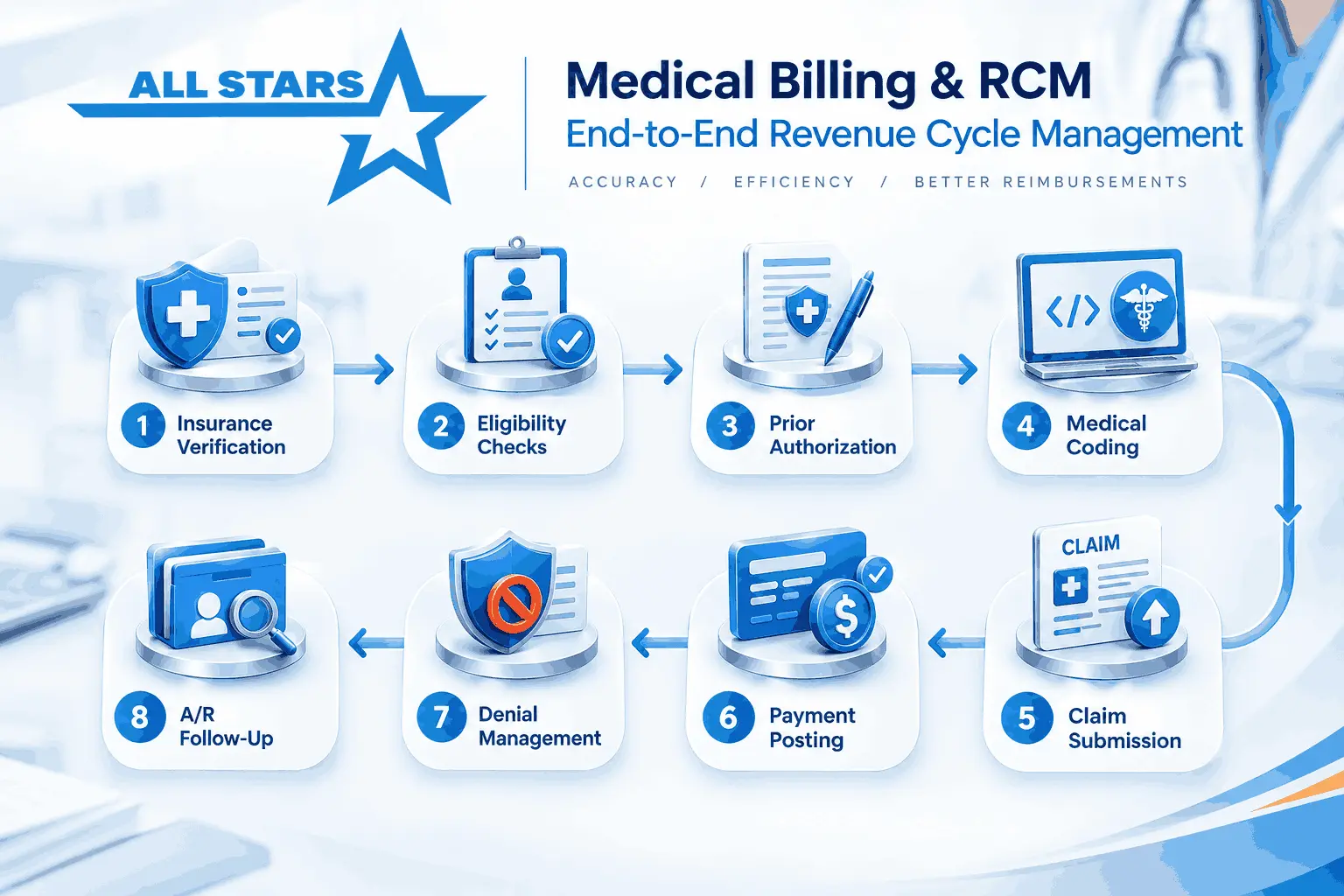
Revenue cycle management includes several stages such as:
- Patient appointment scheduling
- Insurance verification
- Patient registration
- Medical coding
- Charge entry
- Claim submission
- Payment posting
- Denial management
- Accounts receivable management
- Patient billing and collections
Because RCM manages every step of the revenue process, it provides a comprehensive approach to improving financial performance in healthcare organizations.
Benefits of Revenue Cycle Management
Implementing a strong RCM system can offer several advantages:
- Improved cash flow for healthcare practices
- Reduced claim denials
- Faster insurance reimbursements
- Better financial reporting and transparency
- Improved patient billing experience
However, implementing RCM without the right expertise or technology can become complex and costly for smaller practices.
What Are Medical Billing Services?
Medical billing services focus specifically on the process of submitting and managing insurance claims to ensure healthcare providers receive payment for the services they deliver.
Unlike revenue cycle management, medical billing represents only one part of the financial workflow in healthcare administration.
Key Responsibilities of Medical Billing
Medical billing professionals handle tasks such as:
- Preparing medical claims
- Submitting claims to insurance companies
- Following up on unpaid claims
- Managing claim denials and corrections
- Processing payments
- Generating patient invoices
Medical billing services act as a bridge between healthcare providers and insurance companies, ensuring claims are processed correctly.
Benefits of Professional Medical Billing Services
Many healthcare providers outsource billing because it provides benefits such as:
- Reduced administrative workload
- Increased claim accuracy
- Faster payment processing
- Lower operational costs
- Improved claim approval rates
However, relying only on medical billing services may not address larger financial inefficiencies in the revenue cycle.
Revenue Cycle Management vs Medical Billing: Key Differences
When analyzing Revenue Cycle Management vs Medical Billing, it becomes clear that both play unique roles in healthcare financial management.
Understanding Revenue Cycle Management vs Medical Billing is important because each approach impacts healthcare finances differently.
Below are the main differences between the two.
1. Scope of Services
Revenue Cycle Management
- Covers the entire financial workflow
- Starts from patient scheduling
- Ends when the final payment is collected
Medical Billing Services
- Focus only on claim submission and payment processing
- Work mainly after medical services are provided
In simple terms, RCM is a full system, while medical billing is just one component of that system.
2. Level of Financial Control
Revenue cycle management offers greater financial oversight because it tracks revenue performance across all stages.
Medical billing services focus mainly on claim accuracy and payment follow-up, without managing the entire financial structure of the practice.
3. Impact on Practice Revenue
RCM helps healthcare providers:
- Identify revenue leaks
- Reduce billing errors
- Optimize reimbursement rates
Medical billing services help by:
- Ensuring claims are submitted correctly
- Increasing approval rates
- Reducing claim processing delays
While both contribute to financial health, RCM provides a more strategic approach to revenue optimization.
4. Technology and Analytics
Revenue cycle management often uses advanced analytics, automation, and reporting tools to monitor financial performance.
Medical billing typically uses billing software and claim management systems but may not provide deep financial insights.
This difference makes RCM particularly valuable for large healthcare organizations and hospitals.
5. Administrative Involvement
RCM involves multiple departments including:
- Front desk staff
- Billing specialists
- Coders
- Financial analysts
Medical billing services usually involve billing professionals and coders only.
When Should Healthcare Practices Use RCM?
Revenue cycle management is ideal for healthcare providers who want to optimize their entire financial system.
RCM works best for:
- Hospitals
- Large clinics
- Multi-specialty practices
- Healthcare organizations with complex billing structures
These organizations benefit from end-to-end financial management and detailed revenue analytics.
Many healthcare organizations evaluate Revenue Cycle Management vs Medical Billing before deciding whether to implement a full RCM strategy or outsource billing services.
When Are Medical Billing Services Enough?
Medical billing services are often sufficient for smaller healthcare practices that need help managing claims and reimbursements.
They are ideal for:
- Small clinics
- Independent physicians
- New healthcare practices
- Providers looking to outsource administrative work
Medical billing services can significantly reduce administrative burdens without requiring a full RCM system.
Can Revenue Cycle Management and Medical Billing Work Together?
Yes, in fact medical billing is a critical part of revenue cycle management.
Think of it this way:
Revenue Cycle Management = Entire Financial Process
Medical Billing = One Step Within That Process
Many healthcare organizations choose to outsource both RCM and medical billing services to specialized companies that handle everything from patient registration to payment collection.
This approach helps healthcare providers focus on what matters most — patient care.
Challenges Healthcare Providers Face Without Proper RCM or Billing
Without proper revenue management systems, healthcare practices often struggle with:
- Increasing claim denials
- Slow reimbursement cycles
- Poor cash flow management
- Administrative overload
- Patient billing confusion
These issues can significantly impact financial stability and operational efficiency.
Investing in professional billing or RCM solutions can help eliminate these problems.
Conclusion
In summary, understanding Revenue Cycle Management vs Medical Billing helps healthcare providers make smarter financial decisions and choose the best system for managing reimbursements and claims.
While medical billing services focus on claim submission and payment processing, revenue cycle management takes a broader approach by managing the entire financial lifecycle of patient care.
Both solutions have their advantages, and the right choice depends on the size, needs, and goals of your healthcare practice.
Healthcare providers that implement the right system often experience faster reimbursements, reduced claim denials, and improved revenue growth.
Get in Touch
If your healthcare practice is struggling with billing errors, delayed payments, or complex revenue processes, it may be time to consider professional revenue cycle management or medical billing services.
Partnering with an experienced billing company can help streamline your financial operations, improve claim accuracy, and maximize reimbursements—allowing you to focus on delivering quality patient care.