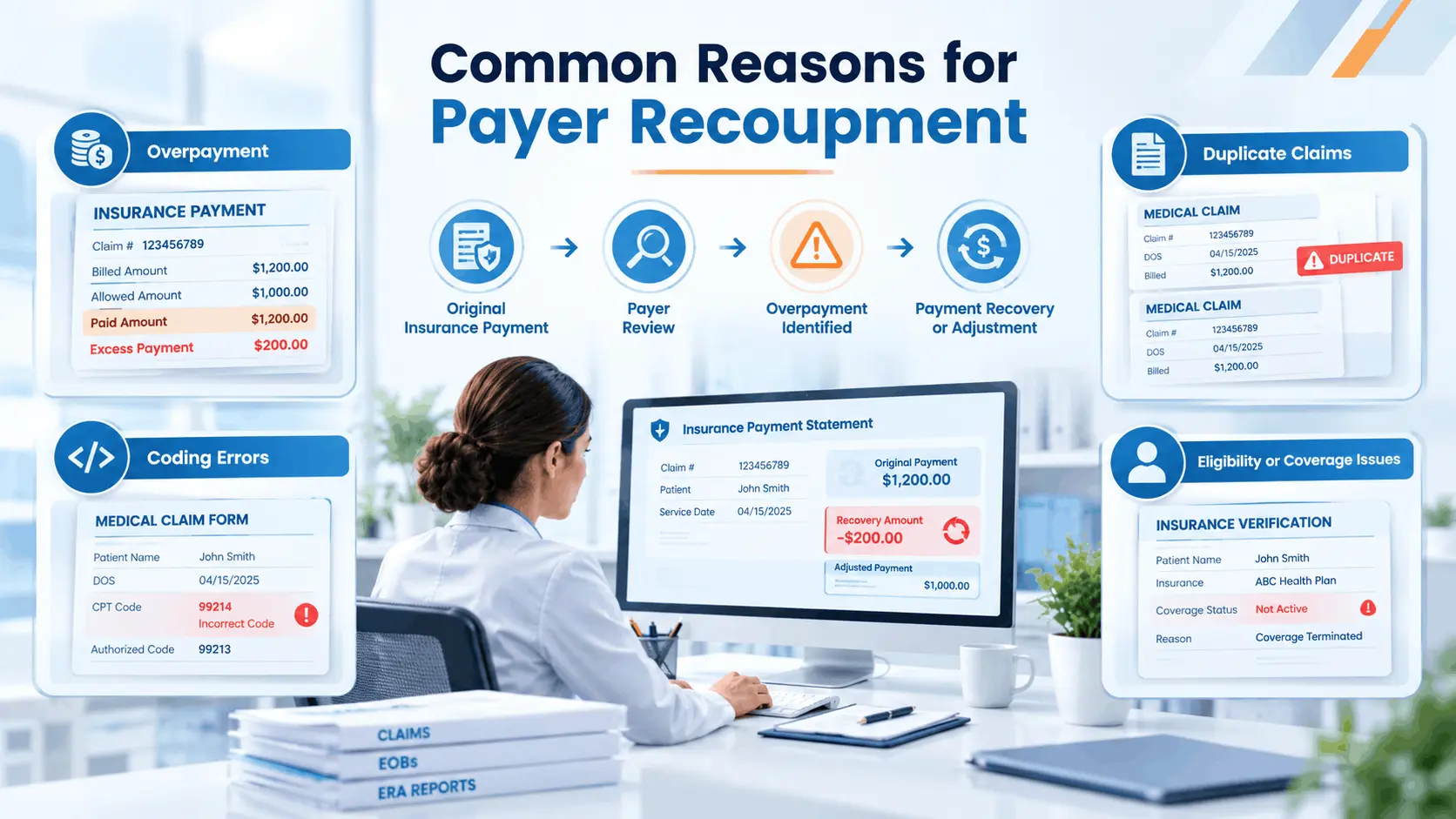
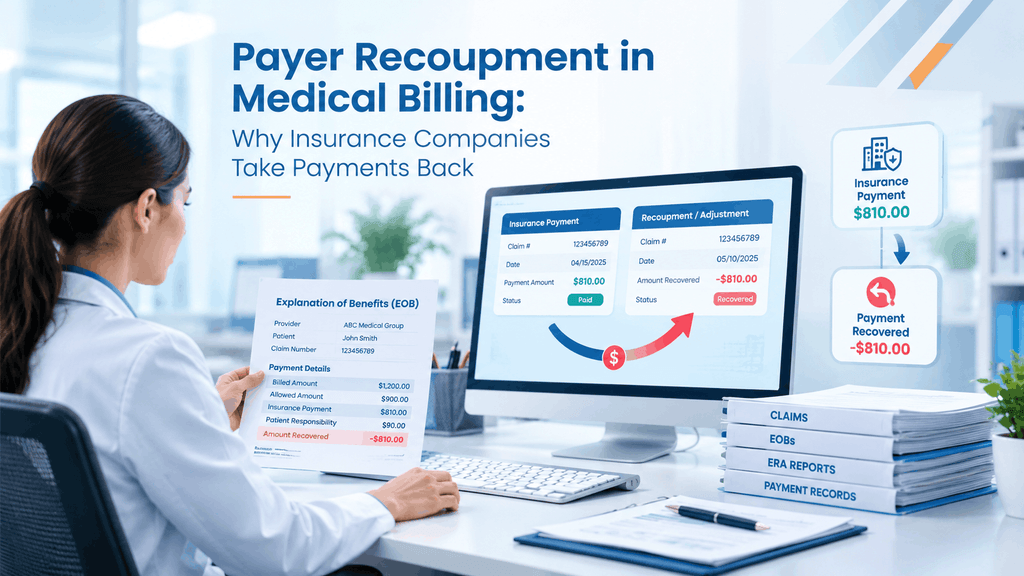
Payer recoupment in medical billing occurs when insurance companies recover payments previously made to healthcare providers due to overpayments, billing errors, incorrect coding, or claim processing discrepancies. Insurance companies may take back payments when they discover duplicate claims, inaccurate reimbursement amounts, or services that do not meet their payment policies. These recoveries can significantly affect a medical practice’s cash flow and financial stability. Healthcare providers should carefully review recoupment notices, explanation of benefits (EOBs), and electronic remittance advice (ERA) to understand why a payment is being recovered.
Maintaining accurate medical records, following payer guidelines, and submitting clean claims can help reduce recoupment risks. Providers should also respond promptly to payer requests and appeal incorrect recoupment decisions when appropriate. An effective revenue cycle management (RCM) process helps practices track payment adjustments, identify discrepancies, and prevent recurring billing issues. AllStars Medical Billing & IT Services supports healthcare providers in improving billing accuracy, managing payment discrepancies, and protecting revenue through effective medical billing and claims management solutions.
What Is Payer Recoupment in Medical Billing?
Payer recoupment (also called a clawback, takeback, or offset) happens when an insurance company recovers money it has already paid to a provider because it now believes the payment was wrong.
Instead of sending a bill and waiting, most payers simply deduct the amount from future claim payments. The provider often sees it first as a line-item adjustment or a reduced check, not a letter.
Recoupment is not the same as a denial:
- Denial: the payer refuses to pay a claim up front.
- Recoupment: the payer pays first, then reverses all or part of that payment later.
Why Insurance Companies Take Payments Back
- Duplicate payments. The same claim was processed twice, often after a resubmission or corrected claim.
- Coordination of benefits (COB) errors. Another payer turns out to be primary, so the original payer says it should never have paid first.
- Eligibility problems. The patient’s coverage was retroactively terminated, or the plan finds the patient was not eligible on the date of service.
- Coding and billing errors. Upcoding, unbundling, incorrect modifiers, or edit conflicts found in a post-payment review.
- Medical necessity findings. A post-payment audit concludes documentation does not support the service billed.
- Contract or fee schedule corrections. The payer applied the wrong rate and now adjusts it.
- Pricing or system errors on the payer side. Yes, payers make mistakes too, and the provider still pays the price until it is disputed.
- Audit extrapolation. In a sample-based audit, an error rate found in a small group of claims may be projected across a much larger claim population.
The Latest Data: Why Recoupment Is a 2026 Hot Topic
- Denials are down, but cash is not improving. A Kodiak Solutions analysis of more than 2,300 hospitals and 375,000 physicians found the overall initial denial rate fell to 10.63% in the first half of 2026, down from 12.00% a year earlier. Yet providers did not see matching cash gains, because insurers recovered more money after payment. Takebacks as a share of accounts receivable rose in the first half of 2026 compared with the same period in 2025, across every payer and setting studied.
- Medicare Advantage is the biggest pressure point. The same analysis reported that MA plans had more than double the takeback percentage of traditional Medicare, and a final denial rate of 3.76% versus 2.22% for traditional Medicare.
- Commercial payers are tightening at the back end. The commercial initial denial rate dropped to 19.98%, but the final denial rate rose 9.1% to 2.89% year over year.
- Appeals are recovering less. Providers recovered fewer dollars through appeals in the first half of 2026 than a year earlier, across all payers and settings analyzed.
- Payer audits are growing. MDaudit’s benchmark data covering the first three quarters of 2025 (more than 1.2 million providers and 4,500 facilities) showed a 30% year-over-year rise in total at-risk amounts from external payer audits per customer, and an 18% rise in the average at-risk amount per claim.
Rules and Rights: What Limits a Payer’s Ability to Recoup?
Medicare
- Six-year window. Medicare overpayments generally carry a six-year statute of limitations, according to CMS manual guidance.
- The 60-day rule. Since January 1, 2025, CMS treats an overpayment as “identified” when a provider knowingly receives or retains it, which includes deliberate ignorance or reckless disregard. The 60-day clock to report and return starts at that point, and a provider can generally use up to 180 days for a timely, good-faith investigation of related overpayments.
- New Part A timeline. CMS announced in August 2026 that the default recoupment date for Part A cost report overpayments will move from 16 to 41 calendar days after the demand date, effective January 4, 2027. This aligns Part A with the existing Part B timeline and affects providers such as home health agencies, hospices, and skilled nursing facilities.
- Appeal rights. Medicare providers can generally appeal an overpayment determination, and filing in time can delay recoupment while the appeal is pending. Check your Medicare Administrative Contractor’s demand letter for exact deadlines.
Commercial Payers and State Law
Many states limit how far back a commercial insurer can reach. According to American Dental Association guidance published in September 2026, lookback limits often fall between 12 and 24 months, with common exceptions for fraud and coordination-of-benefits issues.
State rules are also shifting. Ohio Senate Bill 162, signed into law in 2026, shortens the time insurers have to initiate recoupment from 24 months to 12 months. New Jersey’s HCAPPA framework is another example of a state-level lookback limit that providers have used to challenge old recoveries (18 months, with exceptions).
Your own provider agreement matters just as much as state law. Always check:
- The contractual overpayment lookback period
- Required notice content and timelines
- The dispute and appeal process
- Whether the payer can offset against unrelated claims
What a Valid Recoupment Notice Should Include
A proper notice should identify the original claim, the patient, the date of service, the amount in dispute, and the reason for the adjustment. If any of that is missing, ask for it in writing before you accept the recovery.
7 Steps to Take When You Receive a Recoupment Notice
- Do not ignore it. Appeal and dispute windows are short, and silence can be treated as agreement.
- Match it to the original claim. Tie every adjustment to the original payment so you can confirm it is real and not a duplicate recovery.
- Check the lookback period. Compare the date of the original payment with your contract and state law.
- Verify the reason. Pull the claim, documentation, eligibility history, and COB records to see if the payer is right.
- Request supporting documentation. Ask for the policy, edit, or audit finding the payer relied on.
- File a written dispute or appeal on time. Include the claim data, documentation, and the specific rule or contract term you rely on.
- Track everything. Log recoupments by payer, reason, amount, and outcome so patterns become visible.
How to Reduce Recoupment Risk Before It Happens
- Verify eligibility and COB up front, and again before billing when coverage is unclear.
- Scrub claims for duplicate submissions, edit conflicts, and modifier errors.
- Strengthen documentation so it supports the level of service and medical necessity billed.
- Audit yourself. Internal pre-bill and post-bill reviews catch problems before a payer does.
- Monitor ERAs and remits daily for negative adjustments and unusual reductions.
- Know your contracts, including lookback windows and notice rules for every major payer.
- Build a recoupment tracking report so you can spot payer-specific trends fast.
Why Providers Partner with a Medical Billing Company
Recoupment work is detail heavy and deadline driven. Small practices often lack the staff to monitor remits, track payer notices, and prepare disputes while also handling daily billing.
A specialized billing partner can monitor adjustments, catch invalid recoveries, prepare timely appeals, and fix the upstream errors that trigger takebacks.
What is payer recoupment in medical billing?
It is when an insurance company recovers money it previously paid to a provider after deciding the payment was incorrect, usually by deducting the amount from future payments.
Why do insurance companies take back payments?
Common reasons include duplicate payments, coordination of benefits errors, retroactive eligibility changes, coding or billing errors, medical necessity findings after an audit, and payer-side processing mistakes.
Is Payer Recoupment the same as a claim denial?
No. A denial happens before payment. Payer Recoupment happens after payment has already been issued.
How far back can a payer recoup money?
It depends. Medicare overpayments generally have a six-year limit. Commercial payers are governed by your contract and state law, and many states set limits of roughly 12 to 24 months, with exceptions such as fraud and COB issues.
Can a payer recoup without telling me first?
Notice requirements vary by payer, contract, and state. Many Payer Recoupment first appear as adjustments on a remittance, so monitoring your ERAs is essential. A valid notice should identify the claim, the amount, and the reason.
Can I appeal a Payer Recoupment?
Yes, in most cases. Follow the dispute process in the notice and your provider agreement, and meet the deadlines. For Medicare, appeal rights are outlined in the demand letter.
Protect Your Revenue with Allstars Medical Billing
At Allstars Medical Billing, we help US healthcare providers stop revenue leaks before and after payment, from clean claim submission and denial management to AR follow-up and payer dispute support.
If you are seeing unexplained negative adjustments, short payments, or recoupment letters, our team can review your payer data and help you respond with confidence.
👉 Talk to our team today: https://allstarsmb.com/