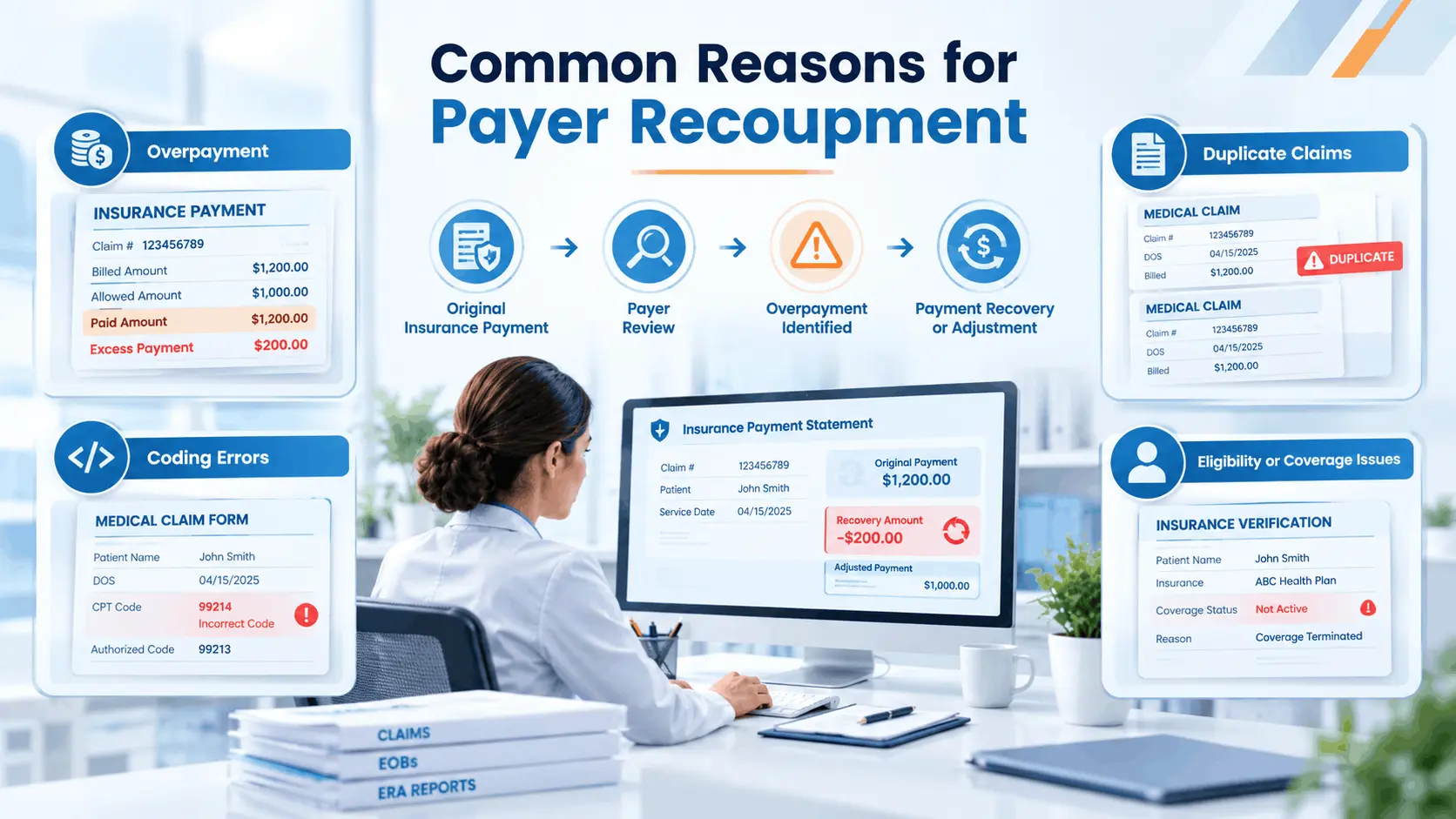

Medical claim overpayments can create significant financial and administrative challenges for healthcare providers. When insurance companies pay more than the amount a provider is entitled to receive, practices may face refund requests, payment adjustments, compliance concerns, and disruptions to cash flow. These overpayments can result from duplicate claim submissions, coding errors, incorrect fee calculations, coordination of benefits issues, or inaccurate payment posting. Identifying and resolving these discrepancies promptly is essential to maintaining accurate financial records and reducing unnecessary revenue loss.
Most practices dread underpayments and denials. Overpayments are quieter, and they can cost more. When a payer sends more money than you were owed, the extra amount is not a bonus. It is a liability with a deadline attached. This guide covers what overpayments are, why they happen, how to refund them properly, and how to stop them at the source.

What Is a Medical Claim Overpayment?
A medical claim overpayment occurs when a provider receives more money than they are entitled to for a service. The excess can come from a payer, a patient, or both.
Common examples:
- A payer pays the same claim twice.
- A payer pays after the patient’s coverage has already ended.
- A claim is paid at a higher rate than the contracted fee schedule allows.
- A provider is paid for a service that was not medically necessary or was not documented well enough to support the billed code.
- Both the primary and secondary payer pay as if each were primary.
Overpayments are not always a billing mistake on your side. Many are payer errors. But once you know about one, the responsibility to deal with it is yours.
Why Medical claim overpayments Matter More Than Ever
1. The 60-day rule carries real legal weight.
Under the Affordable Care Act, providers must report and return Medicare and Medicaid overpayments within 60 days of identifying them. A known overpayment kept past the 60-day window is one of the more straightforward theories a whistleblower can use to bring a False Claims Act case.
2. CMS updated the rules.
CMS addressed the 60-day refund rule in the 2025 Physician Fee Schedule Final Rule. The update added a 180-day period so providers can investigate other overpayments that may share the same cause as the first one found. Failing to report and return an identified overpayment on time can create a false claim situation under the False Claims Act.
3. The “identified” standard shifted.
Earlier guidance debated exactly when an Medical claim overpayments counts as “identified.” The updated approach ties the trigger more closely to the False Claims Act’s “knowingly” standard. In practice, ignoring red flags is not a defense. If a reasonable review would have found the problem, regulators may treat it as known.
4. Payers are auditing harder.
Payers use automated audits and data analytics to find duplicate payments, coding mismatches, and eligibility errors. If you do not find your overpayments, they will, and the recoupment will come with less notice and more friction.
Top Causes of Medical Claim Overpayments
1. Duplicate payments
The same claim is submitted twice, or resubmitted while the first is still processing, and both are paid. This is one of the most common causes and often follows rushed resubmissions after a status delay.
2. Coordination of benefits (COB) errors
When a patient has more than one plan, the order of payment matters. If the wrong payer is billed first, or both pay as primary, the total collected can exceed the allowed amount.
3. Eligibility and coverage lapses
A payer pays a claim for a patient whose coverage had terminated. The payer later finds out and recovers the money.
4. Incorrect coding or modifier use
Upcoding, unbundling, a wrong modifier, or a code that does not match the documentation can all produce payment above what is allowed.
5. Fee schedule or contract loading errors
If a payer loads the wrong rate, every claim at that rate may be overpaid. These errors can run for months before anyone notices.
6. Payments after a patient refund or credit
A patient pays a copay or balance, then insurance pays the same amount. The practice ends up holding a credit.
7. Medical necessity and documentation gaps
Claims paid without strong support in the record can be flagged on audit, turning the payment into an overpayment after the fact.
8. Posting and reconciliation mistakes
A payment is posted to the wrong claim, an adjustment is missed, or an ERA is not reconciled against the actual deposit. The balance looks right until a payer sends a refund request.
How to Identify Overpayments Early
You cannot refund what you have not found. Strong practices build detection into the daily workflow.
- Review credit balances regularly. Run an accounts receivable report for negative balances at least monthly.
- Reconcile ERAs against bank deposits. Differences point to posting errors or payer adjustments.
- Compare payments to contracted rates. Spot-check allowed amounts against your fee schedules.
- Watch for payer refund requests. Log every request letter the day it arrives and track the response deadline.
- Audit coding trends. Look for modifiers, codes, or providers whose payment patterns stand out.
How to Refund an Medical claim overpayments: Step by Step
- Confirm the overpayment is real. Verify the claim, payer, dates of service, and amount. Check whether it is a true overpayment or a payment you are still owed adjustments on.
- Document the date you identified it. This timestamp matters for the 60-day clock.
- Determine the cause. Ask whether this is a one-time error or part of a pattern. If it could affect other claims, begin a good-faith investigation right away.
- Check the payer’s process. Most Medicare Administrative Contractors use a voluntary refund form requiring the amount, the specific claims, the reason for the refund, and payment by check or electronic transfer. Commercial payers have their own forms and portals.
- Submit the refund with full detail. Include claim numbers, patient identifiers, dates of service, and the reason code. Vague refunds cause delays and re-requests.
- Keep proof. Save the submission confirmation, check copy or EFT record, and all correspondence.
- Post the adjustment correctly. Update the patient account and your ledger so the books match.
- Fix the root cause. A refund without a process change guarantees a repeat.
The 60-Day Rule: What Providers Need to Know
- Who it covers: Medicare and Medicaid providers, and Medicare Advantage and Part D in many contexts.
- The deadline: Report and return within 60 days of identification.
- The investigation window: A timely, good-faith investigation into related overpayments can suspend the 60-day deadline for up to 180 days. The investigation must be real and diligent, not a way to stall.
- The risk of delay: Missing the window can turn the overpayment into a reverse false claim, with potential treble damages plus per-claim penalties.
- State rules apply too. Medicaid programs and some commercial payers have their own refund timelines and lookback limits. Check state law and your contracts.
Refund vs. Offset vs. Recoupment
| Method | How it works | Who controls it |
|---|---|---|
| Voluntary refund | You send the money back with documentation | Provider |
| Offset (recoupment) | Payer deducts the amount from future payments | Payer |
| Demand letter | Payer formally requests repayment by a deadline | Payer |
Voluntary refunds give you control over timing and communication. Offsets can disrupt cash flow without warning, and a payer’s notice window can be short. Responding quickly lets you review, dispute, or request an appeal before money is withheld.
How to Prevent Medical claim overpayments
Front end
- Verify eligibility at scheduling and again before the visit.
- Capture complete COB information at registration.
- Collect accurate insurance details and update them each visit.
Coding and documentation
- Use certified coders and schedule regular coding audits.
- Train providers on documentation that supports the billed service.
- Review modifier usage and bundling edits.
Claims and payment posting
- Check claim status before resubmitting to avoid duplicates.
- Use claim scrubbing to catch errors before submission.
- Post payments promptly and reconcile ERAs to deposits.
Monitoring and compliance
- Review credit balances monthly.
- Track payer refund requests in a central log.
- Write an overpayment policy that sets who investigates, who approves refunds, and how fast.
- Run periodic internal compliance reviews.
Key Metrics to Track
- Credit balance volume and age: How much is sitting and for how long.
- Overpayment rate: Refunds as a share of total payments.
- Time to identify and refund: Days from discovery to submission.
- Repeat causes: Which error types recur most.
- Audit and recoupment requests by payer: Where scrutiny is increasing.
What is a medical claim overpayment?
It is any payment you receive from a payer that is higher than what you were entitled to, or a payment you should not have received at all, such as a duplicate or a payment for a non-covered service.
Do I have to return an Medical claim overpayments even if the payer did not notice?
Yes, in most cases. For Medicare and Medicaid, you must report and return identified overpayments within 60 days. Commercial contracts and state laws generally have similar expectations.
When does the 60-day clock start?
Since the 2025 CMS rule, the clock starts when you knowingly receive or retain an Medical claim overpayments, even if you have not yet calculated the exact amount. A good-faith investigation into related overpayments can pause the deadline for up to 180 days.
How far back do I need to look for overpayments?
For Medicare, the general lookback period is six years. Other payers may be governed by contract terms and state law.
What happens if I ignore an Medical claim overpayments?
You may face interest, offsets against future payments, and potentially False Claims Act exposure if you knowingly keep it. Federal settlements in 2026 show the government is actively pursuing these cases.
How can a medical billing company help prevent overpayments?
A strong billing partner verifies eligibility, scrubs claims, reconciles remittances, monitors credit balances, tracks overpayment deadlines, and helps you respond to payer demands.
Don’t Let Overpayments Become Costly Problems
Overpayments hide in the details: a duplicate payment here, an unposted credit there, a payer error nobody caught. That is exactly where Allstars Medical Billing can help. Our U.S.-focused billing team works to reduce errors before claims go out, reconcile payments carefully, flag potential overpayments early, and keep your refund and appeal deadlines on track.
Want a clearer view of your revenue cycle? Talk to Allstars Medical Billing today and find out how to protect your revenue and your compliance.