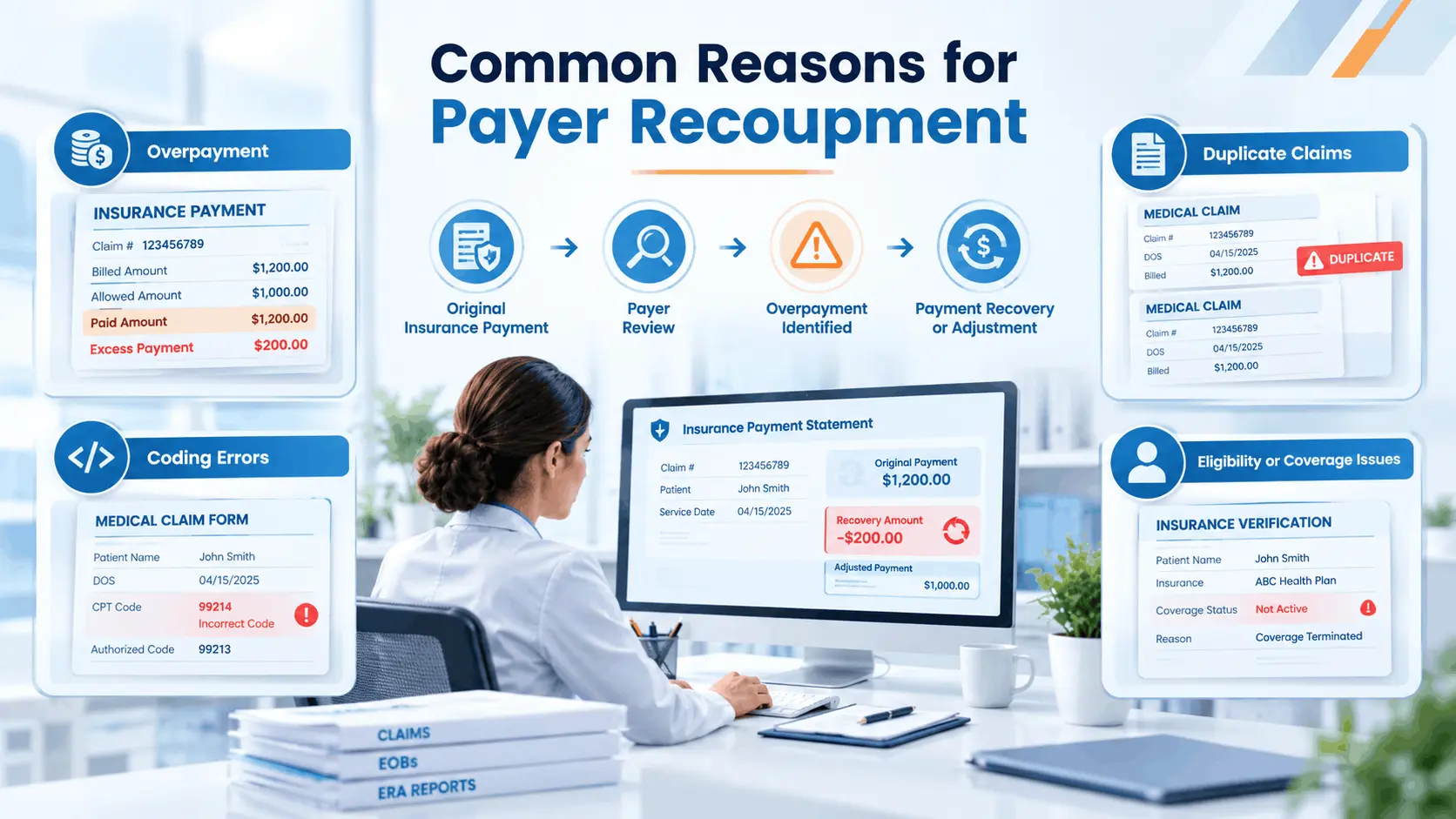

Payer recoupment in medical billing occurs when an insurance company takes back payments previously made to a healthcare provider. This can happen due to claim processing errors, incorrect payments, coding discrepancies, eligibility issues, or changes identified during an insurance audit. For medical practices, unexpected payment reversals can disrupt cash flow, increase administrative workloads, and create challenges in managing accounts receivable.
Understanding why insurance companies initiate recoupments is essential for protecting practice revenue and maintaining accurate billing records. By reviewing payer notices, verifying claim details, correcting billing errors, and responding within required deadlines, healthcare providers can address recoupment requests more effectively. A proactive revenue cycle management (RCM) process can also help reduce payment discrepancies, strengthen compliance, and minimize avoidable financial losses.
What Is Payer Recoupment in Medical Billing?
Recoupment is when a payer withholds part of your current claim payments to offset money it believes it overpaid you earlier. Instead of sending you an invoice and waiting for a check, the payer simply reduces future remittances until the balance is recovered. In the billing world you will also hear this called an offset, takeback or refund request.
The key point: a payer’s review of a claim does not end on the day it pays. Payer Recoupment paid claims, decide the payment was wrong, and recover it. That is very different from a denial, which happens before payment.
| Denial | Recoupment | |
|---|---|---|
| When | Before the payer pays | After the payer has already paid |
| What happens | Claim is refused | Payer pulls money back from future payments |
| Typical timing | Days to weeks | Months, sometimes years later |
| Visible on | Remittance advice (denial codes) | Remittance advice (adjustment/offset lines) and recoupment letters |

Why Do Insurance Companies Take Payments Back?
- Duplicate or erroneous payments. A claim is paid twice, paid at the wrong rate, or processed under the wrong plan.
- Coordination of benefits (COB) issues. The payer later learns another insurer was primary. This is one of the most common triggers, and it often carries exceptions to lookback limits.
- Retroactive eligibility changes. The patient’s coverage is terminated back to an earlier date after claims were already paid.
- Post-payment audits and reviews. The payer, or a contractor working for it, reviews paid claims for coding accuracy, medical necessity and documentation.
- Coding and documentation findings. Missing medical necessity, unsupported time-based codes, absent procedure details, or DRG changes on inpatient claims are frequent triggers.
- Contract or policy reinterpretation. The payer applies a payment policy differently than it did at the time of payment.
- Fraud, waste and abuse investigations. These are the most serious and typically carry the longest recovery windows.
How the Payer Recoupment in Medical Billing Process Typically Works
- Identification. The payer (or an audit contractor) flags a claim or a sample of claims.
- Notice. You receive a letter or portal message describing the claims, the amount and the reason. Notice periods and content vary by payer, contract and state.
- Offset. If you do not dispute or repay, the payer withholds the amount from future payments. It often appears as a negative adjustment or a reduced check/EFT.
- Dispute window. You generally have a limited time to appeal or request a refund arrangement. Missing it can forfeit your rights.
Know the Rules: Lookback Limits and
- Commercial payers: Many states cap how far back a payer may seek an overpayment, commonly in the range of 12 to 24 months, with exceptions for fraud and coordination of benefits. Some states, such as New York with its 18-month rule, are well known for these protections. Always confirm the rule that applies to your state and plan type.
- Medicare: Under the federal 60-day rule, providers must report and return identified overpayments within 60 days. The standard reopening period for Medicare claims has historically been long, and compliance teams continue to debate how far back repayment obligations reach once a reopening window has closed.
- Medicare appeals: The process has five levels: redetermination, reconsideration, an administrative law judge hearing, the Medicare Appeals Council, and federal district court. Filing an appeal at certain early stages can pause recoupment of the disputed amount.
- Medicaid and Medicare Advantage: Recovery rules vary by state program and plan contract. Do not assume commercial rules apply.
Warning Signs on Your Remittance Advice
- Payments that are lower than expected with no corresponding denial
- Negative adjustment lines or offsets tied to old claim numbers
- Refund requests or overpayment letters arriving in the portal or by mail
- Sudden reversals on claims that were paid months earlier
- Unexplained claim adjustments labeled with takeback or recovery language
What To Do When You Receive a Payer Recoupment Notice
- Get the dates down quickly. Notice date, reply date and start date for offset should be recorded.
- Connect each recoupment to the originating claim. This will help to verify the legitimacy of the recoupment and avoid recovering twice on the same thing.
- Pose the fundamental question: is the payer correct? It may apply a policy incorrectly, ignore information previously provided or calculate incorrectly the amounts to recover.
- Read the agreement and the dispute process. Check for any lookback limits, notice requirements or appeal processes.
- Collect all the evidence that you will need. Retrieve the patient’s medical records, signature documents, authorizations for payment, eligibility determination and any payer communication.
- Reply in writing within the deadline. Either file an appeal or negotiate the repayment process.
- Consider the implications for cash flow. You should know how many weeks of offsets will be involved.
- Act when there are repeating recoupments. There might be something in the interpretation of the contract or payer abuse rather than simple error.
How to Prevent Payer Recoupment Before They Happen
- Validate eligibility and COB at each visit. Identify secondary insurance and expired policies prior to billing.
- Prove the need for the service. Indicate why it was necessary, when time-based codes were used, and describe the procedure.
- Code the way you document it. Conduct pre-billing reviews on high-risk procedures and modifiers.
- Audit yourself regularly. Self-auditing helps identify issues before a payer.
- Measure yourself against the right indicators. Check the percentage of recoupment, the average amount of money at risk during an audit, the number of overturned appeals, the time between request and submission, and the frequency of the same findings.
- Keep the contact information up-to-date. Ensure the correct contact information at payers’ portals is provided to avoid missing any notice and losing appeal rights by default.
- Maintain records. Save the trail, signatures, and supporting documentation required by your contracts and state regulations for the whole period required.
- Identify payers’ patterns. Categorize recoupments according to payers, codes, and reasons for that to learn which services get audited more often.
The Business Impact of Recoupment
Payer Recoupment hits practices three ways: lost revenue, administrative burden and unpredictable cash flow. Small and mid-sized practices feel it most because a single large offset can swallow an entire week of deposits. Practices that respond quickly and with strong documentation often reduce or reverse demands. Those that ignore notices frequently end up repaying in full.
What is payer recoupment in medical billing?
It is when an insurance company recovers money it believes it overpaid by withholding it from your future claim payments or by requesting a refund.
What is the difference between a denial and a Payer Recoupment?
A denial occurs when a claim is rejected by the insurance company due to various reasons, such as lack of coverage or incorrect information. A payer recoupment is when an insurance company takes back payment that was previously made, often due to overpayment or billing errors.
Can an insurance company take money back years later?
Sometimes. It depends on your contract, state law and the reason. Many states limit commercial recoveries to roughly 12 to 24 months, but exceptions such as fraud and coordination of benefits can extend that. Medicare has its own, longer rules.
Why do payers recoup payments?
Common reasons are duplicate payments, coordination of benefits errors, retroactive eligibility changes, audit findings, documentation gaps and coding disputes.
Can I dispute a recoupment?
Yes. Review the notice, check your contract, gather documentation and file an appeal or dispute before the deadline. Payers do sometimes make mistakes
Will the payer give me notice before recouping?
Usually, but notice requirements vary by payer, contract and state. Always check your agreement and watch your remittances for unexplained negative adjustments.
How can Allstars Medical Billing help?
Allstars Medical Billing supports clean claim submission, remittance monitoring, denial management and A/R follow-up to help reduce takebacks and protect cash flow. Learn more at allstarsmb.com.
Let Allstars Medical Billing Protect Your Revenue
Payer Recoupment, denials and audits should not be handled in the margins of a busy practice. Allstars Medical Billing helps US providers keep clean claims moving, monitor remittances for offsets and takebacks, track deadlines, and prepare organized responses when payers come asking for money back.
From eligibility and COB verification to coding-accurate claim submission, denial management and accounts receivable follow-up, our team works to reduce your audit exposure and strengthen your cash flow.
Ready to stop losing revenue to payer takebacks? Visit allstarsmb.com and talk to Allstars Medical Billing today.
Key Takeaways
- Payer Recoupment taking back an earlier payment, often by offsetting future remittances.
- It can occur long after the original payment, so monitoring remittances matters.
- Lookback limits, notice rules and appeal rights depend on your contract, state law and payer type.
- Audit extrapolation can multiply a small sample into a very large demand, so respond carefully and promptly.
- Prevention starts with eligibility checks, strong documentation and accurate coding.