
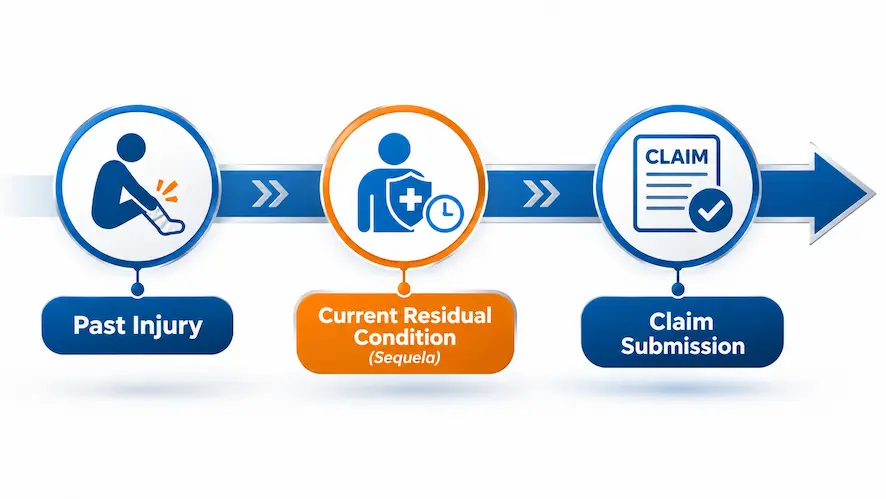
ICD-10-CM Sequela Coding assignment for patients who return long after their initial injury or illness is vital for the accuracy of their claim based on the nature of their encounter. Sequela (or late effects) can be defined as the after-effect of the patient’s initial condition and occurs once the acute phase of the disease or injury has been resolved. It is critical to understand the process of sequela code assignment, which includes the use of seventh character S, proper sequencing of codes, and necessary provider documentation.
What Is Sequela in ICD-10-CM Coding?
Per the FY 2027 ICD-10-CM Official Guidelines for Coding and Reporting (Section I.B.10), a sequela is defined as the residual effect , the condition produced after the acute phase of an illness or injury has terminated. There is no time limit on when a sequela code may be used. The residual may appear early, or it may surface months or years later.
Common sequela examples cited in the official guidelines include:
- Scar formation resulting from a burn
- Deviated septum due to a nasal fracture
- Infertility due to tubal occlusion from old tuberculosis
Key distinctions:
- Original (acute) condition: The illness or injury itself, coded at the time of active treatment.
- Subsequent encounter (character D): Ongoing care during the healing or recovery phase after active treatment has ended.
- Sequela (character S): A new, persistent condition that has developed as a direct result of the original injury or disease, after healing has occurred.
Sequela is not the same as routine recovery. A patient receiving wound checks is in a subsequent encounter. A patient presenting with permanent scarring or a lasting neurological deficit is in a sequela encounter.
When Should Medical Coders Use Sequela Codes?
Use ICD-10-CM Sequela Coding when the encounter is focused on a residual or late-effect condition directly caused by a prior injury or disease. Examples include:
- Contractures or scarring following a healed burn
- Neurological deficits (hemiplegia, aphasia) persisting after a prior stroke
- Post-traumatic osteoarthritis resulting from an old fracture
- Infertility, organ dysfunction, or chronic conditions attributable to a resolved infectious disease
Do not apply sequela coding during active treatment or routine healing-phase care. These encounters use initial or subsequent encounter characters instead.
Understanding the Seventh Character S
Section I.C.19.a of the FY 2027 ICD-10-CM Official Guidelines governs the application of seventh characters for Chapter 19 (Injury, Poisoning, and Certain Other Consequences of External Causes, S00–T88). Three primary values apply:
| 7th Character | Name | When Used |
|---|---|---|
| A | Initial encounter | Patient is receiving active treatment for the condition |
| D | Subsequent encounter | Active treatment is complete; patient is in the healing/recovery phase |
| S | Sequela | A residual condition has developed as a direct result of the original injury |
Critical rules for seventh character S:
- The “S” is appended only to the injury code, never to the code describing the sequela condition itself.
- Two codes are typically required: the sequela (residual) condition is sequenced first; the injury code with the 7th character S is sequenced second.
- The code for the acute phase of the illness or injury is never used alongside a sequela code.
How to ICD-10-CM Sequela Coding Step by Step
Follow this workflow for every sequela encounter:
- Review the medical documentation to confirm the encounter is for a residual condition, not active or recovery-phase care.
- Identify the residual (sequela) condition : the late effect the patient currently presents with.
- Confirm the causal relationship: the residual must be directly linked to the prior injury or disease in provider documentation.
- Search the Alphabetic Index: look up the residual condition. Cross-reference under “Sequela” if needed.
- Verify in the Tabular List: confirm code specificity, seventh character requirements, and any instructional notes.
- Apply sequencing rules: residual condition first, injury code with character S second. Check the Tabular List for code-specific exceptions or combination codes.
Example of ICD-10-CM Sequela Coding
Example 1: Scarring after a healed burn
A patient presents for treatment of hypertrophic scarring on the right hand following a resolved burn injury.
- First: L91.0 (Hypertrophic scar), the residual condition
- Second: T23.001S (Burn of unspecified degree of right hand, sequela)
Example 2: Deviated septum from an old nasal fracture
A patient presents with a deviated nasal septum documented as a result of a previous fracture.
- First: J34.2 (Deviated nasal septum), the residual condition
- Second: S02.2XXS (Fracture of nasal bones, sequela)
Example 3: Neurological residuals after a prior stroke
Section I.C.9.d of the FY 2027 guidelines addresses sequelae of cerebrovascular disease. The I69 category contains specific combination codes that capture both the sequela type and the underlying cerebrovascular condition in a single code. For example:
- I69.351 (Hemiplegia and hemiparesis following cerebral infarction affecting right dominant side)
No separate S-character injury code is needed when using I69 sequela codes , the combination code itself identifies the late effect and its cause.
Example 4: Infertility due to old tuberculosis
A patient presents with tubal-origin infertility linked to prior genitourinary tuberculosis.
- First: N97.1 (Female infertility of tubal origin), the residual condition
- Second: B90.1 (Sequelae of genitourinary tuberculosis)
Common Sequela Coding Mistakes
Medical coders encounter predictable pitfalls with sequela encounters. The five most common:
- Confusing D (subsequent) with S (sequela). A patient receiving physical therapy for a healing fracture is coded with character D, not S. Character S is reserved for conditions that develop after healing.
- Adding character S to the sequela code. The S appends to the injury code only, never to the code describing the residual condition itself.
- Incorrect sequencing. The residual condition is always sequenced first. Placing the injury code first is a sequencing error that can trigger claim edits.
- Missing or insufficient provider documentation. Coders must not infer a causal relationship. If the provider has not explicitly documented the link between the current condition and the prior injury or disease, the claim lacks the documentation support required for accurate sequela coding.
- Applying general sequela rules without checking code-specific instructions. Some chapters, particularly Chapter 9 (cerebrovascular sequelae), use combination codes that change the standard two-code approach. Always review Tabular List instructional notes before applying the general rule.
Documentation Requirements
Providers must clearly document the causal link between the current residual condition and the prior injury or disease. Adequate documentation includes:
- Identification of the specific residual or late-effect condition being treated
- A statement confirming the relationship to the prior injury or disease
- The nature of the prior event (type of injury, fracture, burn, illness)
- Clinical confirmation that the acute phase has resolved
How Accurate Sequela Coding Supports Medical Billing and RCM
Sequela coding errors generate claim denials, payer audits, and delayed reimbursement. When coders apply the wrong seventh character, sequence codes incorrectly, or use the S character without supporting documentation, claims fail first-pass review. Accurate sequela coding strengthens charge capture, supports medical necessity, and keeps your medical coding and medical billing workflows compliant with HIPAA-mandated ICD-10-CM guidelines, a direct driver of clean claims and sustainable revenue cycle management.
Is there a time limit for using sequela codes?
No. Per ICD-10-CM Official Guidelines, there is no time limit on when a sequela code may be applied. A late effect may appear shortly after an injury or years later.
Is there a time limit for using sequela codes?
No. Per ICD-10-CM Sequela Coding Official Guidelines, there is no time limit on when a sequela code may be applied. A late effect may appear shortly after an injury or years later.
Can the S character be used on both the residual condition code and the injury code?
No. The seventh character S applies only to the injury code, not to the code describing the residual condition.
What is the correct sequencing forICD-10-CM Sequela Coding ?
The residual (sequela) condition is sequenced first. The injury code with seventh character S is sequenced second.
Does a sequela encounter always require two codes?
Generally yes, but exceptions exist. When the code itself contains the manifestation (as with many I69 cerebrovascular sequela codes), a single combination code may suffice. Always verify in the Tabular List.
Can an S code and a D code appear on the same claim?
Yes, in specific circumstances. When a current healing wound coexists with a sequela of an old burn (per Section I.C.19.d.8), both a code with character D and a code with character S may be assigned on the same record.
Can a sequela code be the only code on a claim?
No. A ICD-10-CM Sequela Coding cannot stand alone as the principal or first-listed diagnosis. It is sequenced second, after the code identifying the residual condition.
Conclusion
Accurate ICD-10-CM Sequela Coding depends on three elements working together: complete provider documentation that confirms the causal relationship, correct identification of the residual condition, and precise application of sequencing and seventh character rules. Whether you are coding for burn scars, neurological deficits, or long-term disease effects, applying the FY 2027 Official Guidelines correctly protects claim integrity and supports appropriate reimbursement.
AllStars Medical Billing & IT Services provides certified coding support for practices navigating complex late-effects coding, claim reviews, and revenue cycle challenges. Contact us today to learn how our team can strengthen your coding accuracy and billing outcomes.