Every professional medical claim submitted to an insurance payer includes a two-digit Place of Service (POS) code. This small field carries significant weight, it tells the payer exactly where a service was performed, and that location directly shapes how the claim is adjudicated and paid.
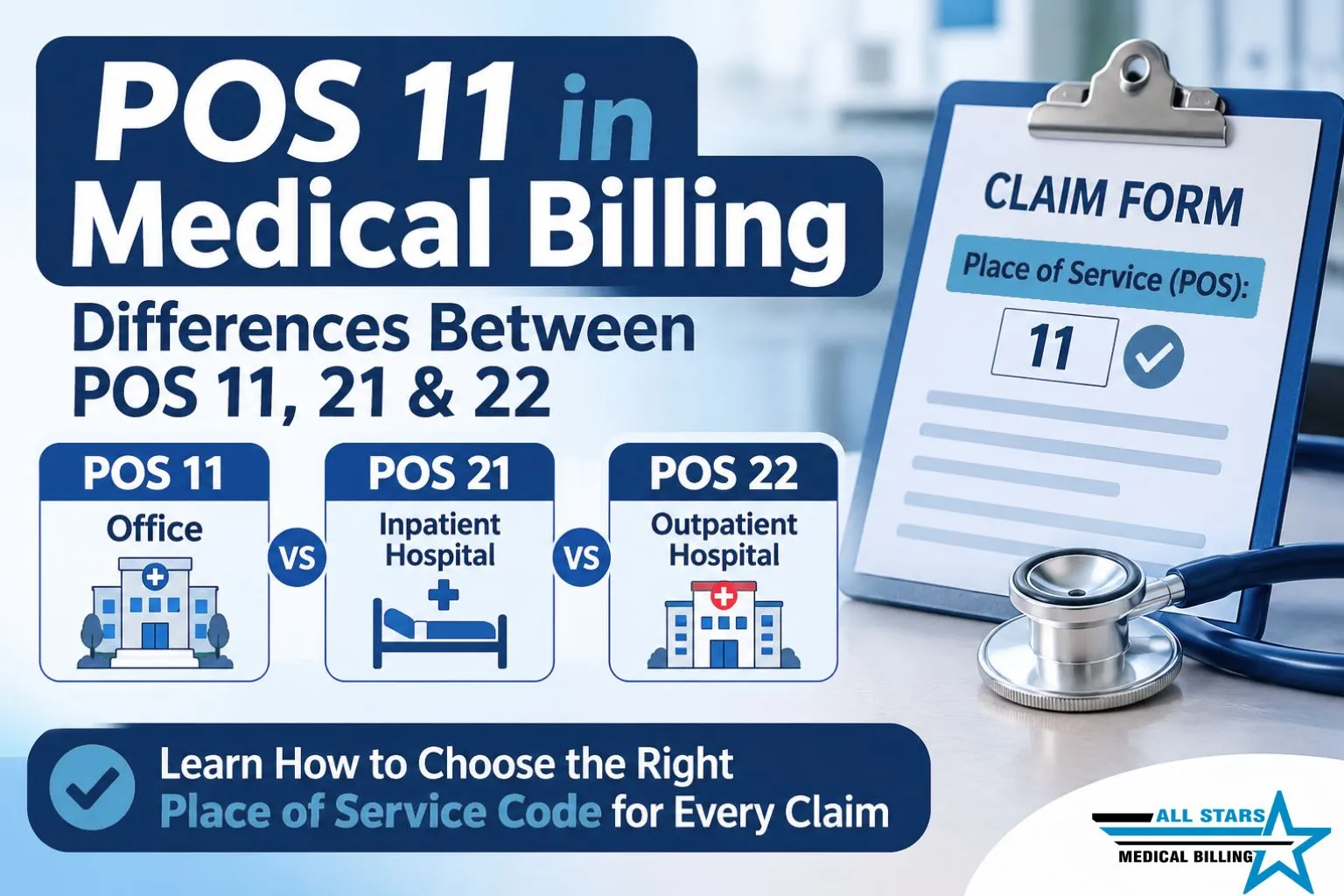
Three POS codes come up constantly in medical billing: POS 11 in Medical Billing (Office), POS 21 (Inpatient Hospital), and POS 22 (On-Campus Outpatient Hospital). Each represents a distinct care setting with its own billing rules, documentation requirements, and payer expectations. Using the wrong one, even unintentionally can result in claim denials, payment delays, or compliance exposure.
This guide breaks down what each code means, how they differ, and the practical steps billing teams can take to report them correctly on every claim.
What Are Place of Service (POS) Codes in Medical Billing?
Place of Service codes are two-digit numeric codes defined by the Centers for Medicare & Medicaid Services (CMS) and used on the CMS-1500 claim form (and its electronic equivalent, the 837P transaction). Their purpose is straightforward: they identify the type of location where a healthcare service was rendered.
POS codes work alongside CPT and HCPCS codes, not in place of them. A CPT code describes what was done; the POS code tells the payer where it was done. Payers use this information to determine applicable fee schedules, apply site-of-service differentials, and verify that the setting matches the service billed.
It’s important to understand that POS codes appear on professional claims, those submitted by physicians, non-physician practitioners, and other individual providers. They are not used the same way on institutional claims (UB-04 / 837I), which hospitals submit for facility services using their own type-of-bill codes. Billing staff should not conflate the two systems.
CMS publishes the official POS code list and updates it periodically. Accurate POS reporting is a compliance requirement under Medicare and is expected by virtually all commercial payers.
What Is POS 11 in Medical Billing? (Office)
Definition
POS 11, officially described as Office, is used when a service is provided in a location, other than a hospital, skilled nursing facility, military treatment facility, community health center, State or local public health clinic, or intermediate care facility, where the health professional routinely provides health examinations, diagnosis, and treatment of illness or injury on an ambulatory basis.
In practical terms, POS 11 in medical billing means the service took place in a physician’s office or an independent medical practice, a setting that the provider owns or leases and that is not affiliated with or physically part of a hospital.
Where POS 11 Is Used
Typical POS 11 in Medical Billing settings include:
- Primary care physician offices
- Specialty practices (cardiology, dermatology, orthopedics, etc.)
- Independent urgent care clinics not owned by a hospital
- Behavioral health practices operating outside of a hospital system
- Optometry and ophthalmology offices
Common Services Billed With POS 11
Office visits (E/M codes 99202–99215), preventive medicine services, minor procedures performed in the office, injections, vaccinations, and in-office diagnostic tests are routinely billed under POS 11.
How POS 11 Affects Professional Claim Submission
Many payers, including Medicare, apply different payment rates depending on the site of service. For Medicare, the physician professional fee is typically higher for office-based services (POS 11 in Medical Billing) than for the same service delivered in a facility setting, because in an office the provider absorbs overhead costs that a hospital would otherwise cover. This distinction is known as the facility versus non-facility payment rate.
Common Mistakes Associated With POS 11 in Medical Billing
The most frequent error is billing POS 11 for services that were actually performed in a hospital-owned or hospital-based outpatient clinic. If the practice is part of a hospital system, the correct code may be POS 22 (or POS 19 for off-campus locations), not POS 11. Providers who moved their practice into a hospital-acquired location and continued billing POS 11 have faced significant payer audits and repayment demands.
What Is POS 21 in Medical Billing? (Inpatient Hospital)
Definition
POS 21 officially described as Inpatient Hospital, is used when services are provided in a facility, other than psychiatric, which primarily provides diagnostic, therapeutic (both surgical and nonsurgical), and rehabilitation services by, or under the supervision of, physicians to patients admitted for a variety of medical conditions.
What Qualifies as an Inpatient Setting
The key word here is admitted. Inpatient status requires a formal physician order for admission. The patient is expected to require hospital care spanning at least two midnights (under Medicare’s Two-Midnight Rule), though the admitting physician’s clinical judgment is the governing factor. Simply receiving care at a hospital does not automatically make someone an inpatient.
How Inpatient Admission Works
When a physician decides a patient requires inpatient care, they issue a written admission order. From that point, all professional services provided by attending physicians, surgeons, and consultants during the hospital stay should be billed on professional claims using POS 21.
Examples of Services Billed Under POS 21
- Physician daily visits (hospital E/M codes 99221–99223 for admission, 99231–99233 for subsequent care)
- Surgical procedures performed while the patient is an inpatient
- Consultations and specialist evaluations during an inpatient stay
- Critical care services in an ICU setting during an inpatient admission
Billing and Documentation Considerations
For Medicare, services billed under POS 21 are reimbursed at the facility rate for the professional component, which is generally lower than the non-facility rate. Documentation must support that an inpatient admission order exists and that the service was medically necessary during that stay. Payer requirements vary, some commercial payers may have specific pre-authorization rules for inpatient admissions.
What Is POS 22 in Medical Billing? (On-Campus Outpatient Hospital)
Definition
POS 22 officially described as On-Campus Outpatient Hospital, is used for services provided in a portion of a hospital’s main campus which provides diagnostic, therapeutic (both surgical and nonsurgical), and rehabilitation services to sick or injured persons who do not require hospitalization or institutionalization. This code applies to facilities on the main campus of the hospital.
Important distinction: POS 22 should not be confused with POS 19, which represents an Off-Campus Outpatient Hospital, a provider-based department that is physically separate from the hospital’s main campus. Using POS 22 for an off-campus location is a reportable billing error.
What Qualifies as an On-Campus Outpatient Hospital Setting
A hospital outpatient department (HOPD) located on the main campus qualifies for POS 22. This includes:
- Hospital-owned outpatient surgery centers on the main campus
- Hospital-based outpatient therapy departments
- Outpatient wound care centers operated by the hospital and located on-campus
- Emergency department visits where the patient is treated and discharged (not admitted)
- Hospital outpatient clinics operated on the main campus
Difference Between POS 22 and POS 21
The critical distinction is patient status. POS 11 in Medical Billing applies when the patient has been formally admitted, they are an inpatient. POS 22 applies when the patient receives services at the hospital but is not admitted, they leave the same day or are under outpatient status. A patient can physically be in the same hospital building, but their admission status determines whether POS 21 or POS 22 belongs on the professional claim.
Billing Considerations for POS 22
Services billed under POS 22 are generally reimbursed at the facility rate for professional claims, similar to POS 21. The hospital will separately submit an institutional claim for the facility component of the service. Billing teams should confirm that the provider has a valid provider-based billing arrangement and that the outpatient department is properly enrolled with payers before using POS 22.
POS 11 vs POS 21 vs POS 22: Key Differences
The table below summarizes the most important distinctions billing professionals need to know.
| Attribute | POS 11 in Medical Billing Office | POS 21 Inpatient Hospital | POS 22 On-Campus Outpatient Hospital |
|---|---|---|---|
| Official CMS description | Office | Inpatient Hospital | On-Campus Outpatient Hospital |
| Healthcare setting | Physician’s office or independent clinic | Main hospital campus | Main hospital campus |
| Patient status | Ambulatory; not admitted | Formally admitted inpatient | Outpatient; not admitted |
| Admission order required | No | Yes | No |
| Common examples | Office visits, in-office procedures, preventive care | Inpatient surgery, daily hospital visits, ICU care | ER visits (discharged), outpatient hospital surgery, HOPD clinic visits |
| Professional fee rate (Medicare) | Non-facility (higher) | Facility (lower) | Facility (lower) |
| Institutional claim filed separately | No | Yes (hospital bills UB-04) | Yes (hospital bills UB-04) |
| Key billing risk | Misusing POS 11 for hospital-based locations | Billing POS 21 without confirmed inpatient admission | Confusing on-campus with off-campus (POS 19) |
Inpatient vs Outpatient Medical Billing: What Is the Difference?
Understanding inpatient versus outpatient status is foundational to choosing the right POS code, and to avoiding costly billing errors.
Inpatient Admission
A patient becomes an inpatient when a physician issues a formal admission order. Under Medicare’s Two-Midnight Rule, a patient generally qualifies as inpatient when the treating physician expects them to require hospital care spanning at least two consecutive midnights. Once admitted, the hospital submits an institutional claim for facility services, and the attending physicians submit separate professional claims using POS 21.
Outpatient Services
Outpatient services cover a broad range, a patient may receive treatment in the emergency department, undergo a same-day procedure in a hospital outpatient surgery suite, or visit a hospital-owned clinic, all without ever being admitted. These patients remain outpatient throughout their visit. Professional claims for services during this visit use POS 22 (on-campus) or POS 19 (off-campus).
Observation Status: A Common Source of Confusion
Observation is a clinical status, not an inpatient admission. A patient placed under observation is still outpatient, even if they spend one or more nights in the hospital. Billing a professional claim with POS 21 for a patient under observation status is incorrect; the appropriate code is POS 22 (or POS 19, depending on the location). Billing staff must verify the patient’s formal status, not just their physical location, before selecting a POS code.
Professional Claims vs. Institutional Claims
Physicians and other individual providers bill professional claims (CMS-1500 / 837P) with POS codes. Hospitals bill institutional claims (UB-04 / 837I) for facility services using type-of-bill codes, a different system entirely. Both claim types may be submitted for the same patient encounter, but they serve different purposes and go through different adjudication pathways.
Billing staff who understand this distinction avoid the mistake of assuming that because the hospital filed a claim, the physician’s POS code doesn’t matter. It does, especially for site-of-service payment calculations and compliance audits.
How POS Codes Affect Medical Billing and Reimbursement
Insurance Claim Processing
Payers use the POS code to route a claim through the correct adjudication pathway A claim with POS 11 in Medical Billing signals a private-practice service and is compared against the payer’s non-facility fee schedule. A claim with POS 21 or POS 22 is processed under the facility fee schedule, which typically yields a lower professional payment because the payer also expects to reimburse the hospital separately for overhead.
Site-of-Service Payment Differentials
For Medicare, the distinction between non-facility and facility rates creates a meaningful payment difference for the same CPT code. A physician who provides the same evaluation and management service at their private office (POS 11 in Medical Billing) versus a hospital outpatient department (POS 22) will receive different professional fee payments. The non-facility rate is higher because the physician’s practice absorbs the overhead costs that a hospital would otherwise cover.
Commercial payers have their own contractual rates and may handle site-of-service differentials differently. Providers should review their payer contracts and payer-specific billing guidelines, reimbursement rules are not universal.
Incorrect POS Codes and Claim Denials
A mismatched POS code is one of the more common reasons a claim is flagged or denied. Payers cross-reference the POS code against other claim data: the billing provider’s enrolled practice location, the rendering provider’s privileges, and the type of service billed. If those elements don’t align, the claim may be rejected, denied, or held for review.
Payment Adjustments and Compliance Risk
If incorrect POS codes result in overpayments for example, billing POS 11 for services actually provided in a hospital-based department, payers may initiate a recoupment. Under Medicare, billing the wrong POS code can also be treated as a false claim, with potential compliance and legal consequences. Accurate POS reporting protects both revenue integrity and regulatory standing.
Common POS Coding and Billing Mistakes
Even experienced billing teams make POS errors. Here are the most frequent ones, and how to prevent them.
1. Billing POS 11 for hospital-based locations. When a physician’s practice is acquired by or affiliated with a hospital system, the office location may be reclassified as a provider-based department. If it meets CMS provider-based status criteria, continuing to bill POS 11 in Medical Billing is incorrect. Practices going through acquisitions or affiliations should work with their compliance team to reassess POS codes.
2. Confusing inpatient and outpatient hospital settings. POS 21 and POS 22 are often used interchangeably by mistake. The determining factor is always the patient’s admission status, not their physical location in the hospital. A quick check of the medical record or ADT (admission, discharge, transfer) system before coding can prevent this error.
3. Using POS 21 without a confirmed inpatient admission order. Billing POS 21 for a patient who is under observation or who was never formally admitted is an error that can trigger payer audits. Billing staff should require confirmation of an inpatient admission order — either in the documentation or from the facility — before assigning POS 21.
4. Confusing POS 22 with POS 19. If the outpatient department is located off the hospital’s main campus, POS 19 applies — not POS 22. Billing POS 22 for an off-campus location misrepresents the care setting. Practices should maintain an accurate list of their service locations and the correct POS code for each.
5. Documentation inconsistencies. The POS code must match what’s in the clinical record. If the notes indicate a hospital outpatient visit but the claim shows POS 11, the inconsistency is a red flag during payer review.
6. Ignoring payer-specific POS requirements. Commercial payers may have billing guidelines that differ from Medicare’s. Some may require prior authorization based on the POS code, or may have carved-out reimbursement arrangements for specific locations. Billing teams should reference payer-specific rules before claim submission.
Prevention: Regular internal audits of claims by service location, [staff training](https://allstarsmb.com/blog/medically-unlikely-edits-mue/) on POS definitions, and clear internal policies for verifying patient status before billing go a long way toward reducing POS-related errors.
How to Select the Correct POS Code for a Medical Claim
Following a consistent process before assigning a POS code reduces errors and protects your practice from avoidable denials.
- Verify where the service was performed. Confirm the physical location, was it the provider’s own office, a hospital main campus, or a separately located outpatient department? Document the address and compare it against your payer enrollment records.
- Confirm the patient’s status when a hospital is involved. If the service occurred at a hospital or hospital-affiliated location, pull the ADT record or review the physician’s admission order. Was the patient admitted (inpatient → POS 21), or were they outpatient/observation (POS 22 or POS 19)?
- Review provider documentation. The clinical note should reflect the setting. An office note billed under POS 11 should describe an ambulatory visit in a physician-owned or operated practice. A hospital visit note should clearly indicate the setting and the patient’s status.
- Check the CMS POS code definitions. CMS publishes the full Place of Service Code Set on its website. When in doubt, compare the specific circumstances of the service against the official definition — not an internal shorthand or an assumption carried over from previous billing habits.
- Verify payer-specific billing requirements. For high-volume payers, maintain a reference sheet of any POS-related requirements noted in the provider manual or payer contract. Some payers require specific modifiers or documentation to accompany certain POS codes.
- Review the claim before submission. A pre-submission claim scrub — automated or manual — should flag any POS codes that don’t match the rendering provider’s enrolled location or the type of service billed. Catching a mismatch before submission is far less costly than dealing with a denial or an audit after the fact.
Best Practices for Accurate POS Reporting
Accurate POS reporting is not a one-time fix, it requires ongoing attention from everyone involved in the revenue cycle. The following practices help medical practices, hospital-affiliated providers, and billing teams maintain POS accuracy over time.
- Maintain a location master list. For each service location your providers use, document the address, CMS-assigned POS code, and provider-based status determination. Update this list whenever a new location is added or a practice affiliation changes.
- Train staff on POS fundamentals. Front-desk staff, coders, and billers all play a role. Coders need to understand how admission status affects POS code selection; billers need to catch mismatches before claims go out.
- Build POS checks into your practice management system. Many PM systems can be configured to flag POS codes that conflict with the rendering provider’s primary location or the service type. Use these tools.
- Audit POS codes regularly. A quarterly review of claims by service location can surface systemic errors before they become audit targets. Pay particular attention to POS 11 claims submitted by providers who also work in hospital settings.
- Confirm patient status before billing hospital services. Build a workflow that requires billing staff to verify inpatient vs. outpatient status for every hospital-based claim. A brief check at the point of coding saves significant rework downstream.
- Stay current with CMS updates. CMS updates the POS code list periodically. Billing teams should monitor CMS transmittals and update their internal coding resources accordingly.
- Engage your compliance team when a practice is acquired or affiliated. Hospital-physician employment or affiliation transactions often trigger a change in the correct POS code. Compliance review at the time of transition prevents systemic billing errors going forward.
What does POS 11 mean in medical billing?
POS 11 stands for Office and is used on professional claims when a service is provided in a physician’s own office or independent medical practice — a location not affiliated with or owned by a hospital. It is one of the most commonly used Place of Service codes in outpatient professional billing.
What is the difference between POS 11 and POS 22?
POS 11 in Medical Billing applies to services in a physician-owned or independently operated office. POS 22 applies to services provided in an outpatient department located on a hospital’s main campus. The key differences are ownership (independent vs. hospital-owned) and the resulting fee schedule applied: non-facility rates for POS 11, facility rates for POS 22.
Is POS 21 inpatient or outpatient?
POS 21 is inpatient. It is used for professional claims when services are rendered to a patient who has been formally admitted to a hospital. A formal physician admission order is required for POS 21 to be appropriate.
What is the difference between POS 21 and POS 22?
Both codes apply to services performed at a hospital, but patient admission status determines which one is correct. POS 21 is for formally admitted inpatients; POS 22 is for outpatients receiving services at a hospital’s on-campus outpatient department. A patient under observation status is outpatient and should not be billed under POS 21.
Who determines the correct Place of Service code?
The rendering provider and the billing team share responsibility. The treating physician’s documentation establishes where the service was performed and what the patient’s status was. The billing team applies that information to select the correct POS code according to CMS definitions and payer-specific guidelines. When the setting is ambiguous or involves a recent practice affiliation, a compliance review may be warranted.
Reduce POS Errors and Strengthen Your Revenue Cycle With AllStars Medical Billing
Getting POS codes right is just one part of a well-functioning revenue cycle but errors in this single field can cascade into denials, payer audits, and delayed reimbursements that strain your practice’s cash flow.
AllStars Medical Billing & IT Services works with U.S. healthcare providers across a wide range of medical specialties to deliver accurate claim submission, proactive denial management, and end-to-end revenue cycle management. Whether your practice is physician-owned, hospital-affiliated, or navigating a recent transition, our billing professionals understand the coding rules and payer-specific requirements that govern POS reporting and we build those checks into every claim before it goes out.
If your team is dealing with [recurring POS-related denials](https://allstarsmb.com/blog/ncci-edits-in-medical-billing/), uncertain about how a recent affiliation affects your billing, or simply looking for a billing partner that takes accuracy seriously, we invite you to explore what AllStars can do for your practice.
Visit allstarsmb.com to learn more about our medical billing and RCM services, or reach out to schedule a consultation.