Every healthcare provider who submits claims to Medicare, Medicaid, or a commercial insurance plan needs an NPI number. Without it, claims cannot be processed, and the practice doesn’t get paid. Yet NPI errors remain one of the most common reasons medical claims are rejected or delayed.
This guide explains what a National Provider Identifier is, how Type 1 and Type 2 NPIs differ, how to apply, and what billing errors to watch foR, so your team can get it right the first time.
What Is an NPI Number?
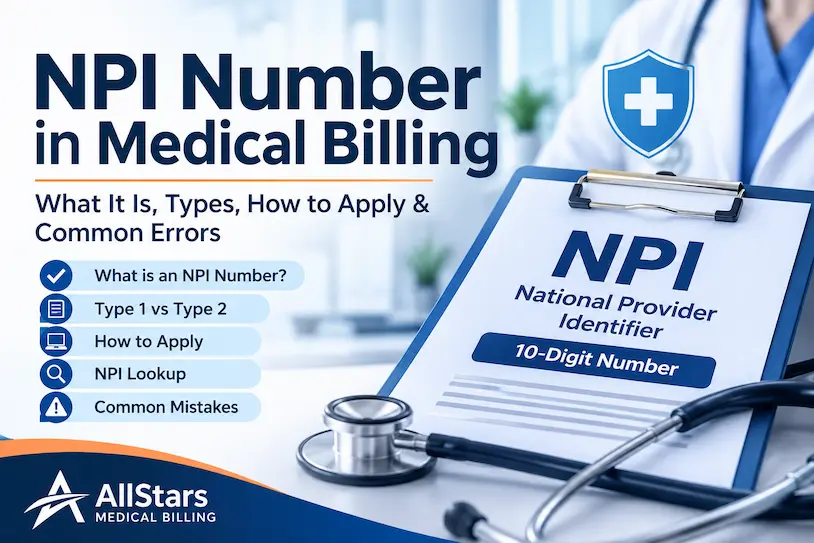
An NPI number short for National Provider Identifier is a unique 10-digit identification number assigned to healthcare providers in the United States. It was established under the Health Insurance Portability and Accountability Act (HIPAA) and is administered by the Centers for Medicare & Medicaid Services (CMS) through the National Plan and Provider Enumeration System (NPPES).
The NPI replaced older provider identification numbers that varied across payers and systems. Today, it serves as the standard identifier for all covered healthcare transactions, including claim submission, eligibility verification, referrals, and coordination of benefits.
Every covered healthcare provider whether an individual physician, nurse practitioner, or a healthcare organization, must obtain an NPI before billing any insurance plan.
Why Is an National Provider Identifier Number Important in Medical Billing?
The NPI number is the foundation of electronic healthcare transactions. Under HIPAA’s Administrative Simplification provisions, covered entities must use the NPI in all standard electronic transactions.
In practical terms, this means:
- Claim submission: The NPI identifies the billing provider, rendering provider, and referring provider on a CMS-1500 or UB-04 claim form.
- Payer-provider communication: Clearinghouses, payers, and providers all use the NPI to route and process claims correctly.
- Insurance enrollment: Payers require a valid NPI as a condition of participation in their networks.
When the wrong NPI appears on a claim, or when billing and rendering provider NPIs are mixed up, the payer’s system either rejects the claim outright or holds it for manual review. That delay directly affects your practice’s cash flow. As part of the broader provider credentialing process, maintaining accurate NPI information is a non-negotiable starting point.
Types of NPI Numbers: Type 1 vs. Type 2
NPPES issues two distinct types of NPIs. Using the wrong type on a claim is a common and avoidable error.
Type 1 NPI – Individual Providers
A Type 1 NPI is assigned to individual healthcare providers, real human beings who render patient care. This includes physicians, nurse practitioners, physician assistants, dentists, chiropractors, physical therapists, and any other licensed individual provider.
A sole proprietor who operates a practice under their own name uses only a Type 1 NPI.
Type 2 NPI – Healthcare Organizations
A Type 2 NPI is assigned to organizations, legal entities that provide healthcare services or bill under a group name. This includes group medical practices, hospitals, clinics, home health agencies, laboratories, and durable medical equipment suppliers.
A sole proprietorship that is incorporated as a legal business entity may need a Type 2 NPI in addition to the owner’s Type 1 NPI.
Difference between provider NPI and Organization NPI
| Feature | Type 1 NPI | Type 2 NPI |
|---|---|---|
| Provider Type | Individual (human being) | Organization (legal entity) |
| Who Uses It | Physicians, NPs, PAs, therapists | Group practices, hospitals, clinics, DME suppliers |
| Examples | Dr. Jane Smith, MD | Smith Family Medical Group, LLC |
| Purpose | Identifies the rendering/referring provider | Identifies the billing organization |
A physician working within a group practice will typically have their own Type 1 NPI as the rendering provider, while the practice bills under a separate Type 2 NPI as the billing entity. Both NPIs often appear on the same claim.
How to Apply for an NPI Number
Applying for an NPI is straightforward, and there is no fee. Here is the step-by-step process:
- Access the NPPES system. Visit the official NPPES website at nppes.cms.hhs.gov. This is the only authorized system for NPI applications, no third party can charge you for this.
- Create or access your account. New applicants must create an Identity & Access Management (I&A) account. Existing account holders can log in directly.
- Select the correct entity type. Choose Entity Type 1 (individual) or Entity Type 2 (organization). Selecting the wrong type causes processing issues.
- Enter provider or organization information. For Type 1, this includes your legal name, date of birth, Social Security Number (for identity verification), and practice address. For Type 2, enter the organization’s legal business name, Employer Identification Number (EIN), and address.
- Select the appropriate healthcare taxonomy code. Taxonomy codes identify your provider type and specialty (e.g., 207Q00000X for Family Medicine). Selecting an incorrect or mismatched taxonomy code leads to claim issues and payer enrollment problems.
- Review and submit your application. Double-check all entries before submitting. Errors here carry forward into every claim and payer enrollment application.
- Maintain and update your NPI record. NPPES requires providers to update their NPI record within 30 days of any change — including address, taxonomy, or contact information. Outdated records cause claim mismatches.
How to Perform an National Provider Identifier Number Lookup
The NPPES NPI Registry is a free, public-facing database where anyone can search for a provider’s NPI. It is available at npiregistry.cms.hhs.gov.
Billing teams should routinely verify the following fields before submitting a claim or completing payer enrollment:
- Provider name (individual or organization)
- NPI number
- Entity type (Type 1 or Type 2)
- Primary practice address
- Healthcare taxonomy code and classification
Verifying NPI information before submitting claims — especially for new providers or recently relocated practices prevents a large category of avoidable denials.
Common National Provider Identifier Errors in Medical Billing
NPI-related mistakes are among the most frequent causes of claim rejections. Here are six errors billing teams encounter regularly:
1. Using an incorrect NPI on the claim. Transposing a digit or copying the wrong provider’s NPI causes immediate rejections. Always verify the NPI directly in NPPES before enrollment or claim submission.
2. Confusing Type 1 and Type 2 NPIs. Submitting the organization’s Type 2 NPI in the rendering provider field — where the individual’s Type 1 NPI belongs — is a common and often subtle error. Payers expect each field to carry the right entity type.
3. Incorrect billing vs. rendering provider information. The billing NPI (usually Type 2) and the rendering NPI (usually Type 1) must each appear in the correct claim field. Many billing software systems have separate fields for these, and mixing them causes payment delays or denials.
4. Outdated address or provider details. When a provider moves or a practice changes addresses, the NPI record must be updated within 30 days. Payers compare the address on the claim with their enrolled records, and mismatches trigger rejections.
5. Incorrect taxonomy code. A taxonomy code that does not match the provider’s enrolled specialty can cause claim denials particularly for Medicare, which cross-references taxonomy codes against enrollment records. When a physician switches specialties or adds a new service line, the taxonomy code in NPPES must reflect that change.
6. Mismatched payer enrollment information. The NPI information on file with a payer must exactly match the NPPES record. If a provider updated their address in NPPES but did not notify each payer separately, claims will mismatch, and payment is withheld until the records are reconciled.
Preventing these problems starts with using NPPES lookup as a standard pre-claim verification step and building NPI audits into your billing workflow on a quarterly basis.
NPI Number vs. Tax ID Number (TIN): What’s the Difference?
The NPI and Tax Identification Number (TIN) are both required for billing, but they serve entirely different purposes and must never be confused.
| Feature | NPI Number | Tax ID Number (TIN) |
|---|---|---|
| Issued By | CMS / NPPES | IRS |
| Purpose | Healthcare provider identification | Tax and financial identification |
| Used For | Claim submission, eligibility, enrollment | Billing, remittance, 1099 reporting |
| Type | 10-digit numeric | 9-digit numeric (SSN or EIN) |
| Public? | Yes — searchable in NPPES registry | No — confidential |
| Cost | Free | Free (SSN) or free EIN via IRS |
A group practice’s Type 2 NPI and EIN are both needed for payer enrollment and claim submission — but they are completely separate identifiers that appear in different fields.
Does Having an NPI Number Mean a Provider Is Credentialed?
This is one of the most important distinctions in medical billing: an NPI number is not proof of credentialing, licensure, or payer enrollment.
Obtaining an NPI simply means a provider has been enumerated in the NPPES system. It does not mean:
- The provider is licensed to practice in any state
- The provider is enrolled with Medicare or Medicaid
- The provider is credentialed with any commercial insurance plan
- The provider can legally bill for services
Understanding who needs provider credentialing and what that process requires is essential before a new provider begins seeing insured patients. Credentialing verifies qualifications; the NPI is simply the identifier used throughout that credentialing process and all subsequent billing.
For example, a physician who obtains an NPI and immediately begins submitting Medicare claims without completing Medicare provider enrollment will have every claim rejected, regardless of how valid the NPI is.
How AllStars Medical Billing Can Help
Managing NPI enrollment, payer credentialing, and billing accuracy across multiple providers and insurance plans is an ongoing administrative responsibility. Errors in any of these areas delay reimbursements and disrupt practice revenue.
At AllStars Medical Billing, we provide end-to-end support across the full provider enrollment and revenue cycle:
- Provider Credentialing We manage the complete credentialing and payer enrollment process, including Medicare, Medicaid, and commercial insurance networks, so providers are set up to bill correctly from day one.
- NPI Registration Assistance We help new providers and organizations apply for Type 1 and Type 2 NPIs, select the correct taxonomy codes, and keep NPPES records current.
- Medical Billing & RCM Our billing specialists verify NPI and enrollment information before every claim submission, reducing rejection rates and accelerating payment.
- Insurance Enrollment Support We handle payer enrollment applications, track approvals, and reconcile NPI information across all payer systems.
- Medical Coding Our certified coders ensure claims include the right provider identifiers alongside accurate procedure and diagnosis codes.
- Claims Management We monitor claim status, work denials, and resolve NPI-related rejections before they affect your bottom line.
Whether you’re a solo practitioner applying for your first NPI or a multi-provider practice managing complex payer relationships, our provider credentialing services are designed to remove administrative friction and protect your revenue cycle.
Is an NPI number free?
Yes. Applying for an NPI through the NPPES system is completely free. CMS does not charge any fee for NPI enumeration.
How many digits does an NPI number have?
An NPI is a unique 10-digit identification number. It does not contain any embedded intelligence about the provider, it is simply a unique numeric identifier.
Can a provider have both a Type 1 and Type 2 NPI?
Yes. This is common. A physician who is also the owner of an incorporated group practice may hold a Type 1 NPI as an individual and a Type 2 NPI for the organization. Both are used in medical billing depending on the claim context.
Does an NPI number expire?
No. An NPI does not expire. However, providers are required to update their NPI record in NPPES within 30 days of any change to their practice information, such as a new address, name change, or additional taxonomy.
Does an NPI automatically enroll a provider with Medicare?
No. Having an NPI is a prerequisite for Medicare enrollment, but the enrollment itself is a separate process completed through PECOS (the Provider Enrollment, Chain, and Ownership System) using the appropriate CMS-855 application form. Providers must complete both steps before billing Medicare.
Managing NPI registration, payer enrollment, and billing compliance doesn’t have to be complicated. Contact AllStars Medical Billing to learn how our credentialing and revenue cycle specialists can help your practice get set up right and stay that way.
📞 (501) 424-0123 | ✉️ info@allstarsmb.com