Every claim your practice submits to a payer begins with a billing code. These standardized alphanumeric identifiers are what transform a clinical encounter, a diagnosis, a procedure, a supply, into language that insurance companies, Medicare, and Medicaid can process, adjudicate, and pay.
Without accurate billing codes, claims stall in queues, get rejected outright, or return at reduced payment. For healthcare providers managing tight margins, that’s not a paperwork inconvenience, it’s a direct hit to revenue.
Medical billing codes also serve a broader purpose. They support public health data, enable clinical quality reporting, facilitate audits, and document medical necessity for every service rendered. Getting them right isn’t optional.
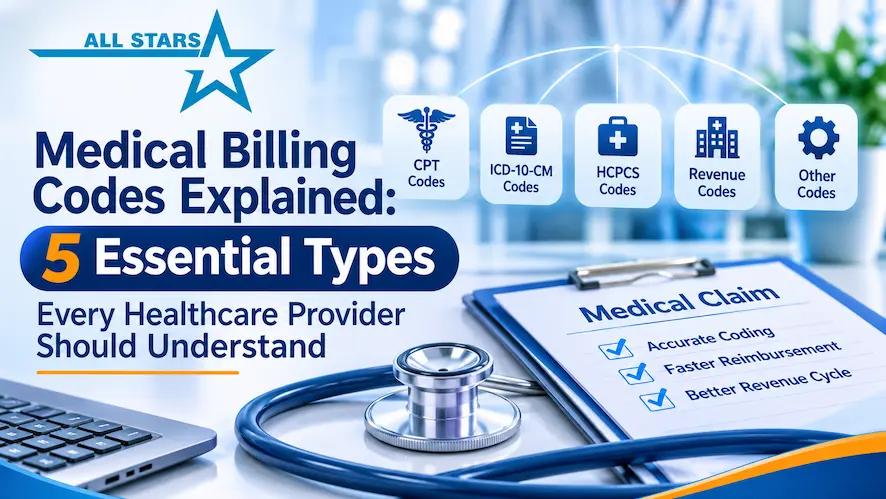
In this article, we break down the five essential types of medical billing codes every healthcare provider, coder, and practice manager should understand, including how they work, where they appear on claims, and how coding errors can derail your reimbursement cycle.
What Is a Medical Billing Code?
A medical billing code is a standardized identifier used to represent a clinical service, diagnosis, procedure, supply, or facility charge on a healthcare claim. These codes follow nationally recognized systems maintained by organizations such as the American Medical Association (AMA), the Centers for Medicare & Medicaid Services (CMS), and the World Health Organization (WHO).
It’s worth clarifying the difference between medical coding and medical billing, since the two terms are often used interchangeably but represent distinct functions.
Medical coding is the process of translating documented clinical information patient history, exam findings, procedures performed, diagnoses confirmed, into the appropriate code from a recognized code set. Certified medical coders review provider documentation and assign codes accordingly.
Medical billing takes those assigned codes and uses them to build a claim, which is then submitted to a payer for reimbursement. The billing team handles claim submission, follow-up, payment posting, and denial management.
Both functions depend on the same foundation: accurate billing codes. When a code is wrong, the entire downstream process suffers.
The 5 Essential Types of Medical Billing Codes
A. CPT Codes Capturing What Providers Do
Current Procedural Terminology (CPT) codes are developed and maintained by the American Medical Association. They are the primary code set used in professional billing to describe the services and procedures a clinician performs.
CPT codes are five-digit numeric codes divided into three categories. Category I codes — the ones used in everyday billing, cover everything from Evaluation and Management (E/M) services to surgery, radiology, pathology, and anesthesia.
For example, CPT code 99213 represents an office or outpatient visit for an established patient with a low to moderate level of medical decision-making. CPT code 93000 describes a standard 12-lead electrocardiogram with interpretation and report. CPT code 27447 is used for a total knee arthroplasty.
E/M codes deserve special attention because they appear on nearly every physician claim. Since CMS revised E/M documentation guidelines in 2021, code selection has been based primarily on medical decision-making (MDM) or total time, not the number of history or exam elements documented. Understanding these updates is essential for avoiding both under-coding and over-coding.
CPT codes appear on the CMS-1500 claim form and are used in professional billing by physicians, mid-level providers, and outpatient practices. They are updated annually each January.
B. ICD-10-CM Codes, Telling the Story of Why
The International Classification of Diseases, 10th Revision, Clinical Modification (ICD-10-CM) is the U.S. diagnosis code set maintained by CMS and the CDC. These codes explain why a service was provided, the medical reason that justifies the clinical encounter.
ICD-10-CM codes are alphanumeric and can extend to seven characters, allowing for a high degree of specificity. For instance, M54.51 describes vertebrogenic low back pain, while E11.9 indicates Type 2 diabetes mellitus without complications, and J45.20 represents mild intermittent asthma, uncomplicated.
For billing purposes, ICD-10-CM codes support medical necessity, the clinical justification that a payer uses to determine whether a service warrants reimbursement. A claim for an MRI of the knee submitted without an appropriate supporting diagnosis code may be denied as not medically necessary, even if the imaging was clinically appropriate.
Accurate diagnosis coding also matters for chronic condition management, hierarchical condition category (HCC) risk adjustment in Medicare Advantage, and quality reporting programs like MIPS.
ICD-10-CM codes are updated annually each October. Providers and coders must reference the current fiscal year’s tabular list to ensure they’re using active, valid codes.
C. HCPCS Codes, Beyond What CPT Covers
The Healthcare Common Procedure Coding System (HCPCS) was developed by CMS to cover services and items not addressed by CPT. It operates on two levels.
HCPCS Level I is simply the CPT code set, the same codes described above.
HCPCS Level II codes are CMS-maintained alphanumeric codes beginning with a letter (A through V) followed by four digits. These codes describe durable medical equipment (DME), prosthetics, orthotics, supplies, drugs administered in a clinical setting, ambulance services, and other items not captured by CPT.
Common examples include A6252 for a wound dressing, E0601 for a CPAP device, J0696 for an injection of ceftriaxone sodium, and A0428 for basic life support ambulance services.
HCPCS Level II codes are essential for DME suppliers, home health agencies, outpatient infusion centers, and any provider that dispenses or administers items outside the standard CPT scope. Many Medicare and Medicaid claims rely heavily on this code set.
D. Revenue Codes,The Language of Institutional Billing
Revenue codes are three- or four-digit codes used exclusively in institutional or facility billing. They appear on the UB-04 claim form (also known as CMS-1450), which is used by hospitals, skilled nursing facilities (SNFs), ambulatory surgical centers (ASCs), and other facility-based providers.
Revenue codes identify the specific department or cost center where a service was performed. For example, revenue code 0450 represents emergency room services, 0272 identifies medical/surgical supply, and 0260 represents IV therapy.
Unlike CPT or ICD-10-CM codes, revenue codes don’t describe the specific service performed, they indicate where it was performed and the type of cost being reported. Revenue codes appear alongside CPT or HCPCS codes on a UB-04 and are required for proper hospital claim processing under Medicare Part A and many commercial payers.
E. Modifiers, Place of Service Codes, and Other Claim Identifiers
These aren’t standalone code sets, but they play a critical supporting role in claim accuracy.
CPT Modifiers are two-character codes appended to a CPT code to provide additional information about a service, such as whether it was bilateral (modifier -50), performed by multiple surgeons (-62), or only the professional component (-26). Incorrect or missing modifiers are one of the most common causes of claim denials and payment reductions.
Place of Service (POS) Codes are two-digit codes on the CMS-1500 that indicate where a professional service was rendered, such as POS 11 for a physician’s office, POS 21 for inpatient hospital, or POS 22 for an on-campus outpatient hospital setting. POS codes affect reimbursement rates because Medicare and many payers pay at different fee schedule levels depending on the site of service.
Taxonomy Codes identify a provider’s specialty and are used in credentialing and claim routing. NPI numbers, while not codes per se, are required identifiers on all HIPAA-compliant claims. These elements collectively complete the billing picture beyond the core code sets.
CPT vs. ICD-10-CM vs. HCPCS vs. Revenue Codes: A Quick Comparison
| Code Type | Maintained By | Used For | Claim Form |
|---|---|---|---|
| CPT | AMA | Procedures & professional services | CMS-1500 |
| ICD-10-CM | CMS / CDC | Diagnoses & medical necessity | CMS-1500 & UB-04 |
| HCPCS Level II | CMS | Supplies, DME, drugs, ambulance | CMS-1500 & UB-04 |
| Revenue Codes | NUBC | Facility cost centers / departments | UB-04 only |
A professional claim from a physician’s office will primarily use CPT and ICD-10-CM codes on the CMS-1500. A hospital inpatient claim on a UB-04 will use ICD-10-CM for diagnoses, revenue codes for each service line, and CPT or HCPCS to identify specific procedures. Understanding which codes belong on which form, and in what combination, is fundamental to clean claim submission.
How Medical Billing Codes Work in the Insurance Claim Process
Understanding each code type is one thing. Seeing how they move through the revenue cycle is what ties it all together.
- Documentation Review. The process begins when a provider completes their clinical documentation the encounter note, operative report, or discharge summary. The coder reviews this documentation to identify all billable diagnoses, procedures, and services.
- Code Assignment. Based on the documentation, the coder assigns the appropriate ICD-10-CM diagnosis codes, CPT or HCPCS procedure codes, modifiers, and any relevant service identifiers. This step requires both coding expertise and clinical knowledge.
- Claim Preparation. The billing team compiles the assigned codes into a claim either a CMS-1500 for professional billing or a UB-04 for institutional billing along with patient demographics, provider identifiers, and payer information.
- Claim Submission. The claim is submitted electronically to the payer through a clearinghouse or direct connection. The AllStars Medical Billing claims team achieves a 98% first-pass acceptance rate, which reflects what a well-structured submission workflow can accomplish.
- Payer Adjudication. The payer reviews the claim, checks for medical necessity using the diagnosis codes, verifies benefits and eligibility, and applies the appropriate fee schedule. Automated edits flag coding discrepancies before human review.
- Payment or Denial. The payer issues an Explanation of Benefits (EOB) or Remittance Advice (RA). Clean, correctly coded claims result in payment. Incorrectly coded claims generate denials, underpayments, or requests for additional documentation.
Common Medical Billing Code Errors, and How to Prevent Them
Coding errors don’t just cost practices money on a single claim, they create patterns that attract audits and damage payer relationships over time.
Incorrect code selection happens when a coder assigns a code that doesn’t match the documented service. This includes upcoding (billing a higher-complexity E/M than documented), downcoding (under-reporting to avoid scrutiny), and assigning the wrong procedure code entirely.
Unsupported diagnosis codes occur when the ICD-10-CM code used doesn’t align with or justify the procedure billed. Medical necessity denials frequently stem from this mismatch.
Missing or incorrect modifiers are among the most common and costly errors. Submitting a bilateral procedure without modifier -50, or omitting a -59 modifier to distinguish separate and distinct services, can result in automatic bundling denials.
Outdated code references are surprisingly common, especially at practices that don’t update their superbill or charge capture templates every year. Using a deleted CPT code or a retired ICD-10-CM code guarantees rejection.
Incorrect code combinations, such as billing CPT codes that are bundled together by NCCI edits, trigger automatic claim denials. Coders need current NCCI edit tables to avoid these conflicts.
Incomplete clinical documentation is the root cause of most errors. When a provider’s note doesn’t support the level of service billed or fails to document medical necessity, even an experienced coder can’t produce an accurate claim from it.
Prevention starts with regular coding audits, up-to-date code references, coder education, and a strong provider documentation improvement program. The medical coding specialists at AllStars conduct free coding audits that help identify and correct these patterns before they become systemic.
Best Practices for Accurate Medical Billing Coding
Accuracy in medical coding and billing doesn’t happen by accident. Here are the practices that separate high-performing billing operations from the rest.
Update your code sets annually. CPT codes are revised every January; ICD-10-CM updates take effect each October. Any charge capture tool, superbill, or EHR template that hasn’t been updated is a liability.
Train providers on documentation requirements. Clinical staff don’t need to be coders, but they need to understand what documentation supports specific billing codes, particularly for E/M services, surgical procedures, and high-complexity diagnoses.
Conduct routine internal coding audits. A quarterly review of a random sample of coded claims can catch systematic errors before they escalate into denial patterns or compliance risks.
Use payer-specific coding guidelines. Medicare, Medicaid, and commercial payers often have local coverage determinations (LCDs) or medical policies that go beyond standard CPT and ICD-10-CM guidance. What’s reimbursable under one payer’s policy may be denied by another.
Invest in certified coding professionals. CPC (Certified Professional Coder) and CCS (Certified Coding Specialist) credentials signal a coder’s demonstrated competency. Practices that rely on untrained staff for coding accept significant reimbursement and compliance risk.
Track denial patterns by code. If a particular CPT code is generating consistent denials, that’s a signal, not just noise. Denial tracking by code category helps identify whether the problem is documentation, modifier usage, or payer policy.
What is the difference between CPT codes and HCPCS codes?
CPT codes are developed by the AMA and describe professional procedures and services. HCPCS Level II codes are CMS-maintained codes that cover supplies, durable medical equipment, drugs, ambulance services, and other items not addressed by CPT. Both appear on claims, but HCPCS Level II is especially important for DME, infusion, and Medicare billing.
Can a claim include both ICD-10-CM and CPT codes?
Yes in fact, it must. ICD-10-CM codes explain the medical reason (diagnosis) for the service, while CPT codes describe what was done. Both are required on a CMS-1500 for a claim to be properly adjudicated.
What happens if I use an outdated ICD-10-CM code on a claim?
The claim will typically be rejected or denied for invalid code. Payers validate submitted codes against the current code set for the date of service, so using a code that has been deleted or revised will trigger an edit failure.
Are revenue codes required on professional claims?
No. Revenue codes appear only on the UB-04, the institutional claim form used by hospitals, SNFs, and facility-based providers. Professional billing uses the CMS-1500, which does not include revenue codes.
How do place of service codes affect reimbursement?
Significantly. Medicare pays physicians at different rates depending on where they provide the service. Office-based services (POS 11) are reimbursed at a higher rate than the same service provided in a facility setting (POS 21 or 22), because the facility receives a separate facility payment. Incorrect POS codes can result in systematic overpayment or underpayment.
Medical billing codes are not administrative formality they are the precise language your practice uses to communicate with payers, justify clinical decisions, and collect the reimbursement your services have earned. Whether you’re assigning a CPT code for an office visit, selecting an ICD-10-CM diagnosis to establish medical necessity, using HCPCS codes for a supply or drug, or reporting facility services through revenue codes on a UB-04, accuracy at every step is what keeps your revenue cycle healthy.
A single coding error can cascade into a denial, a delayed payment, or a compliance issue. Multiply that across hundreds of claims per month, and the financial impact becomes significant.
For independent practices, medical groups, and hospital billing teams looking to tighten coding accuracy and reduce denials, working with an experienced medical billing partner makes a measurable difference.
AllStars Medical Billing & IT Services supports healthcare providers across all 50 states with comprehensive medical billing and medical coding services, from charge capture and claim submission through denial management and AR recovery. With a 98% first-pass claim acceptance rate and certified coders on staff, AllStars helps practices submit cleaner claims, collect faster, and spend less time chasing denials. Contact AllStars today to learn how professional coding and billing support can strengthen your practice’s financial performance.