
Any billed services are identified using a CPT code. CPT codes identify for the payer what was performed during a visit and are used together with ICD-10-CM to establish the necessity of performing these services. Any coding mistakes, missed modifiers, or non-updated codes lead to the denial or delay in processing the claims. The following guide will explain the function of the CPT codes in the office-based billing, most commonly used CPT codes and modifiers, the reasons for mistakes in coding, and the importance of accurate CPT coding for the revenue cycle in 2026.
What are CPT Codes in Medical Billing?
CPT Codes are five-digit codes that are updated and maintained by the American Medical Association and represent the description of all types of medical, surgical, and diagnostic procedures. While the ICD-10-CM tells us why something happened, CPT Codes tell us what was done. It is used by insurance providers to figure out the service rendered, whether it is covered, and how much it is worth.

Importance of CPT Codes in Medical Billing
The CPT codes play a central role in medical billing. The CPT codes allow the service to be identified in a standardized way that is accepted globally, and every claim filed will require a CPT code corresponding to every service provided by the practitioner. Insurers use these codes, and sometimes also modifiers, to determine the amount of payment to be made for every procedure done, and therefore CPT codes are the common language spoken between the provider and the insurer.
In addition to helping claims be processed efficiently, using the correct CPT code ensures that the claims are not rejected, delayed, or even flagged.
What Is the Journey of a CPT Code in the Process of Office Medical Billing?
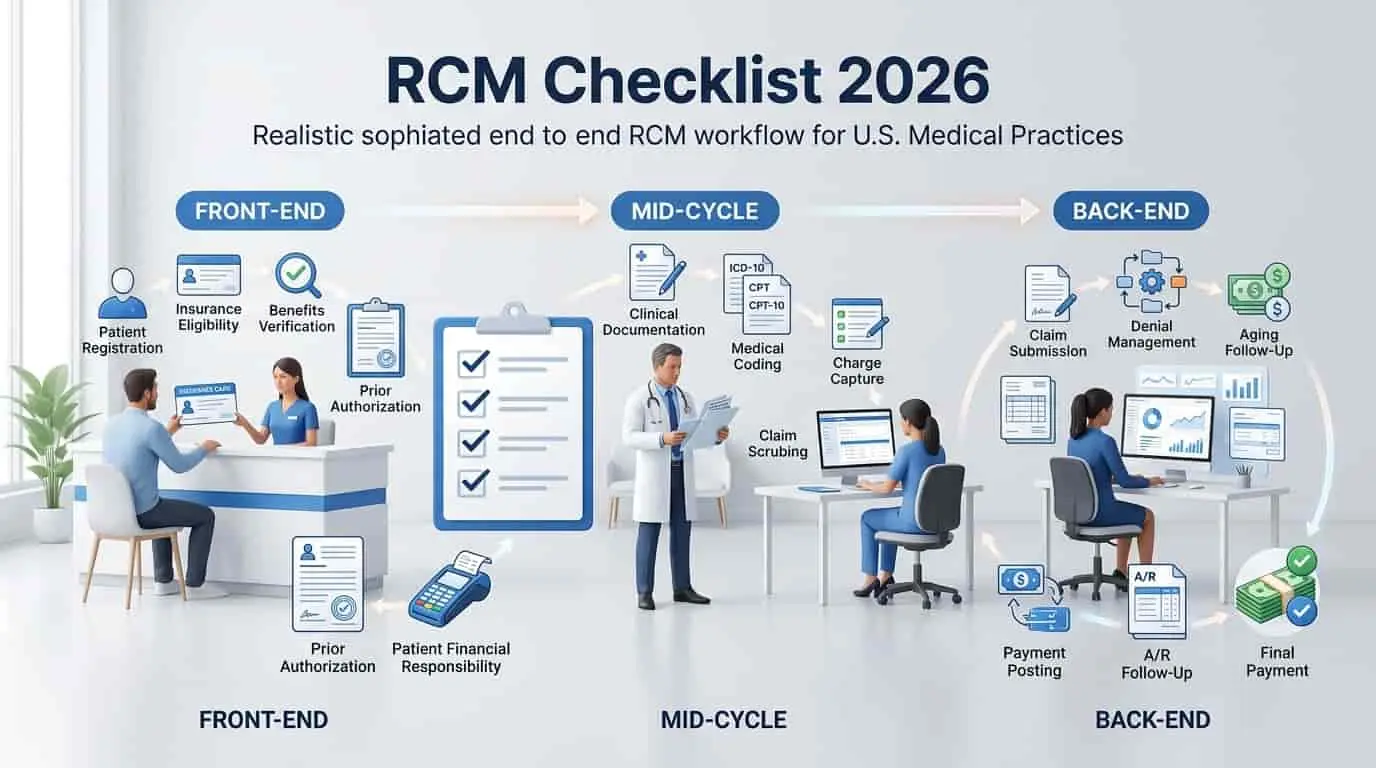
There is a relatively well-defined route that CPT code travels in an office setting, from patient visit to payment: the process includes patient visit, documentation, assignment of CPT code, assignment of the diagnosis code, claim submission, review of claim by payer, and, finally, payment.
The first step occurs as a provider visits a patient and performs some kind of service – evaluation, procedure, testing or injection. Documentation of the visit in terms that would allow selecting a specific CPT code follows. Next, the person responsible for coding or billing reviews the documentation and selects the appropriate CPT code or codes and attaches the appropriate ICD-10-CM code, which justifies medical necessity. The electronic claim, containing codes, is sent to the payer, who reviews it, checks codes against coverage and medical necessity requirements and processes the claim. The result is either payment or partial payment or denial of the claim with detailed explanation that relates back to codes used.
Types of CPT Codes
The CPT codes are classified into a few types of groups, which you should be familiar with even if your job mainly deals with one type of codes.
- Category I – this is the backbone of CPT codes: five-digit codes describing established services and procedures performed by providers throughout the U.S., these are the codes you’ll probably use most often in your office.
- Category II – supplemental alphanumeric tracking codes (with a letter F at the end), useful for reporting and measuring performance, without the actual payment attached to them.
- Category III – provisional alphanumeric codes (codes ending with a letter T) for services that have not yet fulfilled the requirements of being Category I codes, such as new procedures that need to be tracked.
- Proprietary Laboratory Analyses (PLA) – special codes for the testing offered by one specific manufacturer or laboratory.
CPT Codes Used Regularly for Office Medical Billing
There are some CPT codes that are used all the time for office medical billing. For example, evaluation and management (E/M) codes (99202-99215) are used to bill office visits which include both new patients and established patients, and they depend on the complexity and time spent on each case. There are preventive medicine codes (99381-99397), which include annual well-person examinations for various age categories. The list also includes minor procedures performed in the office such as skin lesion removal or repair. Some of the diagnostic tests performed in the office (for example, electrocardiogram or spirometry) also have a specific code, such as 93000 or 94010 respectively. Vaccinations and injections are another group of codes (90471 is used for one vaccine administration).
Comparison Between CPT Codes and ICD-10-CM Codes
Both codes systems complement each other, yet there are differences in the issues they solve. The former identifies the provided service or procedure, or in other words, what was done. The latter provides a diagnosis associated with the service, explaining why it was done. Therefore, CPT is applied to procedure codes, while ICD-10-CM to diagnoses. A claim has to contain both: CPT code explains the service, and associated ICD-10-CM proves its necessity.
CPT Codes vs. HCPCS Codes
The two codes systems are related, yet not similar. CPT contains the core code set for procedures and services and is maintained by the American Medical Association; it is also called HCPCS Level I. HCPCS Level II consists of alphanumeric codes (letter at first, four digits after) describing items that are not covered by CPT, such as durable medical equipment, ambulances, certain drugs, and supplies. Practically, the two code sets are used simultaneously within the same claim: CPT describes the clinical service, and HCPCS Level II – the item used for it.
CPT Modifiers Defined
A CPT modifier is a two-digit alphanumeric code that is attached to a CPT code to provide information about changes made to the service, while still maintaining the meaning of the base code. Modifiers are used to convey that the procedure was done on one particular side of the body, that the service is different from another service provided on the same date of service, that the procedure is being repeated, or that only part of the procedure is being performed.
A typical example of an office modifier is 25, which means a significant, separate E/M service was provided in addition to another procedure on the same day. Modifiers are worth a dedicated discussion, see our complete Modifiers article for all the details on the commonly used modifiers in office billing.
Identifying the Right CPT Code
The key to minimizing mistakes is having a consistent approach. Begin with the full patient record rather than relying solely on the summary provided with each encounter, and pinpoint what was done. Next, look through the current year’s code set and identify the one that comes closest to matching, then double-check that its descriptor is an exact match for the service described. Confirm that the note satisfies all of the requirements of the code for either time, complexity, or component and add any necessary modifiers. Finally, correlate the code with the right diagnosis for medical necessity.
This is where most unnecessary denials begin, with at least one of these steps being skipped.
Effect of Coding Errors on Claims Process
Coding errors not only add additional paper work; they have a direct effect on income and compliance status of a practice. A claim may get rejected right at the beginning without going through any processing at all because of an error in format or invalid code. On the other hand, it may also get denied by the insurance company after processing because of lack of medical need or coding errors. In any case, fixing errors and resubmitting claims would prolong the revenue process. Apart from that, upcoding or undercoding could result in inappropriate reimbursement which could either be overpayment, a potential compliance problem, or underpayment which means loss of income.
Updates to the 2026 CPT Codes
The CPT code set for the year 2026 was implemented on January 1, 2026, and it is one of the largest CPT code set updates in recent history – 418 total code changes were made, including 84 deletion of codes, 46 revised codes, and 288 codes added.
Among those CPT changes, several stand out as particularly significant for office practices. In the area of remote patient monitoring (RPM), the AMA introduced codes to report on shorter duration of RPM, i.e., collection of 2-15 days worth of RPM data during a month. Also, there are several codes added to cover treatment management with RPM after providing 10 minutes of service each month – thus giving more options for billing office RPM programs which are less than 16 days in length. The codes describing digital health services and the AI assistance also received a number of changes, reflecting recognition of AI technologies as a regular tool used by the doctors to make decisions and diagnoses, e.g., coronary risk assessment and multispectral imaging analysis. Finally, on the behavioral health side, several codes have been added to the CPT appendices of services which could be provided with audio/video or only audio communication, increasing flexibility of the ways practices can provide behavioral health services. As far as the whole set of codes goes, some sections underwent substantial changes in this update, including leg revascularization services and hearing devices services.
Why this matters for office billing: while practices which do not engage in surgeries or provide specialty care will not be directly affected by changes, it would be beneficial for them to review whether their billing for remote patient monitoring, telehealth, and diagnostics has been impacted. Thus, one should cross-check the EHR and PM software libraries of CPT codes against the latest year’s CPT code set, removing any outdated codes, training staff to use any newly added codes, etc.
Coding Practice Tips for CPT
There are a few basic practices that will ensure a smooth claims process. Update your code sets and templates at the beginning of the year, not in the middle of the year once a denial necessitates the action, and use the published guidelines in connection with the CPT code set, not quick fixes. Check that there is proper documentation for a particular code before sending the claim, not after receiving a denial, and check payer-specific instructions, because sometimes payers have additional coding or modifiers that they need in addition to CPT. Regular audits will ensure that you find any trends early on before compliance issues develop, and regular training will make sure everyone is up-to-date with new codes every year.
Correct CPT coding is not merely a formality but is necessary for the smooth operation of the revenue cycle for the office-based practice. It defines whether the claim will be paid, postponed or rejected, and mistakes multiply over time in the entire patient roster. Being aware of annual updates, maintaining accurate documentation and utilizing a consistent code selection process is the core of proper office-based medical billing.
Allstars Medical Billing provides the services of coding and billing specialists who will follow the annual CPT updates to make sure that the practice does not need to do it on its own. If you need a revision of your current coding process or denial cleanup assistance, we can help you with that.
What does CPT stand for?
Current Procedural Terminology.
What is the difference between CPT and ICD-10?
CPT codes describe what service was performed; ICD-10-CM codes describe why it was performed (the diagnosis).
What is a CPT modifier?
A two-character code added to a CPT code to indicate that a service was altered in some way without changing its basic definition.