Medicare Provider Credentialing is one of the most critical processes for healthcare providers wishing to cater to Medicare beneficiaries and get paid for their eligible medical services. With millions of Americans using Medicare for healthcare services, being an accredited Medicare provider can increase your patient base tremendously and generate a steady stream of income.
However, even though it is crucial for the practice, many providers find the Medicare Provider Credentialing process difficult due to numerous verification procedures, paperwork, federal requirements, and enrollment conditions. If your documents are incomplete or contain inaccurate information, it can slow down the process and put off billing to Medicare.
Whether you are starting a new practice, joining a group practice, or extending your healthcare services, knowing the Medicare Provider Credentialing process will be very helpful for you. This article covers all the aspects of the Medicare Provider Credentialing process and explains everything you need to know about this process.

What Is Medicare Provider Credentialing?
The Medicare Provider Credentialing is the process through which the Center for Medicare and Medicaid Services (CMS) determines whether the health care provider complies with all the federal requirements to become involved with the Medicare Program.
In credentialing, the CMS assesses the qualifications, licensing, education, certifications, experience, ownership, and compliance with Medicare requirements of the provider. The approved provider gets the right to be paid through Medicare billing privileges for rendering Medicare-approved services to Medicare beneficiaries.
It should be noted that credentialing is not just filling out forms. It is the process of thorough verification of credentials of Medicare providers in order to ensure their patients are being treated by competent and legally qualified healthcare professionals.Who Needs Medicare Provider Credentialing?
Why Medicare Provider Credentialing Is Important
Completing Medicare Provider Credentialing offers numerous advantages for healthcare providers and medical practices.
Obtaining the Medicare Provider Credentialing provides many benefits for health care professionals as well as medical practices.
- Access to Millions of Medicare Beneficiaries
The Medicare program provides coverage to over 65 million Americans who include Americans aged 65 or over as well as eligible younger people with certain disabilities. Credentialing allows the providers to treat this massive number of patients.
- Claim Reimbursements from Medicare
Providers cannot usually get reimbursed by Medicare until the enrollment process is completed. Credentialing ensures that the providers can be reimbursed for services.
- Generate Additional Income for Medical Practices
Being able to accept Medicare patients as part of their practice can help the providers generate diverse sources of income.
- Increase Credibility
Since Medicare credentialing proves that the physician has satisfied certain federal requirements, it increases the credibility of the provider.
- Compliance with CMS Guidelines
Credentialing ensures the providers are compliant with CMS guidelines.
Who Needs Medicare Provider Credentialing?
Many healthcare professionals and organizations must complete Medicare Provider Credentialing before billing Medicare.
These include:
- Physicians (MD and DO)
- Nurse Practitioners (NP)
- Physician Assistants (PA)
- Clinical Nurse Specialists
- Certified Registered Nurse Anesthetists
- Physical Therapists
- Occupational Therapists
- Speech-Language Pathologists
- Clinical Psychologists
- Clinical Social Workers
- Chiropractors
- Independent Diagnostic Testing Facilities
- Rural Health Clinics
- Federally Qualified Health Centers
- Ambulatory Surgery Centers
- Group Medical Practices
- Durable Medical Equipment (DME) Suppliers
Each provider type has specific enrollment requirements and may require different CMS application forms.
Eligibility Requirements for Medicare Provider Credentialing
Before beginning the enrollment process, providers should ensure they meet Medicare’s eligibility requirements.
Generally, providers must have:
- An active and unrestricted professional license
- A valid National Provider Identifier (NPI)
- A Tax Identification Number (TIN/EIN)
- Required education and professional qualifications
- Active malpractice insurance (when applicable)
- Compliance with federal healthcare regulations
- Appropriate certifications and specialty credentials
- Legal authorization to practice in their state
- No disqualifying exclusions from federal healthcare programs
Meeting these requirements before applying helps reduce delays during credentialing.
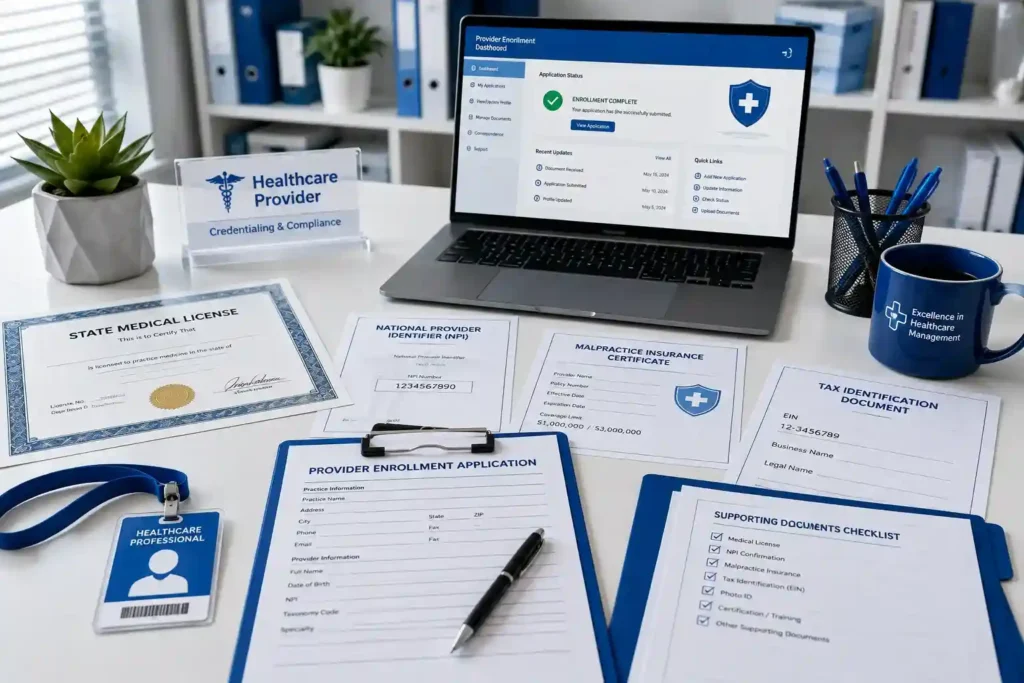
Documents Required for Medicare Provider Credentialing
Preparing documentation in advance makes the enrollment process significantly smoother.
Commonly required documents include:
- National Provider Identifier (NPI)
- State professional license
- DEA registration (if applicable)
- Board certifications
- Medical school diploma
- Residency or fellowship documentation
- Driver’s license or government-issued ID
- Employer Identification Number (EIN)
- Malpractice insurance certificate
- Practice address information
- Banking information for Electronic Funds Transfer (EFT)
- Ownership and managing employee information
- IRS documentation
- Professional references (if requested)
Ensure all documents are current, accurate, and consistent with the information provided on your application.
Step-by-Step Medicare Provider Credentialing Process
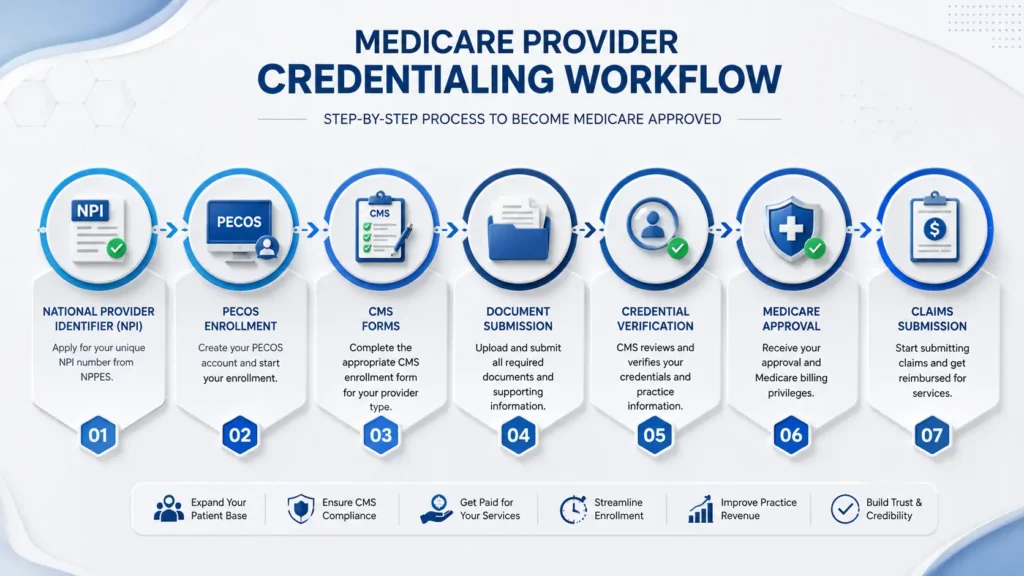
Obtain an NPI
Apply for a National Provider Identifier (NPI), which is required to enroll in Medicare and submit claims.
Create a PECOS Account
Register in PECOS (Provider Enrollment, Chain, and Ownership System) to complete and manage your Medicare enrollment online.
Complete the Correct CMS Form
Submit the appropriate Medicare enrollment application based on your provider type.
| CMS Form | Purpose |
|---|---|
| CMS-855I | Individual Providers |
| CMS-855B | Group Practices |
| CMS-855R | Reassignment of Benefits |
| CMS-855A | Institutional Providers |
| CMS-855S | DME Suppliers |
Submit Required Documents
Upload all necessary documents, including your professional license, NPI, tax information, malpractice insurance (if applicable), and other supporting credentials.
Complete Medicare Screening
CMS verifies your qualifications, licenses, ownership information, and practice details before approving your enrollment.
Respond to CMS Requests
Provide any additional information or documents requested by CMS or your Medicare Administrative Contractor (MAC) as quickly as possible.
Receive Medicare Approval
Once approved, you’ll receive your Medicare billing privileges and can begin submitting claims for reimbursement.
How Long Does Medicare Provider Credentialing Take?
The timeline for Medicare Provider Credentialing varies depending on several factors, including provider type, application accuracy, and whether additional documentation is required.
| Process | Estimated Timeline |
|---|---|
| Online PECOS Application | 30–60 Days |
| Paper Application | 60–90 Days |
| Additional Documentation Review | 2–6 Weeks |
| Site Visit (if required) | Additional Time |
| Application Corrections | Depends on Response Time |
Submitting a complete and accurate application through PECOS generally results in faster processing than paper applications.
Common Challenges During Medicare Provider Credentialing
Healthcare providers may encounter several challenges during the Medicare Provider Credentialing process, including:
- Incomplete or inaccurate applications
- Expired licenses or certifications
- Incorrect practice information
- Missing supporting documents
- Delayed responses to CMS requests
Addressing these issues early can help prevent unnecessary delays and speed up the approval process.
Common Mistakes to Avoid
To ensure a smooth credentialing experience, avoid these common mistakes:
- Using the wrong or outdated CMS forms
- Entering incorrect NPI or practice information
- Forgetting required signatures
- Submitting expired licenses or documents
- Missing ownership or EFT details
- Delaying responses to CMS inquiries
Benefits of Outsourcing Medicare Provider Credentialing
Several health care firms opt to outsource Medicare Provider Credentialing due to several benefits.
The advantages are:
- Increased speed of enrollment and approval
- Minimized mistakes in applications
- Continuous compliance with CMS rules
- Application follow-up
- Help with revalidation
- Billing preparation
- Reduction of administrative work
Outsourcing credentialing allows doctors in expanding medical facilities to concentrate on taking care of their patients and leave all other tasks to the specialists.
How Medical Billing Companies Can Help with Medicare Provider Credentialing
Navigating the Medicare Provider Credentialing process can be time-consuming and complex, especially for new practices or providers expanding their services. At AllStars Medical Billing, we simplify the entire enrollment process by managing every step with accuracy and efficiency.
Our experienced credentialing specialists work closely with physicians, specialists, clinics, and healthcare organizations to ensure timely enrollment and compliance with Medicare requirements. From preparing applications to following up with Medicare Administrative Contractors (MACs), we help reduce delays and minimize administrative burdens.

Medicare Provider Credentialing Services Include:
- Medicare provider enrollment through PECOS
- New provider credentialing and enrollment
- Revalidation and re-enrollment services
- CMS application preparation and submission
- Provider profile setup and maintenance
- Medicare Administrative Contractor (MAC) follow-up
- National Provider Identifier (NPI) assistance
- CAQH profile management
- Commercial insurance credentialing
- Group practice enrollment
- Provider reassignments (CMS-855R)
- Ongoing credentialing support and compliance monitoring
At AllStars Medical Billing, our goal is to help healthcare providers become Medicare-approved quickly while reducing paperwork, preventing application errors, and ensuring compliance with CMS guidelines. By outsourcing your credentialing needs to our experienced team, you can focus on delivering exceptional patient care while we handle the administrative process.
Who needs Medicare Provider Credentialing?
Physicians, nurse practitioners, physician assistants, therapists, psychologists, chiropractors, group practices, and many healthcare facilities must complete Medicare credentialing before billing Medicare.
What is PECOS?
PECOS (Provider Enrollment, Chain, and Ownership System) is CMS’s secure online platform for Medicare provider enrollment and credentialing.
Can I bill Medicare before my application is approved?
No. Providers generally must receive Medicare billing privileges before submitting claims for reimbursement.
What is a PTAN?
A Provider Transaction Access Number (PTAN) is assigned after Medicare enrollment and is used for Medicare billing and provider identification.
Should I hire a credentialing company?
Yes. Working with a professional credentialing company like AllStars Medical Billing can simplify the Medicare Provider Credentialing process, reduce errors, speed up enrollment, and help ensure CMS compliance.
Conclusion
Medicare Provider Credentialing is an essential process for healthcare providers who want to participate in the Medicare program and receive reimbursement for covered services. While the enrollment process requires careful preparation, accurate documentation, and compliance with CMS requirements, completing it successfully opens the door to serving millions of Medicare beneficiaries.
From obtaining an NPI and enrolling through PECOS to submitting the correct CMS forms and maintaining ongoing compliance through revalidation, every step plays a critical role in securing Medicare billing privileges.
Healthcare organizations that invest time in accurate credentialing or partner with experienced credentialing specialists, can minimize delays, reduce administrative burdens, and focus on delivering high-quality patient care while maintaining a healthy revenue cycle.