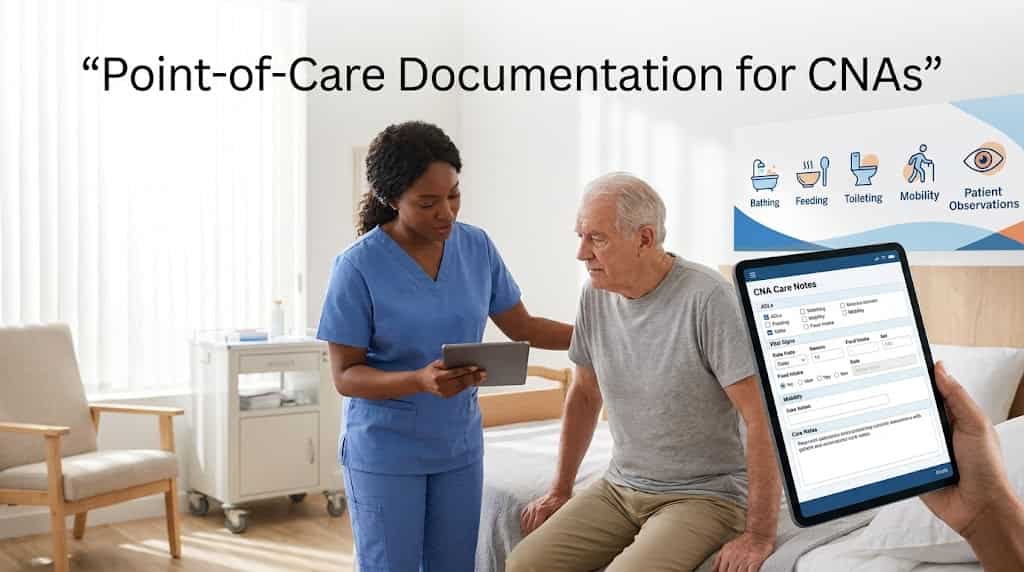
CNAs are usually the health care professionals that interact directly with the patients during most of their working shifts. As they help the patients in bathing, dressing, feeding, toileting and ambulation, they usually become the first ones to detect any signs of change in the condition of the patient. The process that makes such observations a part of the official records of the patient is called point of care (POC) documentation.
In this manual, the concept of POC documentation will be explained in details along with its importance and tasks that need to be fulfilled by the CNAs.
What is Point-of-Care Documentation?
Point-of-care documentation involves making documentation of a patient’s treatment or care while it is being provided by the care provider rather than waiting for some other time within that particular shift to document. Point-of-care documentation for a CNA is the process of logging the performance of a task through the use of a tablet, computer, or other device immediately after (and sometimes even during) performing the task.
The purpose is straightforward: record the information when it is most accurate and then provide this information to others as soon as possible. The modern use of electronic health records makes point-of-care documentation an electronic rather than a paper process.
Why Should Documentation Be Done at the Time of Care Rather Than Later?
Putting off documentation till the end of the shift brings two major problems: the possibility that some information will be forgotten and that the documentation will no longer be current. The attempt by a CNA to remember the events of six or eight patient encounters several hours later means that there is a high likelihood that minor but essential information such as what the patient has eaten and whether he or she was steady on his or her feet will be forgotten.
Benefits of Documentation at the Point of Care Include:
- Accuracy – the information is documented when it is still fresh rather than based on memory
- Timeliness – nurses and other staff members have a real-time account of what has taken place
- Continuity – the patient’s medical record stays up-to-date through the shift
Why Is Point-of-Care Documentation Important for CNAs?
Documenting care as close to the time of service as possible can help reduce the risk of forgetting important details.
When documentation is delayed until the end of a busy shift, a CNA may have difficulty remembering details from multiple patient interactions. Small but relevant observations, such as food intake, mobility, or changes in behavior, may be overlooked.
Point-of-care charting helps keep information available to the care team while it is still current.
Key benefits of POC documentation include:
- Accuracy: Information is recorded while the details are still fresh.
- Timeliness: Care information becomes available to appropriate team members sooner.
- Continuity of care: The patient record remains more current throughout the shift.
- Better communication: Documented observations can support communication between CNAs, nurses, and other authorized care team members.
- Early identification of changes: Repeated observations may help the care team recognize potential changes that require further assessment.
What CNAs Document
Depending on policies, regulations, and individual training, typical POC documentation for CNAs may include:
Daily activities (ADLs) such as bathing, dressing, toileting, feeding, and mobility
Fluid and food intake/elimination
Simple measurements of weight and vitals (what is within the scope of the CNA)
Any behavioral/physical changes: changes in mood, appetite, mobility, level of comfort, or general condition
The fundamental idea behind this is that CNAs document the observation, but not the interpretation of the data. Thus, if a patient has reduced his or her food intake or appears to be moving around with more effort, the CNA documents this observation and informs the nurse about it. The interpretation of the data and further actions are the nurses’ responsibility.
Importance of These Small Details
Task logging can be viewed as mere paperwork. But it is through these small bits that the overall status of the patient is monitored all the time. Reduced appetite alone does not carry much meaning. However, if there is a repeated record of reduced appetite in the span of three days, it can be considered a pattern worth noticing for the nurse.
Given the fact that CNAs have more exposure to patients than any other member of the team providing healthcare, they usually become the first to observe such patterns. It is with the documentation that this becomes possible.
Advantages of Point of Care Documentation
- Avoiding mistakes and overlooking details by recording information while it is fresh
- Helps with effective communication between CNAs, nurses, and other people on the care team
- Ensures that documentation is always up to date, allowing whoever is reviewing the chart to have a current account
- Helps detect any changes in the patient’s condition early
- Saves time from unnecessary duplication of efforts since there will be no need to reconstruct the information
POC Documentation Obstacles
The following obstacles often arise with POC documentation:
- Time constraints : it may become hard to document everything after each procedure when on a hectic shift
Access to equipment/systems: not all units have sufficient tablets/workstations where POC documentation can be done. - Lack of proper training : CNAs require detailed instruction as to what should be documented by them and what by nurses
- Subjective nature: the quality of documentation depends solely on the person rather than on the use of technology
- Facilities where the implementation of the POC documentation process was successful usually managed to overcome all of the above problems.
Best Practices in POC Charting
Record information as close to the task as possible. The closer to the occurrence the task or observation is recorded, the more accurate it will be. Only record the facts. Do not draw any conclusions. Record the observation made the appearance, behavior, amount of intake, etc but do not speculate on the reason.
Make it detailed. Ate approximately half of his breakfast is more beneficial than “ate inadequately.”
Record the information right away in addition to charting it because it would allow a nurse to intervene right away rather than noticing it in the chart later. Abide by facility policy and scope of practice guidelines. Only document the information that you have been trained and authorized to document. Maintain consistency. If you always chart in a certain way, then your colleagues will be able to predict it.
What does POC stand for in CNA documentation?
POC stands for Point of Care. It refers to documenting a patient’s care at or near the time and place the care is actually given, rather than writing it all up later from memory.
Is POC documentation the same as charting?
They’re closely related. Charting is the general term for recording patient information in the medical record. POC documentation is a specific approach to charting — doing it in real time, at the bedside, rather than batching it for later.
Can CNAs document vital signs?
Many CNAs are trained to record certain vital signs, such as temperature, pulse, respiration, and blood pressure, depending on state regulations and facility policy. CNAs should only document measurements they’ve been trained and authorized to take.
What should a CNA do if they notice a change in a patient’s condition?
Document the specific, factual observation — what was seen, not a diagnosis or guess at the cause — and report it to the supervising nurse promptly, in addition to logging it in the record.
Why do facilities use electronic devices instead of paper for POC documentation?
Electronic systems make information available to the care team faster, reduce the risk of illegible or lost notes, and often prompt CNAs to complete required fields, which helps keep records more complete and consistent.
Does POC documentation replace a nurse’s clinical notes?
No. CNA documentation records the direct care and observations made during ADLs and related tasks. It supports and informs the nurse’s clinical assessment and notes — it doesn’t substitute for licensed clinical judgment.
Ready to Strengthen Your Team’s Point-of-Care Documentation?
Consistent, accurate POC documentation starts with the right tools and training. Whether you’re a facility looking to streamline CNA workflows or a CNA looking to sharpen your documentation habits, investing in clear processes now pays off in better patient care and smoother team communication.
At Allstars Medical Billing Services, we understand how accurate point-of-care documentation directly impacts clean claims, faster reimbursements, and fewer denials. Our team helps healthcare facilities bridge the gap between quality patient care documentation and efficient medical billing. Contact Allstars Medical Billing Services today to learn how we can support your documentation and billing workflow.