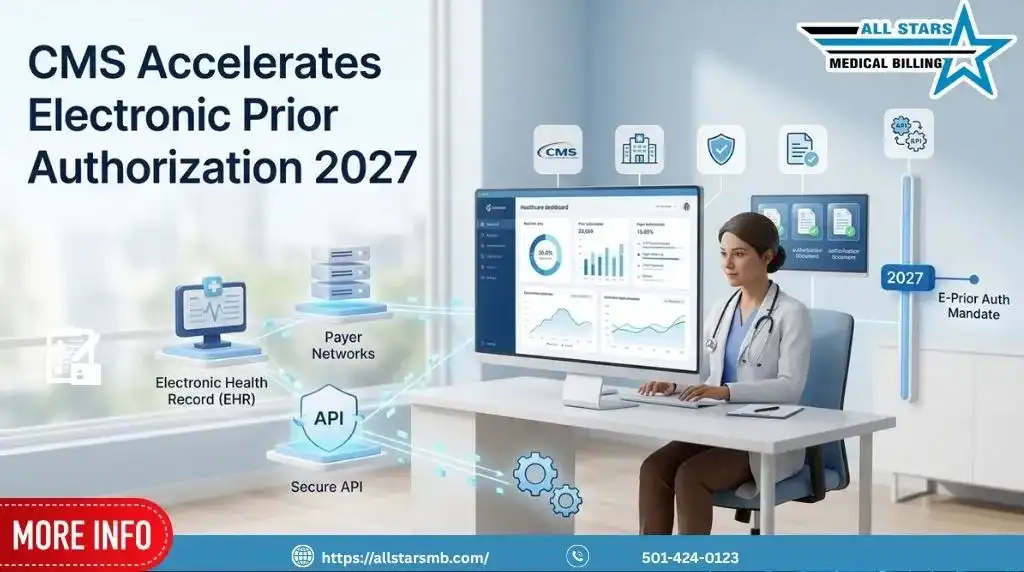
The Centers for Medicare & Medicaid Services (CMS) has identified an initial cohort of nearly 30 healthcare organizations as “Early Adopters” of its new Electronic Prior Authorization Acceleration (EPAA) program. Officially launched on May 14, 2026, through CMS’s Health Tech Ecosystem project, the program brings together health systems, EHR vendors, network partners, and major payers to address the practical challenges involved in moving from today’s fax- and portal-based prior authorization process to a fully electronic, API-driven system. As the healthcare industry prepares for electronic prior authorization 2027, these early adopters will help test and refine the technology and workflows needed for broader implementation.
The EPAA program was announced by CMS Administrator Dr. Mehmet Oz as part of a broader effort to reduce administrative burden across the healthcare system. CMS emphasizes that adopting technology in isolation is not enough; healthcare organizations, payers, technology vendors, and providers need to work together to improve prior authorization workflows and ultimately support faster access to care for patients.
The deadline is approaching. Under the CMS Interoperability and Prior Authorization final rule (CMS-0057-F), applicable payers must make Prior Authorization APIs and related interoperability APIs available by January 1, 2027. The Early Adopters cohort is therefore designed to test real-world implementation challenges before the deadline and help the healthcare industry prepare for the transition to electronic prior authorization 2027.
Who Makes Up the Early Adopter Group
EPAA consists of four groups of participants:
Providers/health systems: AtlantiCare, Bon Secours Mercy Health, Cleveland Clinic, Froedtert ThedaCare, Ochsner Health, Providence, Rush University System for Health, Sanford Health, and Tennessee Oncology.
EHR vendors: athenahealth, eClinicalWorks, Epic, MEDITECH, Modernizing Medicine, Oracle, and TruBridge.
Network partners: b.well Connected Health, CommonWell, eHealth Exchange, and Kno2.
Insurers (through signing the pledge in June 2025): Aetna, Blue Shield of California, Cambia Health Solutions, Cigna, Elevance Health, Highmark Blue Shield, Horizon Blue Cross Blue Shield of New Jersey, Humana, and UnitedHealthcare.
All of these organizations involve numerous physicians and even millions of patients , it is not a small-scale pilot. In fact, CMS has referred to this group as “initial” and believes that there will be more participants in the future.
Latest Developments in Electronic Prior Authorization 2027
A number of significant changes have occurred since the initiative’s launch, especially as the healthcare sector gears up for electronic prior authorization 2027:
- Another provider joined the list of providers following the announcement of the initiative: AtlantiCare is one new provider in addition to the original eight health systems that were announced.
The pledge date for payers has been set as June 2025: While there had been some coverage indicating 2024 as the pledge date, the actual pledge date is June 2025. This change is significant whenever the initiative is referenced elsewhere. - CMS has proposed an expansion of electronic prior authorization to include prescription drugs: The 2026 CMS Interoperability Standards and Prior Authorization for Drugs proposed rule (CMS-0062-P) has proposed to extend the same requirements related to API, timeline, and transparency for prescription drug prior authorizations as per the 2024 final rule. In addition, the proposal requires HHS to implement specific HL7 FHIR standards under the HIPAA’s Administrative Simplification provisions for HIPAA covered entities.
- The requirements in the 2026 timeline have already become effective. From January 1, 2026, payers that are affected by these changes have to make decisions about the prior authorization within 72 hours if the request is urgent and within 7 calendar days if it is not. Payers have to disclose information about the reasons why a patient was denied access to medical procedures and report their prior authorization metrics, which should be disclosed no later than March 31, 2026.
- As for the 2027 deadline, it relates to the API build-out, which means that the implementation of the electronic prior authorization is the main milestone for 2027.
Why CMS Is Doing This Now
There are plenty of studies on the administrative costs of prior authorization. For example, a 2023 AMA survey of physicians found that physicians and their office staff submit an average of 41 prior authorization requests per week, with each request taking about 13 minutes, meaning nine hours a week that could be better spent treating patients.
EPAA is CMS’s attempt at bridging the divide between “the technology exists” and “the technology works inside a clinic’s daily workflow.” That includes figuring out all the unsavory details of getting a prior auth request in the EHR properly transmitted to the payer’s adjudication system, how to keep track of its progress, and how to deal with exceptions and appeals online instead of over the phone.
| Current Manual Process | Electronic Prior Authorization (Target State) |
|---|---|
| ~13 minutes of staff time per request | Automated submission directly through the EHR |
| Phone, fax, or payer portal submission | API-enabled, FHIR-based data exchange |
| Limited visibility into status | Real-time status updates and decisions |
| Inconsistent response timeframes | Defined, regulated decision timeframes |
| Higher denial rates from documentation gaps | Fewer errors through structured, automated data |
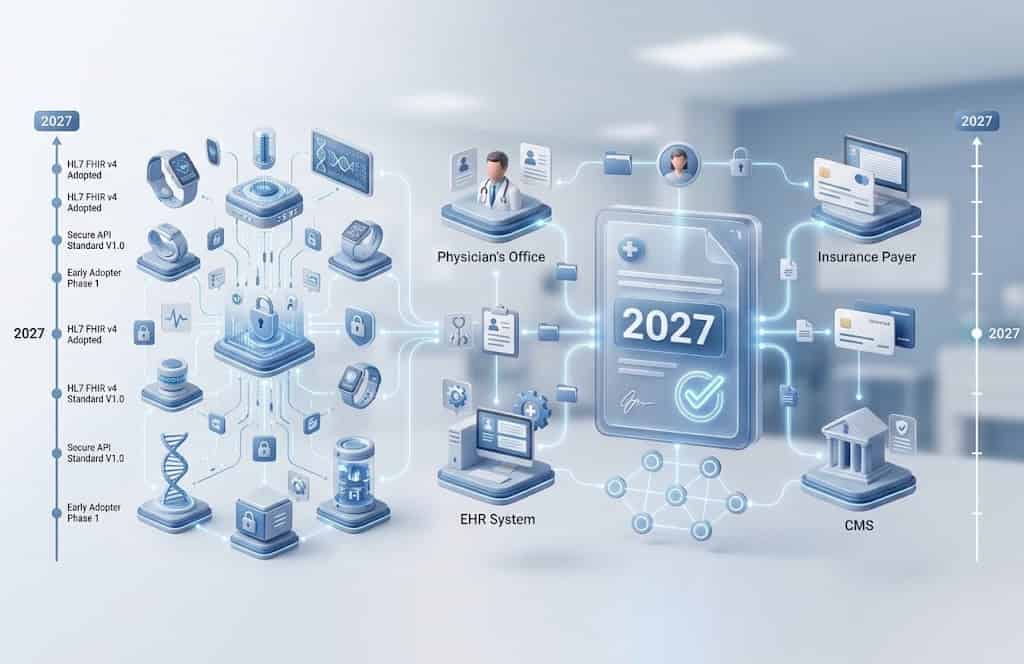
What Electronic Prior Authorization 2027 Means for Providers and Billing Teams
For practices and health systems, the shift to electronic prior authorization 2027 is likely to change daily operational workflows more than overall strategy. Moving prior authorization requests and supporting documentation into electronic, API-driven systems can create several important benefits:
- Fewer denials related to missing or expired authorizations, as requests and supporting documentation can move electronically while authorization status becomes easier to track.
- Shorter time-to-payment, because authorization delays can create bottlenecks between delivering care and receiving reimbursement.
- More efficient use of staff time, with less time spent calling payers or checking multiple portals and more time available for denial management, appeals, and other revenue-cycle tasks that require human judgment.
- Higher impact for specialty practices. Tennessee Oncology’s inclusion is significant because oncology care often involves multiple layers of authorization, including imaging, treatment regimens, and specialty drugs. With electronic prior authorization 2027, streamlined workflows could help reduce administrative delays that may affect treatment timelines.
What You Need Your Practice to Accomplish for Electronic Prior Authorization 2027
As electronic prior authorization 2027 gets closer, your practice should start getting ready now instead of at the time of implementation. Some things you can do include:
- Contacting your EHR provider and asking whether your EHR system is among the seven EHR systems that are early adopters (athenahealth, eClinicalWorks, Epic, MEDITECH, Modernizing Medicine, Oracle, or TruBridge), or has an estimated timeline for implementing a FHIR-based Prior Authorization API.
- Auditing your prior authorization volume now in order to find out what services and/or payers request the most prior authorizations, thus giving your practice a baseline against which to measure improvement once the workflows become electronic.
- Training staff early in advance because your employees, who currently do your prior authorizations, will need to learn how the new electronic workflow works within your EHR system.
- Talk to your payer contacts. For those of you who work with any of the nine payers that took the June 2025 pledge, inquire about the pilot program, implementation plan, and rollout date.
- Seek out professional help when needed. All practices do not have the time and technical capabilities to make a workflow shift amidst the regular process of billing and the revenue cycle. Professional help from billing and technology experts will make it easier for practices to adapt to electronic prior authorization 2027.
What is electronic prior authorization?
It’s the replacement of fax- and portal-based prior authorization with a standardized, API-enabled data exchange between a provider’s EHR and a payer’s system, built on HL7 FHIR standards. It lets a request, its supporting documentation, and the payer’s decision all move electronically instead of manually.
When do CMS’s electronic prior authorization requirements take effect?
The core API requirements including the Prior Authorization API, take effect January 1, 2027, under the CMS Interoperability and Prior Authorization final rule (CMS-0057-F). Separately, shorter decision timeframes, denial-reason requirements, and public metrics reporting for impacted payers have already been in effect since January 1, 2026.
Do providers have to use the Prior Authorization API once it’s live?
Not automatically , the API creates the capability for electronic exchange, and CMS is incentivizing adoption through measures such as the new Electronic Prior Authorization measure in the MIPS Promoting Interoperability performance category. With electronic prior authorization 2027 approaching, it is important to understand that the underlying prior authorization process itself is what the 2027 deadline targets for applicable payers.
CMS isn’t merely developing technical specifications and walking away. It’s developing an operational ecosystem that will allow electronic prior authorization 2027 to work in the clinical/administrative reality before it is mandated. The early adopter group consisting of large health care systems, top EHR vendors, and nine major payers is facilitating the identification and resolution of issues that arise when implementing electronic prior authorization 2027.
Practices which prepare ahead of time , by doing a volume analysis, working with the EHR vendor, and getting ready in advance , will be in a much better position in 2027 compared to those who will get ready only after the deadline is imposed. Early preparation for electronic prior authorization 2027 may help practices adjust their workflows, minimize administrative disruption, and implement electronic prior authorization 2027 smoothly.
Need Help Getting Prior-Authorization Ready?
AllStar Medical Billing helps practices navigate exactly this kind of regulatory transition — from prior authorization workflows to full revenue cycle management. Our team tracks CMS interoperability requirements closely so your practice doesn’t have to, and we work directly with your EHR and payer relationships to reduce denials, speed up reimbursement, and keep your staff focused on patients instead of paperwork.
Contact AllStar Medical Billing today to schedule a compliance readiness review and find out how prepared your practice really is for the 2027 electronic prior authorization deadline.