
Proper management of the finances of a health care practice demands accuracy, efficiency, and consistent monitoring. Professional medical billing services for health care practitioners will make the process of billing easier through correct submission of claims to the insurance companies, tracking payments, and resolving claims that have been denied. Rather than wasting time in administrative duties, physicians can attend to their core responsibility of offering quality health care.
Table of Contents
Why Every Healthcare Practice Requires Professional Medical Billing Services
In today’s complex healthcare environment, managing the billing process has become more challenging than ever. Constant changes in insurance regulations, medical coding standards, payer policies, and healthcare compliance requirements make it difficult for providers to maintain an efficient billing system. Even small mistakes in claim submission, medical coding, or insurance verification can lead to claim denials, delayed reimbursements, increased administrative costs, and lost revenue.
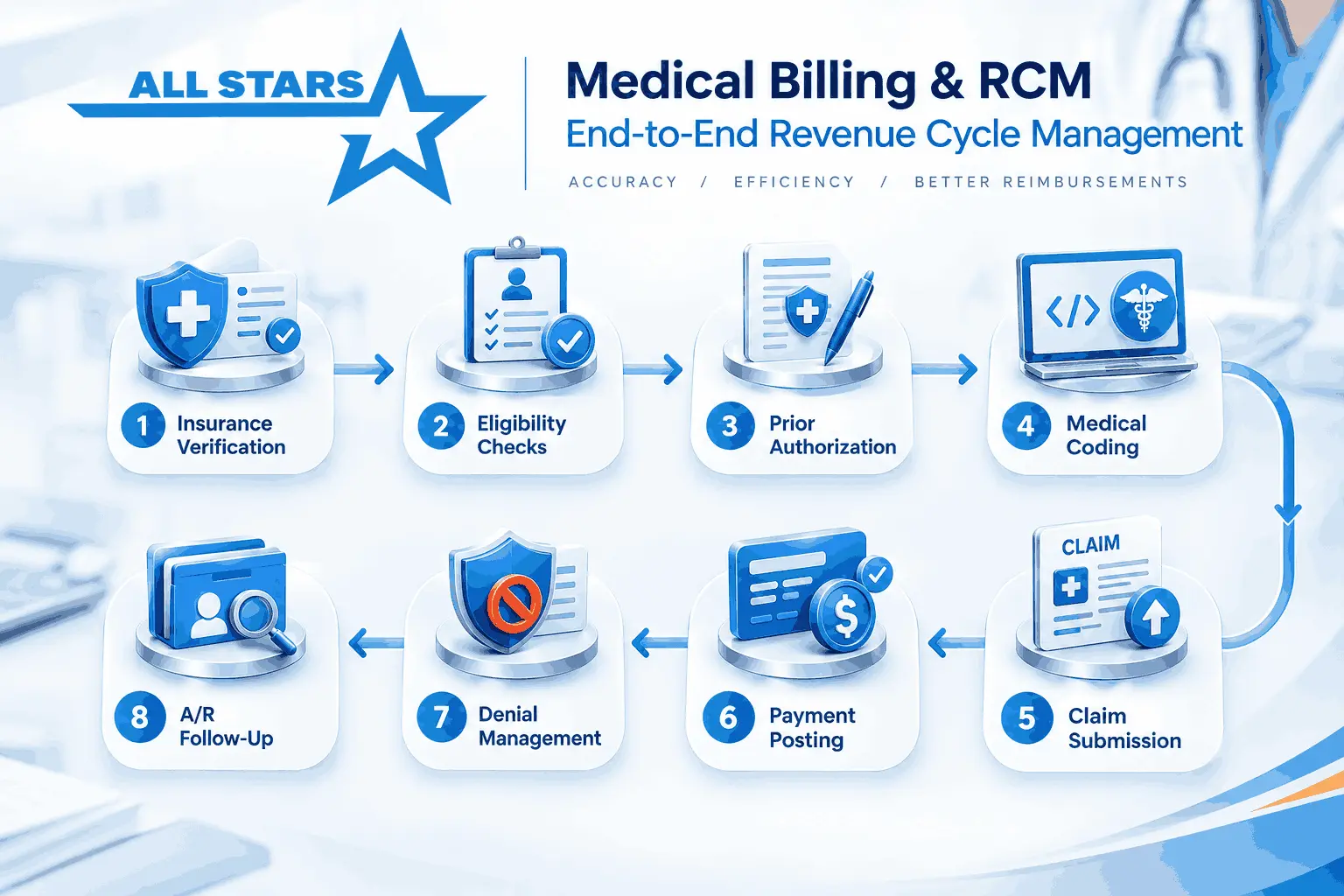
Professional medical billing services for healthcare providers help eliminate these challenges by managing every stage of the billing process with accuracy, compliance, and efficiency. From insurance eligibility verification and medical coding services to electronic claim submission, payment posting, denial management, accounts receivable (AR) follow-up, patient billing, and complete revenue cycle management (RCM), experienced billing specialists ensure that healthcare providers receive timely and accurate reimbursements while maintaining compliance with industry regulations.
Whether you operate a family practice, specialty clinic, hospital, urgent care center, ambulatory surgery center (ASC), behavioral health practice, physical therapy clinic, laboratory, imaging center, or durable medical equipment (DME) company, partnering with a trusted medical billing company can significantly improve your financial performance. Outsourcing professional medical billing and revenue cycle management services reduces administrative burdens, improves claim accuracy, accelerates insurance payments, and allows healthcare providers to focus on delivering exceptional patient care.
Professional medical billing solutions for healthcare practices also provide access to certified billing specialists, advanced billing technology, HIPAA-compliant workflows, and continuous monitoring of insurance claims. This results in fewer billing errors, lower denial rates, improved cash flow, and a more efficient revenue cycle.
Benefits of Professional Medical Billing Services
Healthcare providers who partner with an experienced medical billing company benefit from comprehensive medical billing and revenue cycle management services, including:
- Accurate Medical Claim Submission: Clean, error-free insurance claims improve first-pass claim acceptance rates and reduce costly claim rejections.
- Insurance Eligibility Verification Services: Verify patient insurance coverage before appointments to reduce eligibility-related claim denials.
- Certified Medical Coding Services: Accurate ICD-10-CM, CPT, and HCPCS coding helps maximize reimbursements while ensuring compliance with payer guidelines.
- Faster Insurance Reimbursements: Efficient billing workflows and electronic claim submission help healthcare providers receive payments more quickly.
- Medical Denial Management Services: Identify, correct, appeal, and resubmit denied claims to recover lost revenue and reduce future denials.
- Accounts Receivable (AR) Follow-Up Services: Dedicated AR specialists monitor unpaid claims and follow up with insurance companies to improve collections and reduce aging receivables.
- Complete Revenue Cycle Management (RCM): End-to-end revenue cycle management services for healthcare providers optimize every stage of the billing process, from patient registration to final payment.
- Lower Administrative Costs: Outsourcing medical billing services reduces staffing expenses, software costs, and administrative workload.
- HIPAA-Compliant Medical Billing Services: Secure billing processes help protect patient information while maintaining compliance with federal healthcare regulations.
- Improved Patient Billing Experience: Clear billing statements, transparent communication, and efficient payment processing improve patient satisfaction.
- Greater Healthcare Practice Profitability: Optimized billing operations increase revenue, improve cash flow, and support long-term practice growth.
The Complete Medical Billing Process Explained: A Step-by-Step Guide
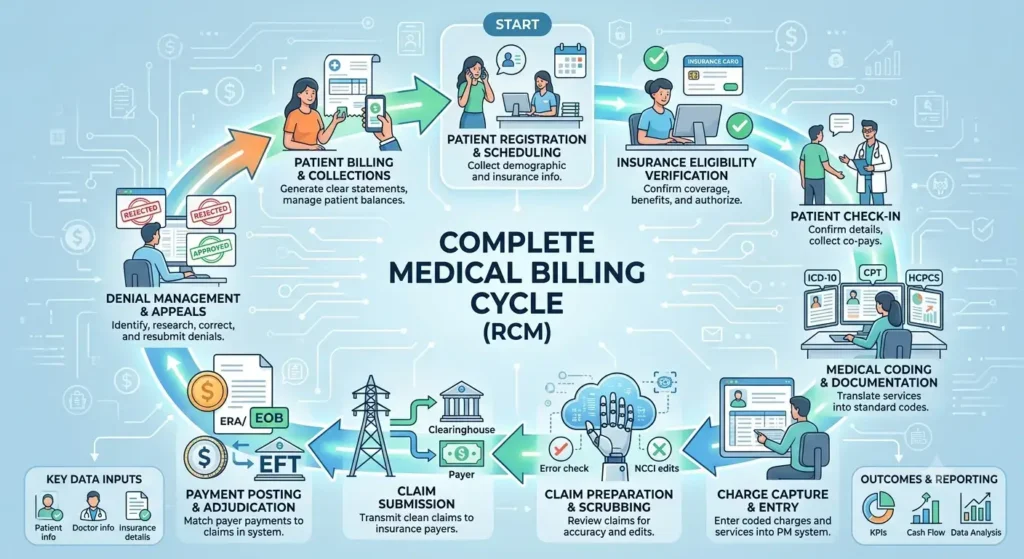
Professional medical billing services involve much more than submitting insurance claims. The complete medical billing process includes multiple steps that ensure healthcare providers receive accurate and timely reimbursements. From patient registration and insurance verification to claim submission, payment posting, and denial management, every stage plays an important role in successful revenue cycle management (RCM).
A reliable medical billing company helps healthcare providers streamline their billing operations, reduce claim denials, improve cash flow, and maximize revenue by managing each step of the billing process accurately and efficiently.
1. Patient Registration and Demographic Data Collection
The first step in the medical billing process is collecting accurate patient information. This includes patient demographics, contact details, insurance information, and medical history.
Proper patient registration helps prevent billing errors, claim rejections, and payment delays. Accurate data entry at the beginning of the process creates a strong foundation for successful insurance claim processing.
2. Insurance Eligibility Verification and Benefits Verification
Before healthcare services are provided, insurance eligibility verification confirms whether a patient’s insurance plan is active and covers the required medical services.
Professional insurance verification services help healthcare providers verify:
- Patient insurance coverage
- Deductibles and copayments
- Benefits and limitations
- Prior authorization requirements
- Coverage restrictions
Accurate eligibility verification reduces claim denials, improves billing accuracy, and helps providers avoid unexpected payment issues.
3. Medical Coding Services
Medical coding is one of the most important steps in healthcare billing. Certified medical coders review clinical documentation and assign accurate ICD-10, CPT, and HCPCS codes for medical procedures, diagnoses, and services provided.
Accurate coding ensures:
- Proper reimbursement from insurance companies
- Compliance with payer guidelines
- Reduced coding errors
- Lower claim denial rates
Professional medical coding services help healthcare practices maintain accurate records while maximizing reimbursement opportunities.
4. Charge Entry and Billing Data Management
During charge entry, medical billing specialists enter patient services, procedures, and related charges into the billing system.
Accurate charge entry ensures that every service performed by healthcare providers is properly documented and billed. Errors during this stage can lead to incorrect claims, underpayments, or delayed reimbursements.
5. Electronic Claim Submission
After coding and charge entry are completed, claims are electronically submitted to insurance companies through secure billing software and electronic data interchange (EDI) systems.
Professional medical claim submission services focus on creating clean claims with accurate patient information, correct codes, and complete documentation.
Effective claim submission helps:
- Increase first-pass claim acceptance rates
- Reduce claim rejections
- Speed up insurance payments
- Improve overall revenue cycle performance
6. Payment Posting and Reimbursement Tracking
Payment posting involves accurately recording payments received from insurance companies and patients.
A professional medical billing service provider ensures that all payments, adjustments, denials, and explanations of benefits (EOBs) are properly documented.
Accurate payment posting helps healthcare providers:
- Track revenue performance
- Identify payment discrepancies
- Maintain accurate financial records
- Monitor reimbursement trends
7. Denial Management and Appeals
Insurance claim denials can negatively impact healthcare revenue if they are not handled properly. Medical billing denial management services focus on identifying the reasons behind denied claims and taking corrective actions.
The denial management process includes:
- Reviewing denied claims
- Identifying billing or coding errors
- Correcting claim information
- Submitting appeals when necessary
- Following up with insurance companies
Effective denial management helps recover lost revenue and improves the financial health of medical practices.
8. Accounts Receivable (AR) Follow-Up Services
Outstanding insurance claims require continuous monitoring and follow-up. Medical billing AR follow-up services help healthcare providers collect unpaid claims and reduce aging accounts receivable.
AR specialists communicate with insurance companies to:
- Check claim status
- Resolve payment delays
- Address outstanding balances
- Accelerate reimbursement
Strong AR management improves cash flow and ensures healthcare providers receive payments faster.
9. Patient Billing and Statement Management
The final step in the medical billing process is patient billing. Patients receive clear statements for any remaining balances after insurance payments are processed.
Professional patient billing services help improve the patient payment experience by providing accurate billing information, easy payment options, and timely communication.
Why Choose Professional Medical Billing Services?
Managing the entire billing process internally can be time-consuming and challenging for healthcare providers. Partnering with an experienced medical billing company allows practices to focus on patient care while experts handle their revenue cycle operations.
Professional medical billing services help healthcare organizations:
- Reduce claim denials
- Improve reimbursement rates
- Increase revenue
- Maintain compliance with healthcare regulations
- Streamline revenue cycle management
- Save administrative time and costs
At AllStars Medical Billing, we provide complete medical billing services tailored to the unique needs of healthcare providers. Our experienced billing professionals understand payer requirements, coding regulations, and revenue cycle management strategies that help maximize reimbursements while reducing claim denials.
Key Performance Indicators (KPIs) in Medical Billing
Successful healthcare organizations monitor important billing metrics to evaluate financial performance and identify opportunities for improvement. These Key Performance Indicators (KPIs) help measure the effectiveness of the revenue cycle.
Important KPIs include:
- First-Pass Claim Acceptance Rate: Measures the percentage of claims accepted on the first submission. A high acceptance rate reflects accurate billing and fewer delays.
- Claim Denial Rate: Tracks the percentage of denied claims. Monitoring denial trends helps practices improve billing processes and reduce revenue loss.
- Days in Accounts Receivable (AR): Indicates how quickly outstanding claims are collected. Lower AR days generally reflect a healthier revenue cycle.
- Net Collection Rate: Measures the percentage of collectible revenue that is actually received. This KPI helps evaluate billing efficiency.
- Clean Claim Rate: Shows the percentage of claims submitted without errors. Clean claims reduce processing delays and improve reimbursement timelines.
Compliance and HIPAA in Medical Billing
Healthcare providers that embrace these innovations can improve billing accuracy, reduce administrative costs, and enhance the patient financial experience.
Compliance is a critical component of every medical billing process. Healthcare organizations must protect patient information while following federal regulations and insurance guidelines.
HIPAA-compliant medical billing includes:
- Protecting patient health information (PHI)
- Secure electronic claim submission
- Controlled access to billing systems
- Regular staff training on privacy requirements
- Data encryption and secure storage
- Compliance with payer documentation standards
Working with a HIPAA-compliant medical billing company reduces the risk of data breaches and regulatory penalties while ensuring patient confidentiality.
The Future of Medical Billing Services
The healthcare industry continues to evolve, and medical billing services are becoming more technology-driven and data-focused. Artificial intelligence (AI), automation, predictive analytics, and cloud-based billing platforms are helping providers improve operational efficiency and financial performance.
Future trends in medical billing include:
- AI-assisted medical coding
- Automated claim scrubbing
- Predictive denial management
- Robotic process automation (RPA)
- Real-time insurance verification
- Advanced revenue cycle analytics
- Improved patient payment solutions
- Greater interoperability between EHR and billing systems
What are medical billing services?
Medical billing services manage the entire billing process for healthcare providers, including insurance verification, medical coding, claim submission, payment posting, denial management, and accounts receivable follow-up.
Why should healthcare providers outsource medical billing?
Outsourcing medical billing helps reduce administrative work, improve claim accuracy, accelerate reimbursements, lower claim denials, and increase overall revenue.
What is Revenue Cycle Management (RCM)?
Revenue Cycle Management is the financial process that manages patient revenue from appointment scheduling through insurance reimbursement and final payment collection.
How does medical coding affect reimbursements?
Accurate medical coding ensures that healthcare providers are reimbursed correctly for services rendered. Incorrect coding can lead to claim denials, audits, and payment delays.
How do medical billing services reduce claim denials?
Professional medical billing specialists verify insurance eligibility, use accurate coding, submit clean claims, monitor claim status, and resolve denied claims promptly, leading to higher reimbursement rates.