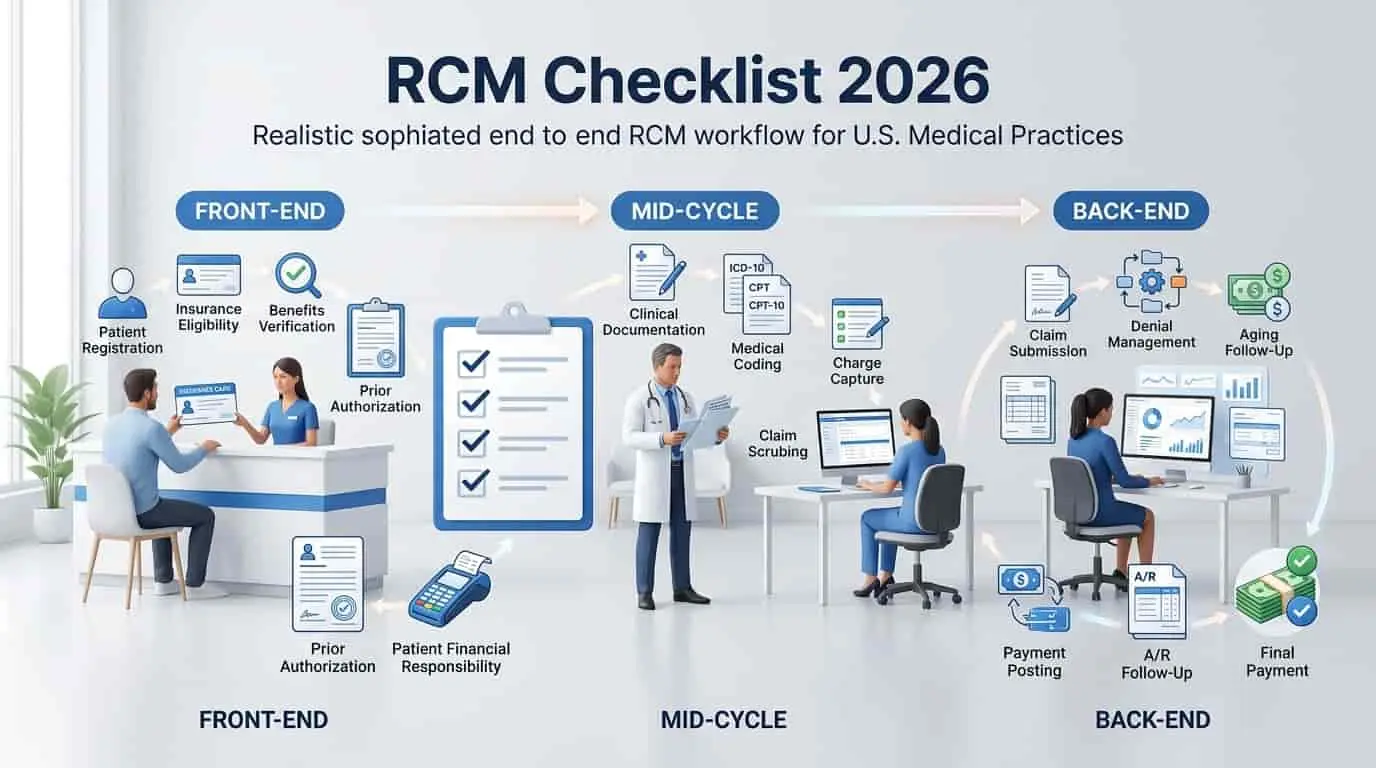

CPT 99214 is among the most vital established patient evaluation and management (E/M) codes used in outpatient medical coding. Being a higher level code than CPT 99213, proper selection of the code is crucial to ensure proper reimbursement to the healthcare provider and also prevent any billing or audit issues.
To report CPT code 99214 accurately in 2026, providers will not only need to document a visit that takes a longer time than those documented for CPT 99213 but also an encounter that meets the criteria of the required MDM or total time if time is being considered for code selection.
The task is not easy for health professionals and coders since there are two extremes in their work — under-billing and over-billing. If a provider underbills his patients, he will lose some money; but, at the same time, if he overbills them without proper documentation, it can lead to claims rejection and audits. Indeed, CPT 99214 was marked by the AMA as one of the codes which is linked to the high improper payment rate due to insufficient documentation or coding errors.
This manual describes how to bill CPT 99214 right in 2026, starting with criteria for level 4 E/M, ending with documentation of MDM, usage of time, typical mistakes in coding and necessary documentation to avoid payer audits. For physicians, coders and billing specialists, this information will be useful for improving coding, decreasing denials and protecting their practice’s revenue.
What Is CPT 99214?
The CPT 99214 is applicable to the office or outpatient E/M encounter of the established patient that satisfies either one of the following two criteria:
- Moderate MDM, or
- 30-39 minutes of total time utilized by the billing physician for the patient on that day
Following the major changes made in 2021 in regard to the E/M guidelines, neither the history nor the exam findings can qualify as the sole basis of coding. The code is determined by MDM or time nothing else.
The Two Paths to CPT 99214
CPT 99214 can be supported through MDM or total time. You only need to meet one path.
| Path | Requirement |
|---|---|
| MDM-Based | Moderate MDM supported by 2 of 3 MDM elements. |
| Time-Based | 30–39 minutes of qualifying total time on the date of service. |
Choose the method that best reflects the work performed and ensure the documentation supports your selection.
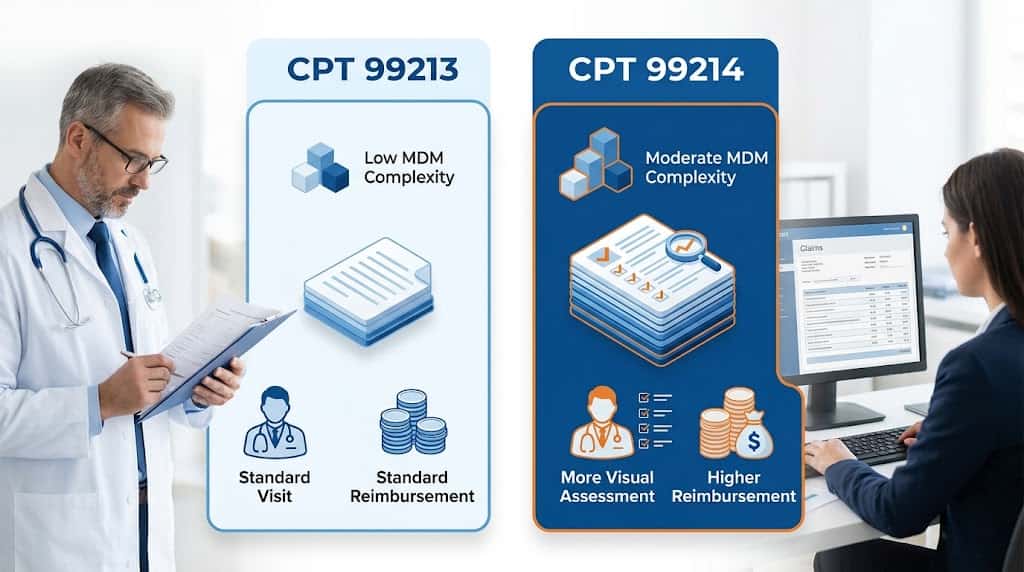
99213 vs. 99214: What’s the Difference?
CPT 99213 and 99214 are both used for established-patient office or outpatient E/M visits. Since the 2021 E/M coding changes, providers select these codes based on medical decision making (MDM) or total time, rather than the number of history or physical exam elements.
| CPT Code | Level | Complexity | Typical Time |
|---|---|---|---|
| 99213 | Level 3 | Low | 20–29 minutes |
| 99214 | Level 4 | Moderate | 30–39 minutes |
The key difference is the level of clinical work and decision-making involved. A 99213 visit generally involves lower-complexity management, while 99214 requires moderate-level MDM or the applicable time requirement.
In simple terms, 99213 is for a lower level of service, while 99214 is used when the encounter requires more complex evaluation and management. The medical record must support whichever code is reported.
Qualifying Through Medical Decision Making
To bill CPT 99214 based on medical decision making (MDM), the documentation must support a moderate level in at least two of the three MDM elements.
| MDM Element | What Moderate MDM Can Include |
|---|---|
| Problems Addressed | Two or more stable chronic conditions, one worsening chronic condition, or a new problem with an uncertain diagnosis. |
| Data Reviewed & Analyzed | Reviewing outside records, ordering or analyzing tests, or using an independent historian. |
| Risk of Complications | Starting or adjusting prescription medications or making management decisions that carry a meaningful level of risk. |
One important point to remember is that having several stable chronic conditions does not automatically make a visit 99214. The documentation should show the level of complexity involved in evaluating or managing the patient. A change in the patient’s condition, additional clinical uncertainty, or a higher-risk management decision may support a higher level of MDM.
Documentation Quick Check
As you’re wrapping up the note, check:
- Have I addressed two or more active issues, or an issue that isn’t behaving the way it should?
- Am I looking at information beyond just a chart (labs, imaging, specialist’s note, etc.)?
- Have I started, stopped, or changed medications, or made a risk-taking decision?
- Do my pre-visit review, visit time, and documentation time equal 30 minutes or more?
A yes to two or more MDM questions, or yes to the time question, typically qualifies for cpt 99214.
Qualification by Time
When billing for time, total time encompasses all activities you have performed yourself for that patient that day:
- Preparation prior to seeing the patient – reviewing previous notes, tests, and/or images
- Patient history and examination
- Discussion of diagnosis and treatment options and risks with the patient
- Medication and test orders
- Coordination with other physicians
- Documenting the encounter later
Documentation for CPT 99214: Two Ways to Make Your Case for Coding
The problem is not the complexity of the visit, but how well you document what occurred during the visit. The right documentation will help prove that you used CPT 99214 correctly and avoid any payer issues or audits.
There are two simple ways you can do this better:
- Relate every problem to your evaluation and management. Instead of saying “continue present treatment,” state your reasoning. For example: “Continue present dose since the A1C level is unchanged; follow-up in three months.”
- Include your rationale for all decisions. If you were considering other diagnoses, treatments, diagnostic studies, or management strategies, make sure to include them in your documentation.
Common Coding Mistakes to Avoid
| Mistake | Why It Happens | Fix |
|---|---|---|
| Defaulting to 99213 out of audit fear | Provider assumes higher codes = higher risk | Use the 4-question test above every visit; bill what’s documented |
| Billing 99214 without supporting notes | Visit felt complex, but note doesn’t show it | Decide MDM vs. time before writing, then document accordingly |
| Vague assessment/plan language | Time pressure, templated notes | One extra sentence per problem linking finding → decision |
| Telehealth denials | Missing modifier, wrong place-of-service code | Keep a payer-specific cheat sheet for modifiers and POS codes |
Billing CPT 99214 Through Telehealth
When the same MDM-or-time criteria are satisfied, 99214 is billable through telehealth when the payer allows it for that code. Specifically:
- For video-based visits, use modifier 95 and POS codes 02 (patient elsewhere) or 10 (patient at home)
- For audio-only visits, there are many payer variances, some require modifier 93, others do not allow audio-only billing of 99214 at all
- Documentation should always specify whether the encounter was audio/video or audio-only to determine the appropriate modifier and POS codes
Because payers differ on how telehealth encounters can be billed more than any other coding area, an internal payer guide what payers require modifier 95, what payers allow modifier 93, what POS code is expected by each payer, would save a lot of headaches.
Modifiers Commonly Paired with CPT 99214 CODE
| Modifier | When to Use |
|---|---|
| 25 | A separately identifiable, medically necessary E/M service was performed the same day as a minor procedure |
| 95 | The visit was delivered via real-time audio-video telehealth |
| 93 | Audio-only telehealth, where the payer specifically allows it |
| 24 | Visit during a post-op period, unrelated to the surgery |
| 57 | The visit resulted in the decision to perform major surgery |
Having Difficulty Coding 99214 Correctly?
The guidelines for coding are consistent in writing, however, each payer interprets documentation slightly differently, all it takes is missing one modifier or one unclear line and your claim becomes denied.
Allstars Medical Billing works with providers to make sure borderline cases are coded correctly by reviewing MDM and time documentation, providing a telehealth guide for each payer, and performing chart audits to prevent undercoding and overcoding.
Schedule a Free 99214 Documentation Review with Allstars Medical Billing →
What’s the minimum time to bill CPT 99214?
30 minutes of total time on the date of service, counting review, the visit itself, orders, and documentation. It caps at 39 minutes; 40+ minutes moves into 99215 territory.
Can I bill 99214 if MDM is only “low”?
Yes, if total time still reaches 30 minutes, time alone justifies 99214 regardless of MDM complexity
Is a full history and exam required for CPT CODE 99214?
No. History and exam should be medically appropriate for the visit, but they don’t independently set the code level , MDM or time does.
Do NPs and PAs bill CPT 99214?
Yes, when the payer allows it and either the MDM or time criteria are met, subject to any supervising-physician requirements the payer imposes.
Is CPT 99214 riskier to bill than CPT 99213?
Not inherently. It’s more heavily audited due to volume and reimbursement gap, but a well-documented, genuinely moderate-complexity visit is not an audit risk, it’s just accurate billing.