
For many patients, the financial side of a medical visit is one of the most stressful parts of the healthcare experience. They arrive at an appointment with little idea of what they’ll owe, and weeks later, a bill arrives that’s nothing like what they expected. For the practice, that same uncertainty often translates into delayed collections, billing disputes, and patient dissatisfaction.
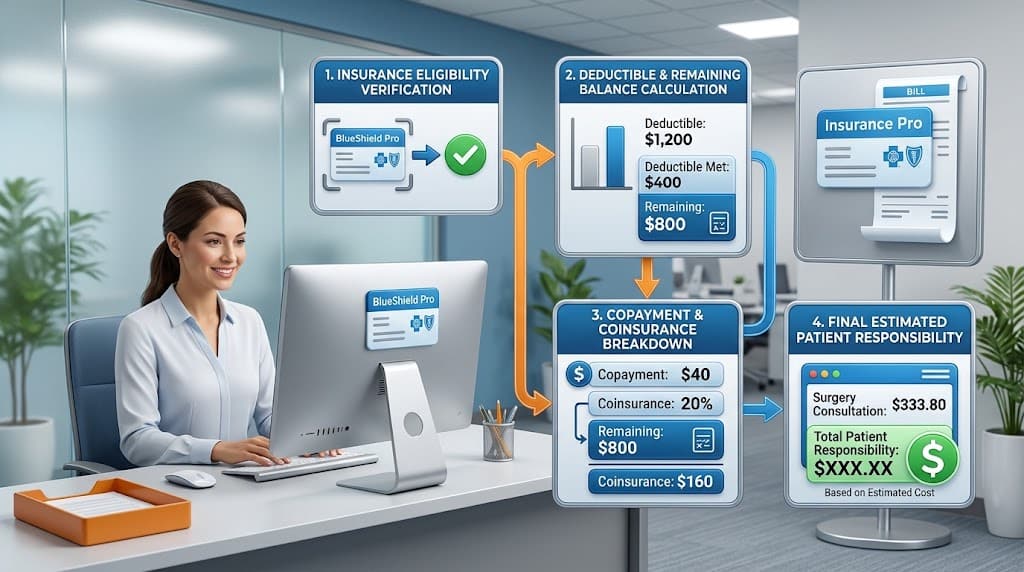
The good news is that most of this confusion is preventable. With the right patient responsibility estimation process in place, a billing team can develop a reasonable estimate of a patient’s financial responsibility before a medical visit even takes place. This doesn’t require guesswork; it requires verifying the patient’s insurance benefits, understanding how the plan’s cost-sharing rules apply to the planned service, and communicating that estimate clearly.
Patient responsibility estimation has become a standard expectation in well-run medical practices. It supports better upfront collections, reduces billing surprises after claim adjudication, and gives patients the financial clarity they need to make informed decisions about their care. This guide walks through the full process, from insurance verification to communicating estimates, so your team can implement it consistently.
What Is Patient Responsibility in Medical Billing?
Patient responsibility refers to the portion of a medical bill that the patient owes after the insurance company has applied its coverage rules and processed the claim. It is not a single fixed number it is the sum of several cost-sharing components that vary by plan, service type, and where the patient is in their benefit year.
Copayments are fixed dollar amounts due at the time of service. A patient’s plan might require a $25 copay for a primary care visit or $50 for a specialist. Copays are generally straightforward, but they vary by plan tier and service type.
Deductibles are the annual amount a patient must pay out of pocket before the insurance plan begins sharing costs. A patient with a $1,500 deductible who has only met $400 of it still owes the next $1,100 before coinsurance kicks in.
Coinsurance is the percentage of an allowed amount that the patient pays after meeting their deductible. A plan with 20% patient coinsurance means the patient pays 20% of the payer’s contracted allowed amount for covered services.
Non-covered services are services the plan explicitly excludes from coverage. These become the patient’s full financial responsibility, billed at the contracted rate (if the provider is in-network) or at billed charges (if out-of-network).
Outstanding balances from prior visits may also factor into a patient’s current responsibility, depending on the practice’s financial policy.
Out-of-pocket maximums cap the total amount a patient pays in a plan year. Once that limit is reached, the insurance plan typically covers 100% of covered services. Knowing whether a patient has met their out-of-pocket maximum can significantly change the estimate.
Why Is It Important to Estimate Patient Costs Before a Medical Visit?
Practices that estimate patient costs before appointments operate differently from those that don’t, and the difference shows up in collections, patient satisfaction, and staff workload.
Financial transparency builds trust. When patients know what to expect before they walk in, the billing conversation becomes far less contentious. There are no surprises, and the practice comes across as organized and professional.
Upfront collection improves. Collecting a copayment at the time of service is standard practice. But when a team can also communicate an estimated balance based on the patient’s deductible status, patients can come prepared to pay more or arrange a payment plan in advance. Collecting at the point of care is consistently more effective than pursuing balances after the fact.
Billing disputes decrease. A significant number of patient billing complaints stem from unexpected charges. Patients who received an estimate beforehand are less likely to dispute a bill that falls close to what they were told.
Patients can make informed decisions. Knowing the estimated cost of a procedure or follow-up visit helps patients make realistic choices about their care, including whether to proceed, schedule differently, or ask about lower-cost alternatives.
Revenue cycle performance improves. When more patient balances are addressed before or at the time of service, practices spend less time on collections, experience fewer write offs, and carry smaller accounts receivable. Patient responsibility estimation is one of the most practical tools a practice has for strengthening its revenue cycle.
How to Estimate Patient Responsibility Before a Medical Visit
Step 1: Verify Patient Insurance Eligibility
Before estimating anything, confirm that the patient’s insurance coverage is active. An eligibility check through the payer’s portal or via an EDI 270/271 transaction will tell you:
- Whether the policy is in force as of the date of service
- The patient’s member ID, group number, and plan type
- The policy effective date and any termination date
- Whether the patient has primary and secondary insurance
If the patient has dual coverage, document both plans so you can apply coordination of benefits (COB) rules correctly. Eligibility should be verified for every visit — insurance coverage can change without notice.
Step 2: Check the Patient’s Deductible Status
Once eligibility is confirmed, pull the patient’s current deductible information from the benefits response. You need two figures: the annual deductible and the amount already met year-to-date.
If a patient has a $2,000 annual deductible and has met $1,400 of it, their remaining deductible is $600. For any covered service with an allowed amount up to $600, the patient would owe that full amount before coinsurance applies. Keep in mind that the benefits response reflects what the payer has processed — recent claims that haven’t yet adjudicated may not be reflected.
Step 3: Verify Copayment Requirements
Check whether the patient’s plan requires a copayment for the type of service being provided. Copayments vary by plan tier and service category:
- Primary care visits typically have a lower copay than specialist visits
- Urgent care, emergency, and mental health visits often have their own copay amounts
- Some plans waive copayments for preventive services
Copays are usually collected at the time of service and are separate from the deductible and coinsurance calculation.
Step 4: Determine Coinsurance
After the deductible has been met, most plans apply coinsurance. If the patient’s plan has 80/20 coinsurance, the insurance pays 80% of the allowed amount and the patient pays 20%.
For example, if the allowed amount for a service is $300 and the patient has already met their deductible, the patient’s estimated coinsurance would be $60 (20% of $300). If the deductible has not yet been fully met, the remaining deductible is applied first, and coinsurance applies only to any portion of the allowed amount beyond what satisfies the deductible.
Step 5: Check Service Coverage and Medical Necessity
Not every service a provider plans to perform is covered by every plan. Before estimating patient costs, confirm:
- Whether the planned service (by CPT or HCPCS code) is a covered benefit under the patient’s plan
- Whether any coverage limitations apply (e.g., a plan that limits physical therapy to 20 visits per year)
- Whether a referral from a primary care provider is required
- Whether prior authorization is needed for the service, and if so, whether it has been obtained
- Whether any applicable diagnosis codes are required to establish medical necessity
Services that require prior authorization but haven’t received it or services that fall outside covered benefits may become the patient’s full financial responsibility.
Step 6: Review Contracted Rates and Allowed Amounts
The allowed amount is the contracted rate that an in-network provider has agreed to accept from a payer and it is the figure that governs cost-sharing calculations, not the billed charge.
If a provider bills $500 for a service but the contracted allowed amount is $280, the patient’s deductible and coinsurance are calculated on $280, not $500. Using billed charges to estimate patient responsibility is one of the most common sources of estimation errors.
For out-of-network services, patients may face higher cost-sharing, and the allowed amount may differ significantly from billed charges.
Step 7: Calculate the Estimated Patient Responsibility
With all of the above information in hand, the billing team can build the estimate. The components remaining deductible, copayment, and coinsurance are applied according to the patient’s specific plan benefits and are not automatically added together.
The general logic is:
- If a copayment applies, note it as a separate fixed amount.
- Apply the remaining deductible to the allowed amount first.
- Apply coinsurance to any portion of the allowed amount that exceeds the remaining deductible.
- Add any non-covered service charges separately.
This estimate should always be presented as an estimate, not a guarantee. Actual patient responsibility is determined after claim adjudication and may differ based on coding, medical necessity review, and final payer processing.
Comparison Table
| Example 1 | Example 2 | Example 3 | |
|---|---|---|---|
| Service Allowed Amount | $120 | $150 | $200 |
| Remaining Deductible | N/A | $100 | $0 |
| Copayment | $30 | $0 | $0 |
| Coinsurance (Patient %) | N/A | 20% of $50 = $10 | 20% of $200 = $40 |
| Estimated Patient Responsibility | $30 | $110 | $40 |
Tools Used for Patient Responsibility Estimation
- Insurance company eligibility portals are web-based platforms that most major payers make available to in-network providers. They allow staff to look up a patient’s active coverage, deductible status, copay amounts, and benefit limitations in real time.
- Electronic eligibility verification (EDI 270/271) is the industry-standard transaction set for automated eligibility inquiries. A practice management system or clearinghouse sends a 270 request to the payer, and the payer responds with a 271 transaction that includes the patient’s benefit details. This process can be batched overnight so that eligibility is verified for all scheduled patients before the workday begins.
- Practice management (PM) systems are the operational backbone of most medical practices. Many PM systems include built-in eligibility verification tools that pull benefit information directly from payers and apply it to the patient’s account, flagging deductible balances, copay requirements, and authorization needs.
- Electronic health record (EHR) systems increasingly include integrated eligibility and cost-estimation features that allow clinical and billing staff to review benefit information alongside the patient’s clinical record.
- Insurance benefits verification tools , offered by some clearinghouses and third-party RCM platforms go beyond eligibility and parse detailed benefits for specific service types, providing a more granular basis for estimation.
- Payer cost-estimation tools are available through select payers and allow providers to enter a specific procedure code and patient benefit information to generate an estimate of the patient’s likely out of pocket cost. Availability varies by payer.
How do you estimate patient responsibility before a medical visit?.
Verify the patient’s insurance eligibility, deductible, copayment, coinsurance, and service coverage. Then calculate the estimated cost using the payer’s allowed amount and the patient’s specific benefit rules.
What information is needed to calculate patient responsibility?
You typically need the patient’s insurance details, remaining deductible, copay, coinsurance percentage, out-of-pocket maximum, planned service, and applicable allowed amount.
Can insurance eligibility verification guarantee the final patient cost?
No. Eligibility verification provides coverage and benefit information, but it does not guarantee claim payment or the final patient responsibility.
Should medical practices collect estimated patient responsibility before an appointment?
Should medical practices collect estimated patient responsibility before an appointment?
Practices may collect applicable copayments and other amounts according to their financial policies and applicable requirements. They should clearly explain that estimates are not final bills.
What is an allowed amount in medical billing?
What is an allowed amount in medical billing?
The allowed amount is the amount an insurance payer recognizes for a covered service. For in-network care, deductible and coinsurance calculations are generally based on this amount rather than the provider’s original billed charge.
Conclusion
Estimating patient responsibility before a medical visit is an important part of effective medical billing and revenue cycle management. By verifying insurance eligibility, reviewing deductibles, copayments, coinsurance, service coverage, and allowed amounts, healthcare practices can give patients a clearer understanding of their expected costs.
A consistent patient responsibility estimation process helps reduce billing confusion, improve upfront collections, and build patient trust. However, every estimate should be communicated as an approximation, not a guarantee, because the final amount depends on the insurance company’s claim processing and benefit rules.
For healthcare providers looking to improve their billing operations, AllStars Medical Billing & IT Services offers medical billing and revenue cycle management support designed to simplify administrative tasks, strengthen payment workflows, and support practice growth. With reliable insurance verification, accurate billing processes, and professional RCM assistance, AllStars helps healthcare practices focus more on patient care while managing their revenue cycle more efficiently.
Implementing a clear pre-visit cost estimation process can create a better financial experience for patients and a more organized, financially healthy practice.