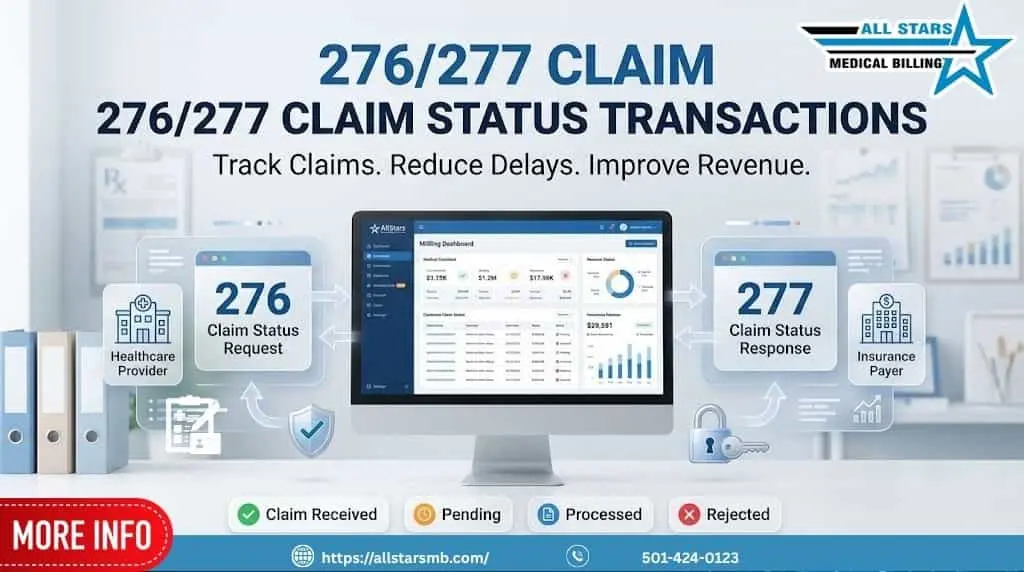
In medical billing, tracking claim progress is essential for maintaining a healthy revenue cycle and ensuring timely reimbursements. 276/277 Claim Status Transactions allow healthcare providers and medical billing teams to electronically check the status of submitted insurance claims and receive updates from payers. The 276 transaction is used to request claim status information, while the 277 transaction is used by the payer to respond with details about the claim’s current status, processing progress, or any issues requiring attention. Understanding how these transactions work helps medical practices identify delayed claims, follow up on pending submissions, reduce administrative workload, and improve revenue cycle management (RCM) efficiency. In this guide, we will explain the 276/277 claim status process, its benefits, common status responses, and best practices for healthcare providers.
What Is the 276/277 Claim Status Transactions?
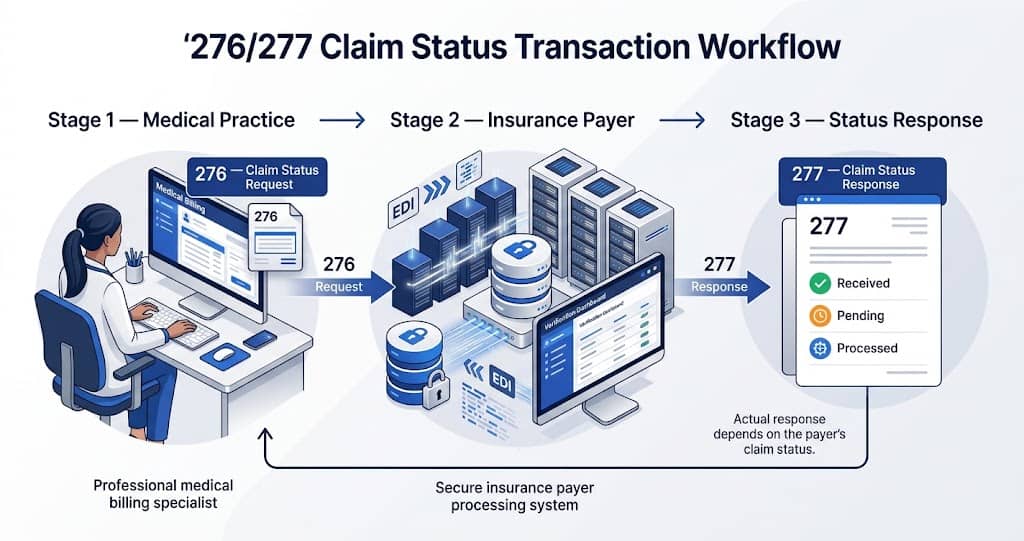
The 276/277 is a pair of electronic messages that let a provider ask a health plan about a claim and receive a standardized answer, without a phone call or a portal login.
- 276 (Health Care Claim Status Request): your practice’s inquiry about a specific claim.
- 277 (Health Care Claim Status Response): the payer’s reply, telling you where the claim stands.
Both are part of the ASC X12 standards adopted under HIPAA, and for the current 5010 generation the claim status guide is identified as 005010X212. In practical terms, your practice management (PM) or EHR system, or your clearinghouse, sends the 276 and receives the 277 back, often in seconds when real-time processing is used.
277 Claim Status vs. 277CA: Don’t Mix Them Up
| Transaction | Purpose | When it happens |
|---|---|---|
| 277 (claim status response) | Answers your 276 inquiry about where a claim is in the payer’s process | After you ask |
| 277CA (claim acknowledgment) | Tells you whether the payer or clearinghouse accepted or rejected the claim file you submitted | Automatically, soon after submission |
The 277CA is your early warning that a claim never made it into adjudication. The 276/277 Claim Status Transactions pair is how you check on a claim afterward.
Why Claim Status Matters to Your Revenue Cycle
- They detect missing or rejected claims. A claim that was never submitted will never be paid, and timely filing windows will continue to run.
- They identify pended claims. If the payer is awaiting some documentation, you can act while the claim has not yet become stale.
- They facilitate denial management. Being aware of a claim’s ultimate denial status enables faster appeals.
- They reduce days in A/R. Fewer claims going undetected results in reduced days in A/R
How a 276/277 Claim Status Transactions Exchange Works, Step by Step
- Claim is submitted through your clearinghouse or directly to the payer.
- Acknowledgments arrive (999 and 277CA) confirming the file and claim were received or rejected.
- Your system sends a 276 with identifying details such as patient, subscriber ID, payer, provider, date of service, and billed amount (and the payer’s claim number if you have it).
- The payer returns a 277 with a category code, a status code, and often dates and amounts.
- Your team acts on it: wait, correct and resubmit, send documentation, or appeal.
How to Read 277 Status Codes
| Category family | What it generally means | Typical next step |
|---|---|---|
| A: Acknowledgment | Claim received, accepted, or returned | Confirm it moved forward; fix and resend if returned |
| P: Pending | Claim is in process or under review | Monitor; respond if the payer needs something |
| F: Finalized | Adjudication complete (paid, denied, or adjusted) | Post payment or start denial follow-up |
| R: Request for more information | Payer needs additional information from you | Send records or corrections quickly |
| E: Error | The inquiry itself could not be processed | Correct the 276 data and resubmit |
| D: Data reporting | Informational status data only | Review and document |
An Important Rule on Codes
HIPAA requires that health plans use only the claim status categories and codes that have been approved by the Code Maintenance Committee for the nation. The CMS has further highlighted that these code tables get revised a few times a year, and there is no place for proprietary codes when it comes to reporting of the claim status in the 276/277 Claim Status Transactions
The Latest Data: Where the Industry Stands
The CAQH Index, the industry’s annual benchmark, offers the clearest picture of how claim status is used today. Here is what the most recent public figures show (figures paraphrased and summarized; see sources below):
- Electronic adoption is strong but not universal. The 2025 CAQH Index reports that fully electronic claim status inquiry adoption in the medical industry reached 81%, up from 74% in the 2023 Index.
- Manual checks are expensive. The 2025 CAQH Index issue brief puts the labor cost of a single manual claim status transaction at about $16.76, up from roughly $15.96 in the 2023 edition.
- A multibillion-dollar opportunity remains. The same brief estimates combined annual savings of about $2.9 billion across the medical and dental industries if claim status moved fully to electronic transactions. The 2024 Index had pointed to roughly $2.8 billion.
- Dental lags behind. The 2024 Index reported dental adoption of electronic claim status at only 28%, compared with 80% for medical plans.
- The bigger picture. The 2025 CAQH Index found more than $20 billion in potential savings across administrative transactions if automation expanded further.
Common Challenges With Claim Status Transactions
- Inconsistent payer responses. Industry groups note that payers vary in how they use status and category codes, so the same situation can read differently from one plan to another.
- Limited detail. A “pending” response may not explain why a claim is pending.
- Authorization requirements. Payers generally require that the requester be authorized to ask about the claim, so enrollment and setup matter.
- PM/EHR limitations. Some systems handle only single real-time requests, while others support batch inquiries. Knowing what your system does is half the battle.
- Mismatched data. A small mismatch in patient ID, date of service, or billed amount can produce an “unable to locate” or error response.
Best Practices for Medical Practices
- Automate status checks at set intervals. Many practices check claims around a defined number of days after submission, then again if still unpaid.
- Work the exceptions, not every claim. Let the system flag pended, rejected, and finalized-denied claims, and focus staff time there.
- Reconcile 277CA rejections daily. A rejected claim is the cheapest problem to fix and the costliest to ignore.
- Keep demographic and payer data clean. Most failed inquiries trace back to bad subscriber IDs or payer mapping.
- Track timely filing deadlines by payer. Status data helps you prove when a claim was submitted and accepted.
- Measure results. Watch days in A/R, first-pass acceptance rate, and denial rate, and see whether claim status automation moves them.
- Train staff to read codes. Even with automation, someone must know what an “R” or “P” response requires.
What is the difference between a 276/277 Claim Status Transactions
The 276 is the request your practice sends to ask about a claim’s status. The 277 is the payer’s response telling you where that claim stands.
Is the 276/277 Claim Status Transactions required by HIPAA?
Yes. The 276/277 is a HIPAA-adopted standard transaction for health care claim status. Covered entities that conduct this transaction electronically must use the standard format and the approved code sets.
What is the difference between a 277 and a 277CA?
A 277 answers your status inquiry. A 277CA is a claim acknowledgment that tells you whether a submitted claim was accepted or rejected at intake. You should review both.
How long should I wait before checking claim status?
There is no single rule. Many practices check at a set interval after submission, and the right timing depends on the payer’s typical turnaround and your contract terms. Check your payer agreements and adjust by payer.
What does a “pending” claim status mean?
A pending response (the “P” category family) means the payer received the claim but has not finished adjudicating it. The specific status code can indicate whether it is in normal processing, under review, or waiting on information.
What should I do when I get a request for additional information?
Respond quickly with the requested records or corrections. Delays can lead to denial or push you past timely filing limits.
Can I check claim status through a payer portal instead?
Yes, portals work, but they are manual, vary by payer, and are slower at scale. Electronic 276/277 Claim Status Transactions exchange can be built into your PM or clearinghouse workflow so it runs more consistently.
Should You Handle 276/277 Claim Status Transactions In-House or Outsource It?
Claim status work is repetitive, deadline-driven, and easy to push aside when the front desk is busy. That is why many practices hand claim follow-up to a specialist billing partner. An experienced team can run status checks consistently, interpret payer-specific responses, correct and resubmit rejected claims, and escalate denials before deadlines pass, freeing your staff to focus on patients.
Let Allstars Medical Billing Handle the Follow-Up
Tired of chasing payers and watching claims age in A/R? Allstars Medical Billing helps U.S. medical practices keep claims moving, from clean submission to proactive claim status follow-up and denial management, so you get paid faster and your team gets its time back.
👉 Visit allstarsmb.com to request a free consultation and see how much revenue is hiding in your unpaid claims.