
Healthcare risk management is the process of identifying, evaluating, and reducing risks that can affect patient safety, regulatory compliance, and the financial health of a medical practice. Risk Management Strategies helps healthcare organizations prevent claim denials, protect patient data, improve Revenue Cycle Management (RCM), and ensure long-term operational success.
Table of Contents
The 2026 Healthcare Risk Landscape
Cyber Risk Has Become a Business Interruption Threat
Healthcare data breaches are escalating at an alarming rate. The sector has experienced more than twice as many breaches in recent years as in previous periods. Ransomware groups are increasingly targeting clinical workflows, recognizing that disruptions to patient care may pressure organizations to pay ransoms. Top Healthcare Risk Management Strategies Every Practice Should Know
Even more concerning, threat actors are now targeting third-party vendors,clearinghouses, EHR platform hosts, and managed service providers. A single point of failure anywhere in the supply chain can leave organizations unable to submit claims, receive reimbursement, or validate insurance coverage.
What this means for your organization:
Cyber risk is no longer an IT issue it’s a revenue cycle issue. Ransomware attacks can freeze billing operations, delay reimbursements for weeks, and erode patient trust. Cyber-resilient revenue cycle operations are non-negotiable.
Workforce Strain and Workplace Violence
The healthcare workforce is under unprecedented pressure. An ongoing shortage of healthcare professionals continues to strain the sector, with a significant percentage of nurses intending to leave or retire within the next five years. Meanwhile, healthcare workers face substantially higher rates of workplace violence injuries compared to private-sector workers overall.
Patient harm data reinforces this picture: harm isn’t driven by isolated failures but by persistent, system-level vulnerabilities, the same fragile processes, cognitive shortcuts, and communication breakdowns that surface year after year.
Nuclear Verdicts and Social Inflation
Social inflation, the rise in large liability awards, continues to pressure the Medical Professional Liability space. Large malpractice verdicts exceeding $10 million are becoming increasingly common, driven by aggressive legal tactics and third-party litigation funding.
Expanded Regulatory Enforcement
Regulatory enforcement activity is expanding across multiple areas of healthcare operations. Health system leaders report that the regulatory environment is moving faster and reaching deeper into core operations than at any point in recent years.
Proactive compliance monitoring and risk analytics are becoming essential tools for staying ahead of a faster-moving regulatory environment.
Common Risks That Threaten Healthcare Revenue
1. Medical Billing Errors & Claim Denials
Billing inaccuracies remain one of the leading causes of delayed payments and denied claims. Common issues include incorrect CPT codes, ICD-10 coding errors, missing documentation, duplicate claims, and eligibility verification mistakes.
Payers are deploying increasingly sophisticated automated denial engines. Batch denials are issued within hours rather than days, and automated down coding and medical necessity reviews are now standard. Reactive denial management is no longer financially viable, providers must shift to denial prevention through front-end accuracy and predictive analytics.
2. Revenue Cycle Inefficiencies
An inefficient Revenue Cycle Management process affects every stage of reimbursement. Common problems include slow payment processing, high Accounts Receivable (AR), poor follow-up procedures, billing backlogs, and inconsistent reporting.
Revenue cycle leaders emphasize that technology will not fix broken workflows. Before investing in new solutions, organizations must do the foundational process engineering work first.
3. HIPAA Compliance Risks
Healthcare organizations must protect patient information and comply with HIPAA regulations. Failure to safeguard sensitive healthcare data may result in regulatory fines, legal consequences, reputation damage and loss of patient trust.
4. Patient Financial Friction
High-deductible health plans have made patients a core revenue stream. Patients expect real-time eligibility verification, cost estimates, and simple digital payment options. Practices that still rely heavily on paper statements are experiencing significantly slower collection cycles than digital-first peers.

Why Healthcare Risk Management Is Essential in 2026
Healthcare organizations that fail to manage operational and financial risks face:
- Increased claim denials
- Delayed reimbursements
- Revenue loss
- Higher administrative costs
- Compliance penalties
- Poor patient satisfaction
- Cash flow disruptions
Healthcare finance leaders emphasize that the most sustainable dollar is the one a provider has already earned but hasn’t yet captured. Protecting earned revenue, preventing avoidable losses, and helping teams work more effectively under pressure are now the pillars of financial sustainability.
Best Practices for Healthcare Risk Management in 2026
1. Strengthen Cyber Resilience
- Evaluate the security posture of all vendors
- Establish incident response plans with clear backup and recovery processes
- Conduct frequent tabletop exercises to prepare for cyberattacks
- Confirm cyber insurance policies include coverage for extortion and incident response
- Review cyber business interruption provisions
2. Shift from Cost Containment to Revenue Integrity
- Shifting energy from back-end cleanup to front-end accuracy
- Verifying patient information, locating all available coverage, and confirming eligibility before a patient arrives
- Preventing errors that drive denials rather than fixing them after submission
3. Leverage Technology Strategically
Technology is moving from buzzword to everyday backbone of revenue cycle operations. By analyzing historical claims, predictive models can recognize patterns that lead to denials and forecast them before a claim leaves your system.
However, industry leaders are clear: never automate a broken process. Before implementing new technology, do the process engineering work first. Once workflows are optimized, technology can deliver measurable results in:
- Denial prediction and prevention
- Coding accuracy for high-volume services
- Claims monitoring and data analytics
4. Build Cross-Functional Collaboration
Regulatory enforcement is pushing health systems toward earlier cross-functional coordination. Organizations should:
- Align compliance, operations, finance, clinical leadership, and governance teams earlier in decision-making
- Build synergy between revenue cycle, managed care, and IT operations to address root causes of denials rather than just reacting to them
- Bring cross-functional leaders together to adjust daily workflows based on key contract provisions
5. Prepare for Regulatory Shifts
Several regulatory changes are reshaping medical billing compliance:
- Financial assistance screening is moving to intake, requiring providers to conduct standardized screening before care is delivered
- Income-based payment plans are becoming baseline requirements in multiple states
- Collections are becoming a last resort with documented prerequisites before escalation
6. Optimize the Workforce
With leaner revenue cycle teams and growing demands, organizations should:
- Sort work by complexity and match tasks to staff by skill and risk
- Cross-train staff to enable coverage and resilience
- Provide certification support, flexible scheduling, and clear career paths to improve retention
- Bring staff into decisions and be transparent about financial and operational goals
How AllStarsMB Supports Healthcare Risk Management
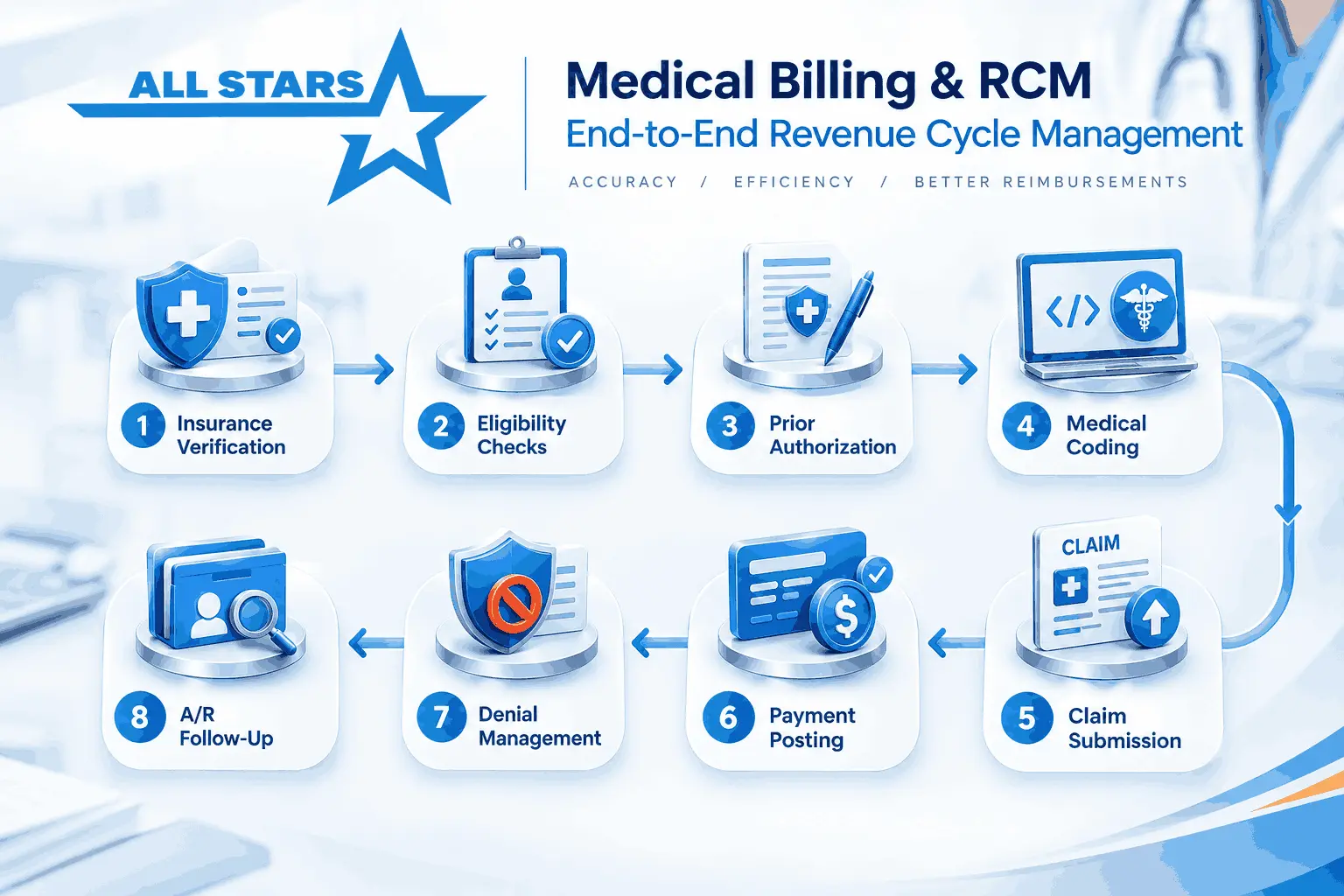
At AllStarsMB, we understand that effective risk management begins with accurate medical billing, clean claim submission, compliance-driven processes, and proactive denial prevention. Our comprehensive medical billing solutions help healthcare providers reduce financial risk while maximizing reimbursement and improving practice performance.
Our Services Include:
- Medical Billing & Coding :Certified coding practices minimize compliance risks while maximizing reimbursement opportunities
- Insurance Verification: Verifying patient insurance before appointments prevents claim rejections and payment delays
- Prior Authorization: Streamlining authorization workflows reduces administrative burden and prevents denials
- Claims Submission: Accurate claims reduce rejection rates and increase first-pass acceptance
- Denial Management: Our team identifies denial trends, resolves rejected claims quickly, and implements strategies to prevent future denials
- Accounts Receivable Management: Consistent follow-up improves collections and reduces outstanding balances
- Revenue Cycle Reporting : Real-time reporting gives providers complete visibility into financial performance and billing efficiency
- Compliance Support : Strong compliance policies and secure billing processes help minimize regulatory risks
Benefits of Partnering with AllStarsMB
Healthcare organizations that work with AllStarsMB experience:
- Higher clean claim rates
- Reduced claim denials
- Faster reimbursements
- Improved cash flow
- Lower administrative costs
- Increased revenue
- Stronger HIPAA compliance
- Better financial reporting
- Greater operational efficiency
- Enhanced patient satisfaction
Conclusion
Healthcare risk management in 2026 extends beyond patient safety, it directly impacts revenue, compliance, and long-term practice success. With cyber threats escalating, payer automation accelerating, and regulatory enforcement expanding, proactive risk management is no longer optional, it is essential for survival.
Ready to improve your Revenue Cycle Management and reduce financial risk? Partner with AllStarsMB for professional medical billing solutions tailored to your practice’s needs. Contact us today to learn how our experienced team can help your healthcare organization increase revenue, reduce claim denials, and improve operational efficiency.