A medical practice can provide excellent patient care and still experience delayed payments when claims are submitted with errors. Incorrect patient information, inactive insurance, missing authorization, coding mistakes, and incomplete claim data can prevent a claim from being processed correctly.
This is why the clean claim rate is an important medical billing metric. It helps healthcare providers understand how often their claims are accepted for processing without requiring corrections or additional information.
A strong clean claim process can help practices reduce avoidable rejections, improve payment timelines, minimize administrative work, and maintain a healthier revenue cycle.
What Is a Clean Claim in Medical Billing?
A clean claim is a medical claim that contains complete and accurate information and can be processed by the payer without requiring corrections, additional information, or manual intervention.
A clean claim generally includes accurate:
- Patient demographics
- Insurance information
- Subscriber details
- Provider information
- Diagnosis codes
- Procedure codes
- Modifiers
- Dates of service
- Place of service
- Authorization information when required
- Required claim documentation
When this information is correct before submission, the claim has a better chance of moving through the payer’s processing system without an avoidable rejection.
What Is Clean Claim Rate?
Clean claim rate measures the percentage of submitted claims that are accepted and processed without requiring correction or rework.
In simple terms, it answers an important question:
How many of the claims we submit are going through correctly the first time?
For example, if a medical practice submits 1,000 claims and 950 are processed without requiring corrections, its clean claim rate would be:
950 ÷ 1,000 × 100 = 95%
The exact definition and calculation can vary between organizations and payers, so practices should use a consistent internal definition when monitoring this KPI.
Why Does Clean Claim Rate Matter?
A low clean claim rate can create problems throughout the revenue cycle.
When claims require correction or are rejected, billing teams may need to:
- Identify the problem
- Research the patient’s account
- Correct the claim
- Resubmit it
- Monitor the payer response
- Follow up if payment is still delayed
This additional work can increase administrative costs and delay reimbursement.
A better clean claim process can help practices:
- Reduce preventable claim rejections
- Minimize billing rework
- Improve claim processing efficiency
- Reduce payment delays
- Support healthier accounts receivable
- Improve staff productivity
- Strengthen overall revenue cycle performance
What Causes Medical Claims to Be Rejected?
Medical claims can be rejected for many reasons. Some problems begin before the claim is ever created.
Incorrect Patient Information
Small demographic errors can cause processing problems.
Common issues include:
- Incorrect spelling of the patient’s name
- Wrong date of birth
- Incorrect member ID
- Incorrect subscriber information
- Missing relationship-to-subscriber information
Patient information should be verified and updated consistently.
Insurance Eligibility Problems
Submitting a claim to an inactive or incorrect insurance plan can result in an avoidable rejection.
Eligibility verification should confirm:
- Coverage status
- Member ID
- Effective dates
- Insurance plan
- Patient responsibility
- Benefits relevant to the planned service
Eligibility should ideally be checked before the service is provided and again when appropriate based on the practice’s workflow.
Missing Prior Authorization
Some procedures, medications, imaging services, and other healthcare services may require prior authorization depending on the payer and plan.
If authorization is required but missing or incorrect, the claim may face processing problems or denial.
That is why authorization should be verified before the service whenever applicable.
Coding Errors
Incorrect or incomplete coding can affect claim processing.
Potential problems include:
- Incorrect CPT codes
- Incorrect ICD-10-CM codes
- Missing modifiers
- Invalid modifiers
- Diagnosis-procedure mismatches
- Incorrect units
- Incorrect place of service
Coding should accurately represent the services documented in the medical record.
Incorrect Provider Information
Claims also depend on accurate provider information.
Problems may include:
- Incorrect NPI
- Incorrect taxonomy
- Incorrect billing provider information
- Incorrect rendering provider information
- Payer enrollment discrepancies
Provider information should remain consistent with payer records.
Claim Formatting and Data Errors
Electronic claims must follow required data and formatting standards.
Errors in required fields or electronic claim data can prevent a payer from accepting the claim for processing.
A strong claim-scrubbing process can identify many of these issues before submission.
What Is the Difference Between a Rejected Claim and a Denied Claim?
A rejected claim is generally a claim that the payer or clearinghouse cannot accept for processing because of an issue with the submitted information or claim format.
A denied claim, on the other hand, is generally a claim that has been processed but the payer has determined that payment will not be made as submitted.
The distinction matters because the follow-up process can be different.
For a rejection, the billing team may need to:
Identify error → Correct claim → Resubmit
For a denial, the workflow may involve:
Review denial reason → Determine responsibility → Correct/appeal when appropriate → Resubmit or follow up
Understanding this difference helps billing teams respond to claim problems more efficiently.
How Can Providers Improve Their Clean Claim Rate?
Improving clean claim performance requires more than fixing claims after they fail. The goal should be to identify preventable problems before submission.
Verify Patient Information
Make demographic verification part of the front-end workflow.
Confirm:
- Patient name
- Date of birth
- Address
- Subscriber information
- Member ID
- Group number
- Relationship to subscriber
Verify Insurance Eligibility
Confirm active coverage and relevant benefits before services are rendered whenever appropriate.
This can help identify coverage problems before they become billing problems.
Check Authorization Requirements
Determine whether the payer requires authorization or referral for the planned service.
Document authorization information accurately and make sure it is associated with the correct patient and service.
Review Coding Before Submission
Claims should be reviewed for coding accuracy and consistency with documentation.
Check:
- CPT codes
- ICD-10-CM codes
- Modifiers
- Units
- Place of service
- Diagnosis linkage
Use Claim Scrubbing
A claim-scrubbing process can identify certain errors before claims are transmitted to the payer.
This can reduce preventable errors and give billing teams an opportunity to correct problems before submission.
Monitor Rejection Patterns
Don’t treat every rejected claim as an isolated incident.
Instead, track rejection reasons.
For example, if a practice repeatedly sees eligibility-related rejections, the problem may be in the front-end verification process rather than the billing team’s claim submission process.
This is where claim data becomes useful for process improvement.
Clean Claim Rate vs. First-Pass Resolution Rate
These two metrics are related but should not automatically be treated as identical.
Clean claim rate focuses on how many claims move through the submission process without requiring correction or rework.
First-pass resolution rate generally looks at how effectively claims are resolved on the initial submission without additional follow-up or resubmission.
A practice should define each metric clearly and use consistent calculation rules when tracking performance over time.
How Does Clean Claim Rate Affect Revenue Cycle Management?
Clean claims are closely connected to the overall revenue cycle.
A simplified relationship looks like this:
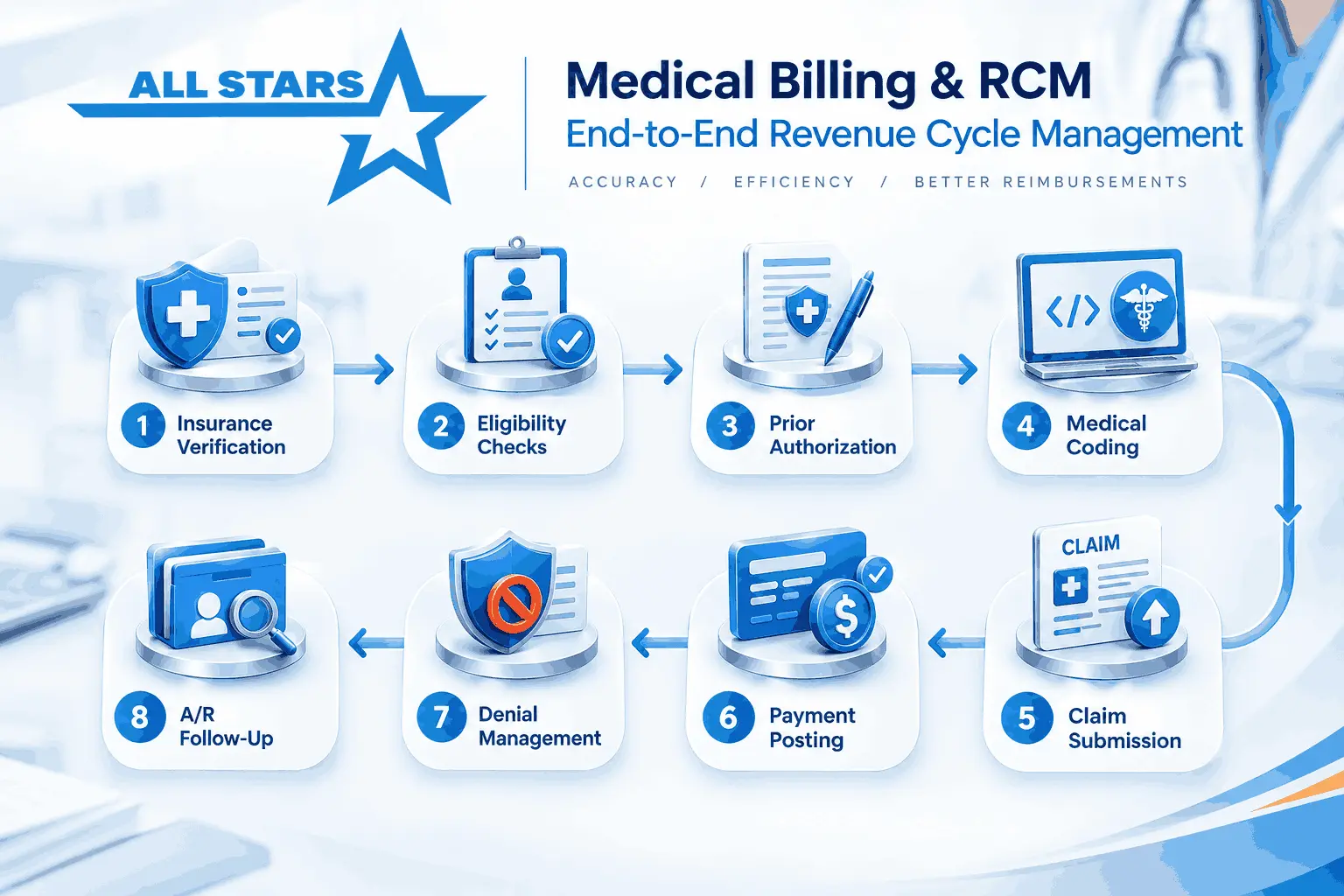
Accurate Registration → Eligibility Verification → Authorization → Accurate Coding → Clean Claim Submission → Payer Processing → Payment Posting → A/R Follow-Up
A problem early in this process can create additional work later.
For example:
Incorrect eligibility information → Claim rejection → Correction → Resubmission → Payment delay → Additional A/R follow-up
Improving the front end of the revenue cycle can therefore reduce avoidable downstream work.
Clean Claim Checklist for Medical Practices
Before submitting a claim, billing teams can review the following:
- Patient demographics are accurate
- Insurance information is verified
- Member ID is correct
- Subscriber information is accurate
- Coverage is active
- Authorization requirements were checked
- Provider information is correct
- NPI information is accurate
- CPT codes are correct
- ICD-10-CM codes are appropriate
- Modifiers are reviewed
- Units are correct
- Place of service is accurate
- Required claim fields are complete
- Supporting documentation is available when required
- Claim has passed applicable billing edits or scrubbing
How Often Should Practices Monitor Clean Claim Rate?
Clean claim performance should be monitored regularly rather than only when revenue problems appear.
Depending on the size and workflow of the practice, billing managers may review the metric weekly or monthly and compare it with previous periods.
More importantly, practices should monitor why claims are not clean.
For example:
| Problem | Possible Process Area |
|---|---|
| Incorrect member ID | Eligibility/registration |
| Missing authorization | Authorization workflow |
| Coding error | Coding |
| Incorrect provider information | Credentialing/enrollment |
| Claim-format issue | Billing/EDI |
| Missing documentation | Clinical documentation/billing workflow |
This approach helps practices move from simply fixing claims to preventing recurring problems.
When Should a Practice Consider Professional Medical Billing Support?
If a practice has frequent claim rejections, growing A/R, repeated billing errors, or limited internal resources for claim follow-up, professional billing support may help strengthen the revenue cycle.
A medical billing partner can support areas such as:
- Insurance eligibility verification
- Prior authorization
- Medical coding
- Claim submission
- Claim follow-up
- Denial management
- Payment posting
- A/R management
- Billing audits
- Revenue cycle analysis
The goal is not simply to submit more claims. It is to create a billing workflow that helps claims move through the revenue cycle accurately and efficiently.
What is a clean claim?
A clean claim is a medical claim submitted with complete and accurate information that can be processed without requiring corrections or additional information.
What is clean claim rate?
Clean claim rate is a metric used to measure the percentage of claims that are processed without requiring correction or rework.
How do you calculate clean claim rate?
Clean Claim Rate = Clean Claims ÷ Total Claims Submitted × 100
Practices should use a clearly defined and consistent methodology when calculating this metric.
What causes a claim to be rejected?
Common causes include incorrect patient information, inactive insurance, incorrect member information, missing authorization, coding errors, provider information problems, and claim data or formatting errors.
What is the difference between a rejected claim and a denied claim?
A rejection generally means the claim could not be accepted for processing because of an issue with the submitted information or format. A denial generally occurs after the claim has been processed and the payer determines that payment will not be made as submitted.
How can a medical practice improve its clean claim rate?
Practices can improve clean claim performance by strengthening registration, eligibility verification, authorization checks, coding accuracy, claim scrubbing, provider data accuracy, and ongoing rejection analysis.
A clean claim rate is more than another number on a medical billing report. It can provide insight into how effectively a practice’s front-end, coding, billing, and claim-submission processes are working together.
The most effective approach is to identify recurring problems before claims are submitted rather than repeatedly correcting the same errors afterward.
By improving patient information, verifying insurance, confirming authorization requirements, reviewing coding, and monitoring rejection patterns, healthcare organizations can create a more consistent billing workflow and reduce avoidable claim rework.
For practices that need additional support, AllStars Medical Billing & IT Services provides medical billing and revenue cycle management solutions designed to help healthcare providers manage the billing process more efficiently.
AllStars — Simplifying Healthcare. Supporting Growth.
Learn more about our medical billing and RCM services at AllStars Medical Billing & IT Services.