
Sending a claim to a payer is only the halfway point. After submission, a claim might sit in a queue, come back denied, get paid at the wrong amount, or stall because the payer needs one more document. Someone has to notice and act. That work is called A/R follow-up.
Accounts receivable (A/R) is the money a practice has earned but not yet collected. A/R follow-up is how a billing team tracks that money down: finding out why a claim hasn’t been paid, fixing whatever went wrong, and pushing it toward payment or a proper resolution.
This guide covers how the process works, the usual reasons claims stall, the steps for recovering unpaid balances, the numbers worth tracking, and when it makes sense to hand the work to an outside team.
What Is A/R Follow-Up?
A/R follow-up is the ongoing review and resolution of unpaid accounts after a service has been delivered and billed. In daily practice, that usually means:
- Checking where a claim stands
- Reading payer responses and remittances
- Working out why a claim was denied or underpaid
- Confirming eligibility and authorization details
- Fixing coding or data errors
- Resubmitting corrected claims or filing appeals
- Chasing patient balances
- Logging every action in the billing system
It is often mistaken for “calling the insurance company,” but the call is just one tool. The real job is investigation. Say a claim was denied: the team has to figure out whether it needs a correction, a reconsideration request, or a formal appeal. If it is simply pending, they need to confirm the payer actually received it.
Why It Matters for Your Practice
Delivering care doesn’t guarantee payment. Claims stall because of wrong patient details, coverage changes, missing authorizations, coding mistakes, incomplete documentation, or slow payers. When nobody owns the follow-up, staff drift toward new claims and older ones quietly age.
A steady follow-up routine helps a practice:
- See its cash position clearly. A current work queue shows what is outstanding and why.
- Act on old claims in time. Recovery gets harder as filing and appeal deadlines approach.
- Avoid unnecessary write-offs. Many claims are collectible once the underlying problem is fixed.
- Spot patterns. If one payer keeps denying the same thing, the real problem is probably upstream.
How the Process Works
1. Start with the aging report
The A/R aging report groups unpaid balances by how long they’ve been open. A common layout looks like this:
| Age of A/R | Typical focus |
|---|---|
| 0–30 days | Monitor; most claims are still processing |
| 31–60 days | Check status and investigate delays |
| 61–90 days | Raise priority |
| 91–120 days | Escalate and review recovery options |
| 120+ days | Urgent review for appeal or other action |
These buckets are internal guidelines, not payer rules. Actual timing should follow each payer’s processing times, filing limits, appeal windows, and your contracts.
2. Find out why the claim is unpaid
Every unpaid claim has a reason, and the reason decides the next step. A claim may be still processing, never received, rejected before review, denied after review, waiting on documents, or blocked by an eligibility, authorization, coding, or coordination-of-benefits problem. It may also be underpaid, or the balance may belong to the patient.
3. Check claim status
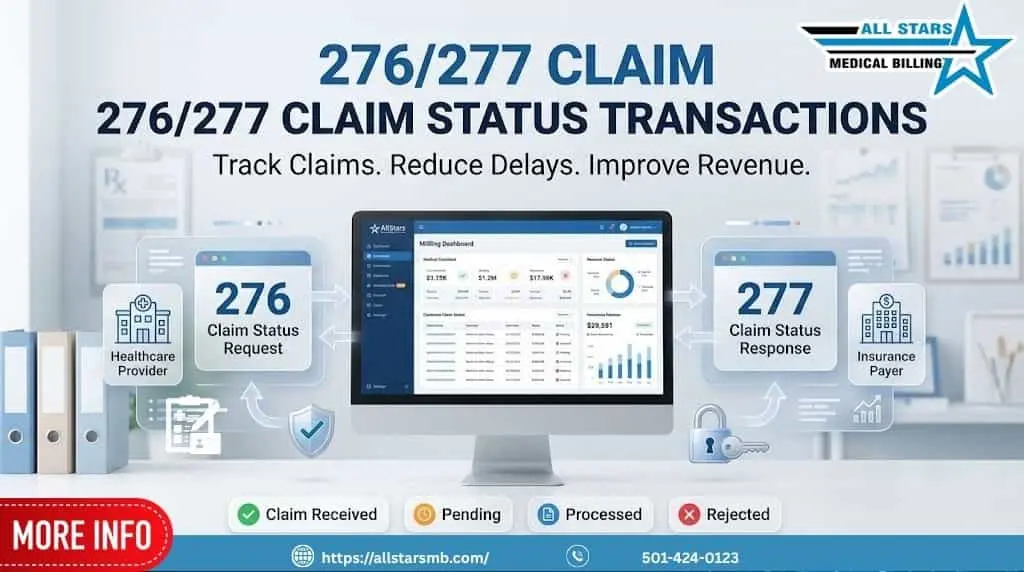
Payer portals and clearinghouse tools are the quickest way to see where a claim is. CMS notes that providers can send an electronic 276 claim status request and get a 277 response, which cuts down on manual inquiries and allows automated workflows. Medicare providers can also use their Medicare Administrative Contractor’s portal.
4. Read the payer’s response
If the claim has been processed, the Electronic Remittance Advice (ERA) explains what happened. It carries Claim Adjustment Reason Codes (CARCs) and Remittance Advice Remark Codes (RARCs). Read them for answers to basic questions: Was the service denied? Was it partly paid? Was the rest moved to the patient? Was the payment cut for contractual reasons?
Common Reasons Claims Go Unpaid
Eligibility problems. Patients change plans, lose coverage, or give outdated details. Re-verify coverage for the date of service, find the correct payer, check for secondary insurance, and correct the claim.
Missing or wrong prior authorization. Some services need approval in advance. If it wasn’t obtained or wasn’t documented properly, the claim usually needs investigation and possibly an appeal.
Coding errors. Wrong CPT, ICD-10-CM, or HCPCS codes, modifier issues, mismatched diagnoses and procedures, wrong units, and NCCI edits can all block payment. Review these carefully instead of resubmitting them blindly.
Missing documentation. Some claims need medical records or supporting forms. The A/R team may need to work with providers, coders, clinical staff, or the records department.
Timely filing. Each payer sets its own deadline. If a claim is questioned as late, look for proof that it was originally submitted on time, such as clearinghouse acceptance reports.
Coordination of benefits. When a patient has two plans, the claim can stall until the payer order is settled or the other payer’s information arrives.
Underpayments. Not every problem is a denial. A claim can be paid at less than the contracted rate. Compare the expected allowed amount with the actual payment, the contractual adjustment, and the remaining balance. Any gap needs a closer look.
How to Recover Unpaid Claims
Prioritize the accounts that matter most
Don’t work claims in random order. Weigh age, dollar amount, filing or appeal deadlines, the payer, the denial reason, and the likelihood of recovery. A large claim close to its appeal deadline should go to the top.
Confirm the payer received the claim
Before spending time on a correction, check the clearinghouse acceptance, transmission record, payer acknowledgement, claim control number, and portal status. A claim that never arrived needs a different fix than one that was denied.
Take useful notes
“Called insurance, claim pending” helps no one. A good note includes the date, payer, representative name or reference number, claim status, reason for the delay, action taken, documents requested, and the next follow-up date.
Fix the actual cause in A/R follow-up
- Wrong modifier: have coding review it, correct it if the record supports it, and send a corrected claim.
- Missing records: gather them and submit through the payer’s required channel.
- Eligibility issue: verify coverage, identify the right payer, and rebill accordingly.
- Underpayment: compare against the contract, document the variance, and request payer review.
Submit corrected claims properly
Follow the payer’s rules on claim frequency codes, attachments, and original claim references, and keep proof of submission.
Appeal when the denial is wrong
Not every denial should become a write-off. Before appealing, review the denial reason, payer policy, contract terms, clinical notes, coding, authorization records, claim history, and the deadline. The strongest appeals tie the documentation directly to the reason the payer gave for denying or reducing payment.
A Simple Example
A primary care practice bills an office visit and, weeks later, sees no payment. The A/R specialist checks the payer portal and confirms the claim was received. The payer says it needs additional information. The specialist identifies what’s missing, gets it from the right internal department, submits it the way the payer instructs, and sets a new follow-up date. When payment arrives, it’s posted and the account is reconciled.
Nothing in that sequence was a random phone call. It was a chain of checks and actions with a clear end point.
A/R Follow-Up vs. Denial Management
The two overlap but aren’t the same. A/R follow-up covers all unresolved receivables, including pending claims, denials, underpayments, and patient balances. Denial management is narrower: it deals with denied or reduced claims, from identifying the reason through correction, appeal, outcome tracking, and prevention. Think of denial management as one part of the larger A/R effort.
Metrics Worth Tracking
Days in A/R. A widely used indicator of how efficiently a practice collects. A simple version is Net A/R divided by average daily net patient revenue. Benchmarks differ by specialty, payer mix, and how the figure is calculated, so compare against your own trend more than a universal target.
A/R aging percentages. Watch how much of your balance sits in each age bucket. A growing share in the older buckets often points to weak submission, follow-up, denial handling, or patient collections.
Denial rate. Denied claims divided by total submitted claims, times 100. Break it down by payer, provider, procedure, and denial reason to see where the trouble is.
Net collection rate. Shows how much of the collectible amount you actually bring in after contractual adjustments. Read it alongside your other numbers, not on its own.
A/R over 90 days. Older balances are harder to recover as deadlines close in, so this figure deserves regular attention.
Best Practices for 2026
- Work A/R on a schedule, not only when cash gets tight. Set regular times for aging review, status checks, denials, appeals, underpayments, and patient balances.
- Use a priority-based work queue. Put large, old, or deadline-sensitive claims first. Recently submitted claims within normal processing time can wait.
- Document every action so a colleague can pick up the account without starting over.
- Track denial patterns. Repeated denials often trace back to scheduling, eligibility, authorization, coding, documentation, charge entry, or claim submission. Fix the source, not just the symptom.
- Keep payer rules current. Filing limits, appeal steps, documentation needs, and correction processes all vary. Your workflow should be standard, but flexible enough for each payer’s rules.
How Technology Helps
- Automated claim status: 276/277 transactions reduce manual lookups.
- ERA: Structured payment data supports automated posting and analysis.
- Dashboards: Give a live view of aging, denials, payments, staff productivity, and payer performance.
- Rule-based work queues: Route accounts by age, balance, payer, denial reason, deadline, or status.
- AI-assisted tools: Can help spot patterns and flag accounts for review, but their suggestions should always be checked against payer rules, coding guidance, and the details of the claim.
When to Consider Outsourcing
Outsourcing may make sense if:
- A/R keeps aging despite your efforts
- Balances over 90 days are growing
- Staff can’t keep up with follow-up volume
- Denials sit unresolved or appeal deadlines get missed
- Underpayments go unnoticed
- Reporting is unclear or inconsistent
- Too much staff time goes into routine status checks
If you go this route, evaluate vendors on specialty experience, reporting quality, data security, compliance practices, system integration, communication, and clearly defined responsibilities.
A/R Follow-Up Checklist
- Review the full aging report
- Flag high-dollar open claims
- Review all 60+ and 90+ day accounts
- Check claims nearing filing or appeal deadlines
- Verify the status of unpaid claims
- Review ERAs and EOBs
- Identify denial reasons
- Correct billing and coding errors
- Send corrected claims where appropriate
- File justified appeals
- Investigate underpayments
- Follow up on patient balances
- Log all payer contacts
- Set the next follow-up date
- Track recovered amounts
- Analyze recurring denials
- Report A/R metrics to management
What is A/R follow-up in medical billing?
It is the process of tracking and resolving unpaid healthcare receivables by checking claim status, investigating denials and delays, correcting errors, contacting payers, and submitting corrections or appeals.
What does an A/R specialist do?
They work open accounts, check claim status, review payer responses, contact insurers, coordinate documentation and corrections, file appeals, and record every step.
How often should claims be followed up?
There’s no universal schedule. It depends on the payer’s processing time, claim age, balance, denial status, and filing and appeal deadlines.
What’s the difference between A/R and A/R follow-up?
A/R is the money owed to the practice. A/R follow-up is the work done to collect it.
Can A/R follow-up reduce denials?
Yes, indirectly. It reveals recurring denial patterns, and fixing their causes upstream can prevent future denials.
What happens if AR follow-up is neglected?
Claims keep aging, deadlines get missed, denials go unresolved, and revenue that could have been collected becomes harder or impossible to recover.
Submitting a claim doesn’t guarantee payment, and every unpaid claim is a problem waiting to be understood. Some just need time. Others need a correction, a document, a call, an appeal, or a closer look at the payment amount.
Good A/R management is about more than checking status again and again. It combines regular aging review, clear notes, payer-specific knowledge, denial analysis, and timely action. The real goal isn’t a shorter report. It’s a dependable process that moves valid receivables to resolution and fixes the causes that created them.
Need help with aging claims or denials? AllStars Medical Billing & IT Services can support your team with more consistent A/R management and a smoother revenue cycle.