Table of Contents
Who Needs Credentialing? The answer is simple: any healthcare professional who wants to treat insured patients and receive reimbursement from insurance companies must complete the provider credentialing process. Healthcare professionals cannot simply start treating insured patients and expect payments from insurance companies. To join insurance networks and become eligible for reimbursement from Medicare, Medicaid, and commercial insurance plans, providers must first complete provider credentialing.
Provider credentialing is one of the most critical administrative processes in the healthcare industry. It helps protect patient safety, verifies professional qualifications, ensures compliance with federal and state regulations, and enables healthcare providers to receive timely reimbursement for the services they deliver.
In this comprehensive guide, you’ll learn who needs provider credentialing, the requirements, benefits, step-by-step credentialing process, common challenges providers face, and how AllStars Medical Billing simplifies credentialing to help healthcare practices get enrolled faster and maximize revenue.
Provider Credentialing Process
Provider credentialing refers to the procedure that involves the verification of credentials of a healthcare provider, such as his/her licenses, education, training, certifications, and background. It becomes necessary to verify the credentials before a healthcare provider joins an insurance network and gets reimbursed by the payers.
Rather than repeating the whole process of provider credentialing in this article, we will focus on answering a practical and more specific question. The following paragraphs will give us a clear idea about Who Needs Provider Credentialing and why.
Who Needs Provider Credentialing?
Any health care professional who wishes to bill insurance companies or join any health care network must be credentialed.
Who is eligible?
- Doctors (MD, DO)
- Nurse Practitioners (NP)
- Physician Assistants (PA)
- Physical Therapists
- Occupational Therapists
- Speech Therapists
- Psychologists
- Psychiatrists
- Licensed Clinical Social Workers
- Mental Health Counselors
- Chiropractors
- Dentists
- Podiatrists
- Optometrists
- Behavioral Health Providers
- Home Health Providers
- Durable Medical Equipment (DME) Providers
- Laboratories
- Imaging Centers
- Surgery Centers
- Telehealth Providers
- Specialty Clinics
- Group Practices
Whether starting a new practice or joining an existing organization, credentialing is usually a mandatory step prior to billing insurance companies.
Why Is Provider Credentialing Important?
Credentialing serves multiple purposes within the healthcare system.
It helps:
- Verify provider qualifications
- Protect patient safety
- Prevent healthcare fraud
- Meet federal and state regulations
- Maintain payer compliance
- Enable insurance reimbursement
- Build patient trust
- Reduce claim denials
Without credentialing, providers may face delayed payments, denied claims, or inability to participate in insurance networks.
Provider Credentialing Requirements
Despite credentialing policies differing between different insurance companies and health care organizations, providers are expected to provide a general list of documents and information to be eligible to enter an insurance network.
Professional License
Providers should have a current and unrestricted license to practice medicine or another type of profession that is issued by the respective authorities of the state.
DEA Registration
Those providers who prescribe controlled substances are expected to have an active registration from the Drug Enforcement Administration (DEA).
Board Certification
If relevant, providers may submit their documentation about having a board certification in a respective medical specialty.
Medical Education
The medical education of the provider, which includes attending medical school, residencies, and fellowships, is verified by insurance companies.
National Provider Identifier (NPI)
It is mandatory for all healthcare providers to possess and maintain an active National Provider Identifier (NPI). The NPI is a unique identifier that is used for billing and administrative purposes.
CAQH Profile
Many commercial insurance companies require the creation and maintenance of an updated Council for Affordable Quality Healthcare (CAQH) profile for providers. A CAQH profile helps in making the process of credentialing and payer enrollment smooth and fast.
Malpractice Insurance
Providers are expected to provide proof of malpractice insurance, which must meet the coverage requirements set by the insurance payers and health organizations.
Work History
The providers should provide an accurate work history, which covers any breaks from work, if any, to avoid delays in the credentialing process.
Hospital Privileges
According to the specialty of the provider and the payer’s requirements, it may be necessary for the provider to produce documents regarding active hospital privileges.
Background Checks
Many health organizations and insurance companies verify their credentialing candidates through background checks that include criminal history, sanction information from the federal or state level, as well as any information in OIG exclusion list databases.
Types of Provider Credentialing
Initial Credentialing
Completed when a provider first enrolls with an insurance payer.
Recredentialing
Most insurance companies require providers to renew credentialing every 2–3 years.
Hospital Credentialing
Hospitals verify providers before granting admitting or surgical privileges.
Facility Credentialing
Healthcare organizations such as:
- Clinics
- Ambulatory Surgery Centers
- Imaging Centers
- Laboratories
must also complete credentialing.
In-Network vs. Out-of-Network Credentialing
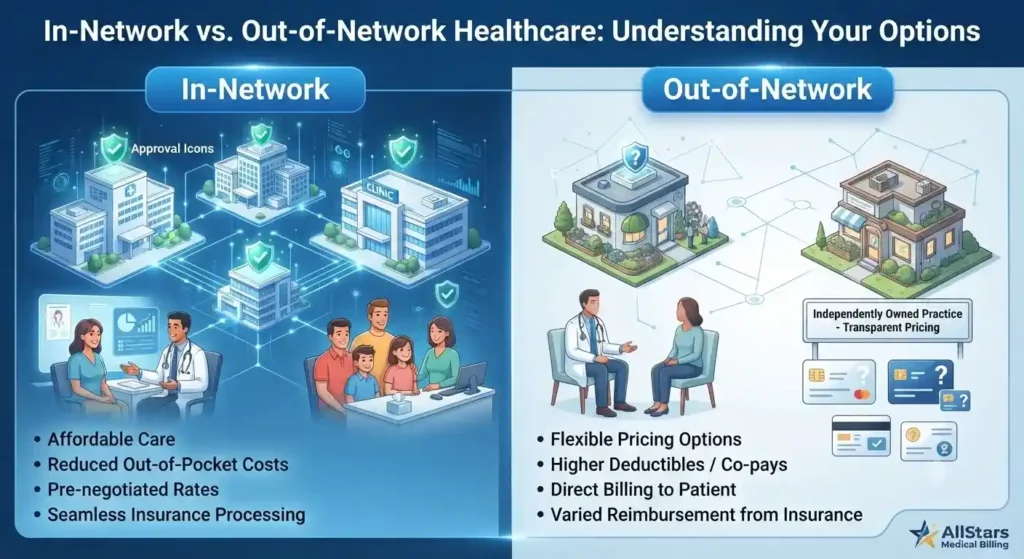
Understanding the difference between in-network and out-of-network credentialing is essential for healthcare providers. Who Needs Provider Credentialing? Any provider who wants to participate in insurance networks, expand patient access, and receive reimbursement from Medicare, Medicaid, or commercial insurance plans should understand these two credentialing options before choosing the best approach for their practice.
In-Network Credentialing
In-network credentialing allows providers to become participating providers with insurance companies. After approval, providers agree to negotiated reimbursement rates and are listed in the payer’s provider directory.
Benefits include:
- Higher patient volume
- Greater insurance coverage for patients
- Lower out-of-pocket costs for patients
- Increased referrals
- More predictable reimbursement
However, providers must comply with payer rules, contracts, and fee schedules.
Out-of-Network Credentialing
Out-of-network providers are not contracted with insurance companies. While they may still treat insured patients, reimbursement rules differ by payer and plan.
Potential advantages include:
- Greater flexibility in setting fees
- No contractual fee schedule obligations
- Increased autonomy over practice operations
Challenges may include:
- Lower reimbursement from some payers
- Higher patient financial responsibility
- More complex billing and collections
- Fewer referrals from insurance networks
Choosing between in-network and out-of-network participation depends on your specialty, patient population, location, and business goals. Many practices begin with in-network participation to expand access and build a stable patient base.
Step-by-Step Provider Credentialing Process
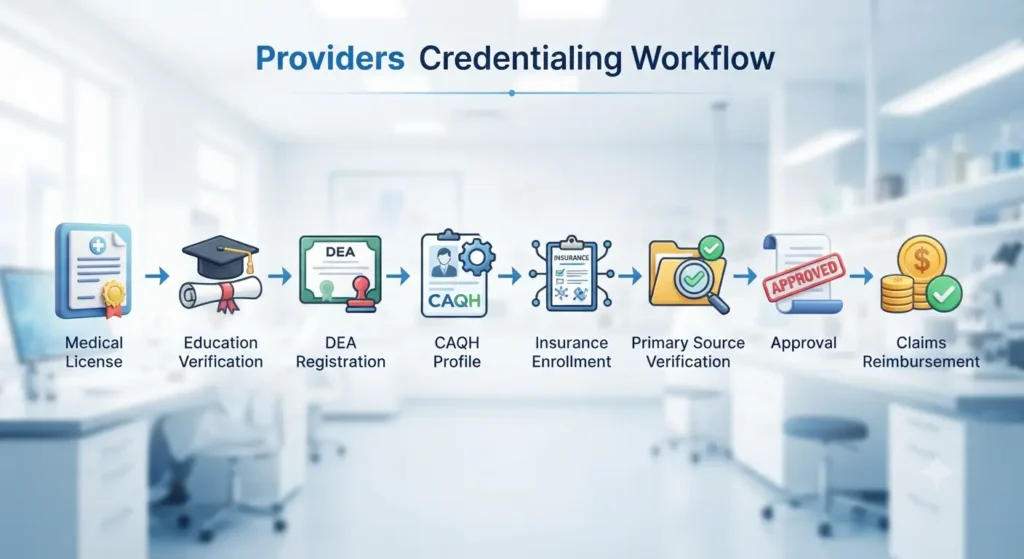
Step 1: Gather Required Documents
Collect all licenses, certifications, insurance documents, and identification.
Step 2: Complete CAQH Profile
Enter accurate provider information and authorize participating payers to access the profile.
Step 3: Submit Enrollment Applications
Apply to Medicare, Medicaid, and commercial insurance companies.
Step 4: Primary Source Verification
Payers verify:
- Licenses
- Education
- Certifications
- DEA registration
- Malpractice history
Step 5: Committee Review
Credentialing committees review the provider’s qualifications.
Step 6: Contract Approval
After approval, providers receive participation agreements.
Step 7: Provider Enrollment
The provider becomes active and can begin billing insurance companies.
Common Credentialing Challenges
Many healthcare providers experience delays due to:
- Incomplete applications
- Missing documentation
- Expired licenses
- Outdated CAQH profiles
- Slow payer responses
- Enrollment errors
- Frequent follow-up requirements
- Recredentialing deadlines
These issues can delay insurance payments and disrupt practice revenue.
Benefits of Professional Credentialing Services
Outsourcing credentialing helps providers avoid administrative burdens and accelerate payer enrollment.
Professional credentialing services can:
- Reduce processing delays
- Improve application accuracy
- Track payer requirements
- Manage CAQH updates
- Monitor renewals
- Handle follow-ups with insurance companies
- Minimize claim denials caused by enrollment issues
- Save valuable staff time
How AllStars Medical Billing Simplifies Provider Credentialing
At AllStars Medical Billing, we provide end-to-end provider credentialing and payer enrollment services designed to help healthcare providers get credentialed faster and maintain compliance.
Our credentialing services include:
- Individual provider credentialing
- Group practice credentialing
- Medicare enrollment
- Medicaid enrollment
- Commercial insurance enrollment
- CAQH profile creation and maintenance
- NPI registration assistance
- PECOS enrollment
- In-network credentialing
- Out-of-network enrollment support
- Recredentialing management
- License and credential monitoring
- Payer follow-up and status tracking
Our experienced credentialing specialists work closely with providers to ensure applications are complete, accurate, and submitted on time, helping practices avoid unnecessary delays and maximize reimbursement opportunities.

Best Practices for Successful Provider Credentialing
A successful provider credentialing process requires careful planning, accurate documentation, and ongoing maintenance. Healthcare providers should begin the credentialing process several months before seeing insured patients, keep their licenses, certifications, and malpractice insurance up to date, maintain an accurate CAQH profile, monitor recredentialing deadlines, and respond promptly to payer requests for additional information to avoid unnecessary delays.
Partnering with an experienced credentialing company like AllStars Medical Billing credentialing services can further simplify the process. Our credentialing specialists manage application preparation, CAQH maintenance, payer enrollment, follow-ups, and recredentialing, helping healthcare providers reduce administrative burdens, avoid costly delays, and become credentialed with Medicare, Medicaid, and commercial insurance payers as efficiently as possible.
How long does provider credentialing take?
Credentialing typically takes 60–180 days, depending on the payer, application completeness, and verification timelines.
Is credentialing required for Medicare?
Yes. Providers must complete Medicare enrollment and credentialing before they can bill Medicare beneficiaries.
What happens if credentialing expires?
Expired credentialing can result in payment interruptions, claim denials, removal from payer networks, and delays in patient care reimbursement.
What is the difference between credentialing and provider enrollment?
Credentialing verifies a provider’s qualifications and eligibility. Provider enrollment is the process of registering the credentialed provider with a payer so claims can be submitted and reimbursed.
Conclusion
Provider credentialing is essential for healthcare professionals who want to participate in insurance networks, comply with payer requirements, and receive timely reimbursement for patient care. While the process can be detailed and time-consuming, maintaining accurate credentials and completing enrollment correctly helps reduce delays, prevent claim denials, and support long-term practice growth.
Whether you’re a new provider, expanding a group practice, or managing multiple specialties, efficient credentialing is a critical part of a successful revenue cycle. AllStars Medical Billing offers comprehensive credentialing, enrollment, and ongoing maintenance services so healthcare providers can focus on delivering quality patient care while we handle the administrative complexities.