
October 1 marks the start of a new fiscal-year code set of ICD-10-CM, thus making it a significant event for all healthcare professionals such as providers, coders, billers, and practice managers. The FY 2026 ICD-10-CM update went into effect on October 1, 2025 and is valid till September 30, 2026. Apart from impacting the choice of codes in documentation, this change will impact the entire process from claim submission to denial management and revenue cycle.
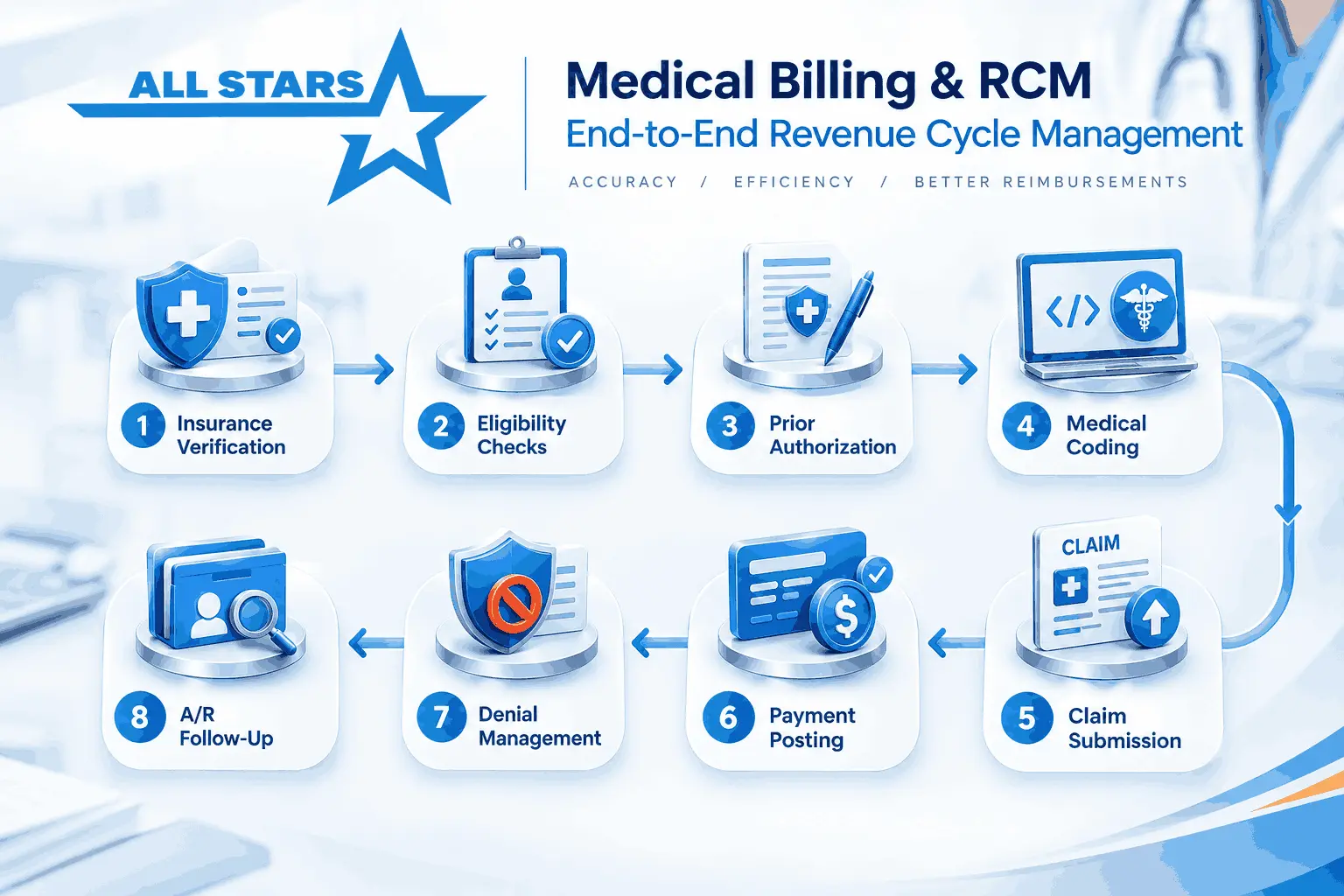
The updates in FY 2026 will provide additional specificity related to chronic ulcers (non-pressure), pain & symptom, diabetes, oncology, HIV, eye & adnexa conditions, and Social Determinants of Health (SDoH). It is likely that practices may have to make necessary amendments in their EHR templates, diagnosis list, billing systems, and claim scrubbing criteria to facilitate the new codes. Proper coding will be beneficial to maintain smooth RCM workflow in the sequence of Provider Documentation → Coding → Claim Submission → Payer Adjudication → Payment or Denial.
Code Set Highlights
The release of the FY 2026 ICD-10-CM code set took place on June 9, 2025, with its effective date to be October 1, 2025. The major statistics:
- 487 new diagnosis codes
- 38 revised code descriptions
- 28 deleted codes
FY 2026 ICD-10-CM Update Statistics
Looking only at these three categories:
| Change Type | Number | Approx. Share |
|---|---|---|
| New codes | 487 | 88.1% |
| Revised codes | 38 | 6.9% |
| Deleted codes | 28 | 5.1% |
| Total | 553 | 100% |
These numbers indicate the spread of the 553 changes that have been added, modified, or deleted. It is not the percentage of growth of the total ICD-10-CM code set.
Healthcare facilities should utilize the official CMS FY 2026 ICD-10-CM files (Code Tables, Tabular List, Alphabetic Index, Addenda, Conversion Tables, and Official Coding Guidelines) in order to validate individual code changes along with the effective dates.
Certain industry sources might indicate a different number of new codes, such as the number of about 614 new codes, depending on what criteria for counting the code set changes they employ. Due to the differences in criteria, medical practices should validate the final number by means of the official CMS data source prior to using this number in internal documents or publications.
One should also differentiate between new codes, modified codes, deleted codes, and other types of changes, such as changes in Excludes Notes and other coding guidelines. These changes do not necessarily mean code modifications.
It is worth discussing the April 1, 2026, update to ICD-10-CM despite there being no additions, deletions, or changes to any diagnosis codes, code titles, etc.
What About the April 1, 2026 Update?
Areas that underwent changes in coding instructions include, but are not limited to:
- Neoplasms
- Blood and immune disorders
- Diabetes and endocrine coding
- Neurology
- Eye
- Cardiovascular
- Respiratory
- Signs and symptoms
- Poisonings and adverse effects coding
- Long-term use of medications coding
For example, some Excludes1 notes were turned into Excludes2 notes. The distinction is significant since, usually, an Excludes1 note means that two codes cannot be coded together, while an Excludes2 note means that the condition mentioned in the Excludes1 note is not part of the coded condition and, thus, can be coded separately if present.
Consequently, this update highlights an important principle: an ICD-10-CM update can affect the billing and coding process despite no changes to the code numbers.
Non-Pressure Chronic Ulcers
Among the areas that have seen the biggest growth in FY 2026 are non-pressure chronic ulcers, specifically site-specific and severity-specific coding.
New codes for this condition include those in the L98.A range for non-pressure chronic ulcers of the upper limb, among others, as follows:
- L98.A11 – Non-pressure chronic ulcer of right upper arm, skin only
- L98.A12 – Non-pressure chronic ulcer of right upper arm, fat layer exposure
- L98.A21 – Non-pressure chronic ulcer of left upper arm, skin only
- L98.A22 – Non-pressure chronic ulcer of left upper arm, fat layer exposure
There are also further codes to differentiate the extent of involvement of tissues, such as necrosis of muscles, necrosis of bones, and other/ unspecified severity.
Documentation Requirements
Providers need to document, where appropriate:
- Specific location of the wound
- Right side, left side, or unspecified side
- Severity/depth
- Tissue involvement
- Necrosis
- Conditions associated
Specialties Most Affected
- Wound care
- Podiatry
- Vascular surgery
- Primary care
- Diabetes care
- General surgery
- Home health
Pain’s and Symptom Codes
This year’s update makes many changes to increase specificity for conditions within the symptom chapter, especially those related to abdominal, pelvic, perineal, flank, and associated pain and tenderness.
Symptom codes added include:
- R10.20 : Pelvic and perineal pain, unspecified side
- R10.21 : Pelvic and perineal pain, right side
- R10.22 : Pelvic and perineal pain, left side
- R10.23 : Pelvic and perineal pain, bilateral
- R10.A0 : Flank pain, unspecified side
- R10.A1: Flank pain, right side
- R10.A2 : Flank pain, left side
- R10.A3: Flank pain, bilateral
- R11.16 : Cannabis hyperemesis syndrome
- The old R10.2: Pelvic and perineal pain was modified to allow for more detailed specificity regarding side.
Requirements for Documentation
- Location
- Laterality
- Type of pain
- Other symptoms
- Diagnosis, if one has been made
Specialties Most Impacted
- Primary care
- Emergency medicine
- Gastroenterology
- Urology
- Gynecology
- Pain management
Type 2 Diabetes, Cannabis Hyperemesis, and Oncology
E11.A for FY 2026 provides code for Type 2 diabetes mellitus without complications in remission, which allows the provider to report remission of the condition more specifically. Remission should be properly documented; “controlled” and “resolved” do not equal remission. In addition, there is now R11.16 for Cannabis hyperemesis syndrome, which allows the proper diagnosis code to be used if the condition is documented. The category codes C18, C50, Z15, and Z85 still reflect the importance of being able to differentiate between active malignancy and history or genetic predisposition to it.
Eye, HIV, and Social Determinants of Health Codes
FY ICD-10-CM 2026 also contains updates pertaining to eye and adnexa, HIV, and SDoH codes. These include H01 for inflamed eyelids, H05 for orbit problems, B20 for HIV disease, and Z21 for asymptomatic HIV infection. Social determinant of health codes like Z59.86 for financial insecurity and Z59.82 for transportation insecurity offer enhanced reporting of the social environment. Documentation of site, laterality, clinical condition, and the exact social determinant of health is crucial for appropriate code assignment and claim submission.
FY 2026 ICD-10-CM Code Examples
For coders and billers looking for a quick reference, the following table highlights selected FY 2026 ICD-10-CM codes that were introduced, expanded, or restructured during the current cycle:
| Code | Description | Billing Consideration |
|---|---|---|
| E11.A | Type 2 diabetes mellitus without complications, in remission | Requires provider documentation of remission. A normal lab result or “well-controlled” wording alone does not establish remission; “resolved” is not synonymous with “in remission.” |
| R10.20 | Pelvic and perineal pain, unspecified side | Use when the documentation does not support a more specific laterality. |
| R10.21 | Pelvic and perineal pain, right side | Requires documentation of right-sided pain. |
| R10.22 | Pelvic and perineal pain, left side | Requires documentation of left-sided pain. |
| R10.23 | Pelvic and perineal pain, bilateral | Requires documentation confirming bilateral involvement. |
| R10.A1 | Flank pain, right side | Requires documented right-sided flank pain. |
| R10.A2 | Flank pain, left side | Requires documented left-sided flank pain. |
| R10.A3 | Flank pain, bilateral | Requires documentation confirming bilateral flank pain. |
| R11.16 | Cannabis hyperemesis syndrome | The diagnosis should be clearly documented, along with any associated conditions required by the applicable coding guidelines. |
| B20 | Human immunodeficiency virus [HIV] disease | Do not use interchangeably with Z21; verify the patient’s documented clinical status. |
| Z21 | Asymptomatic human immunodeficiency virus [HIV] infection status | Represents a different clinical status from B20 and should be assigned according to the documentation and coding guidelines. |
| Z59.861 | Financial insecurity, difficulty paying for utilities | Requires documentation supporting the specific financial hardship. |
| Z59.868 | Other specified financial insecurity | The specific circumstance supporting the code should be documented. |
| Z59.869 | Financial insecurity, unspecified | Use when the documentation does not support a more specific financial-insecurity code. |
| Z59.82 | Transportation insecurity | Requires documentation of the relevant transportation-related barrier. |
Note: Please be advised that this table only includes a sample of ICD-10-CM codes that will be added to the FY 2026 version. Before filing your claim, you should ensure the validity of the code for the particular date of service. You can find the full definition of the code along with all other coding rules in the FY 2026 CMS/CDC Official Files.
The Specificity Trend in ICD-10-CM 2026
The ICD-10-CM FY 2026 update reinforces a long-term movement towards greater diagnostic specificity.
Instead of using a broad unspecified code whenever possible, coders increasingly need to distinguish between:
- Right and left
- Specific and unspecified sites
- Severity levels
- Tissue involvement
- Disease status
- Current disease and personal history
- Specific clinical circumstances
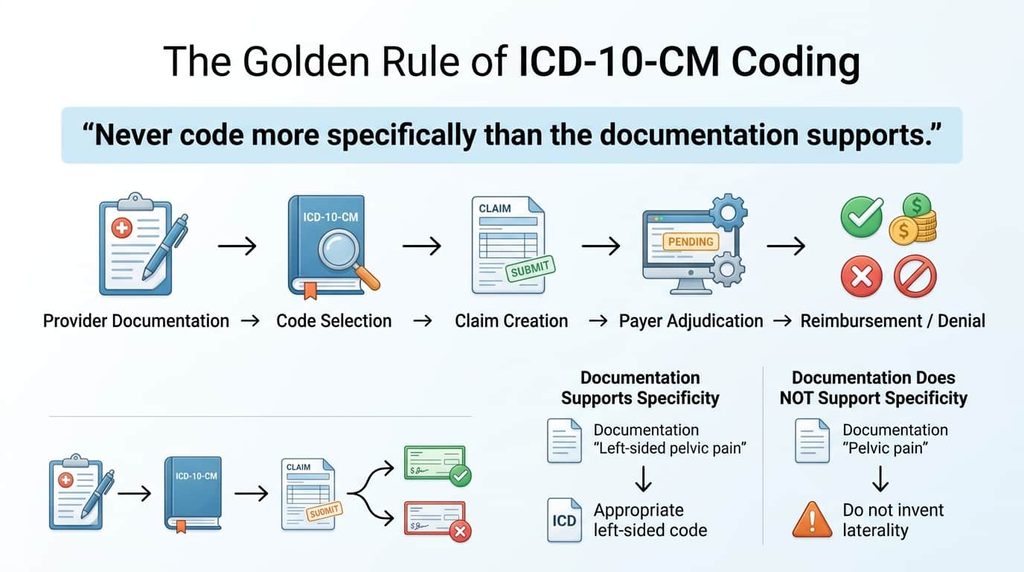
The Golden Rule
Never code more specifically than the documentation supports.
The correct workflow is:
Provider Documentation
↓
Code Selection
↓
Claim Creation
↓
Payer Adjudication
↓
Reimbursement / Denial
A highly specific code is useful only when the medical record supports it.
For example, if the provider documents left-sided pelvic pain, the coder can select a left-sided code when the applicable guidelines support it. But if the provider documents only “pelvic pain,” the coder should not invent laterality.
Impact on Billing and Denials
ICD-10-CM code updates may have an impact on the billing process in many ways. One of the most typical issues is the use of obsolete or inactive codes beyond their effective date. An outdated code cannot be used on dates of service when the code is not active anymore. In order to avoid the problem, practices must check EHR diagnosis favorites, encounter forms, diagnosis pick lists, billing system, claim scrubber rules, and automated diagnosis maps each time there is a new code update.
Missing specificity is another important problem. If a diagnosis needs to include information such as laterality, anatomical location, severity, or clinical status, lack of information may lead to coding corrections, claim edits, and payer review. Moreover, practices must pay attention to EHR mapping issues since obsolete diagnosis shortcuts may still exist despite deletion or replacement of a code. The existence of a code in an EHR does not necessarily mean its validity for all dates of service.
It is equally important for organizations to monitor ICD-10-CM codes through the year, and not just in October 1. There could be instructional changes related to sequencing, excludes notes, code first/also and the ability to code conditions together. In addition, different payers might use their claim edits and medical necessity policies. Therefore, it would be wrong to assume that any claim denial after April 1, 2026 is related to the new ICD-10-CM update and not to the other factors. After a claim denial, organizations should focus on the denial rationale and payer policy, but not on ICD-10-CM update.
Denial Prevention Example
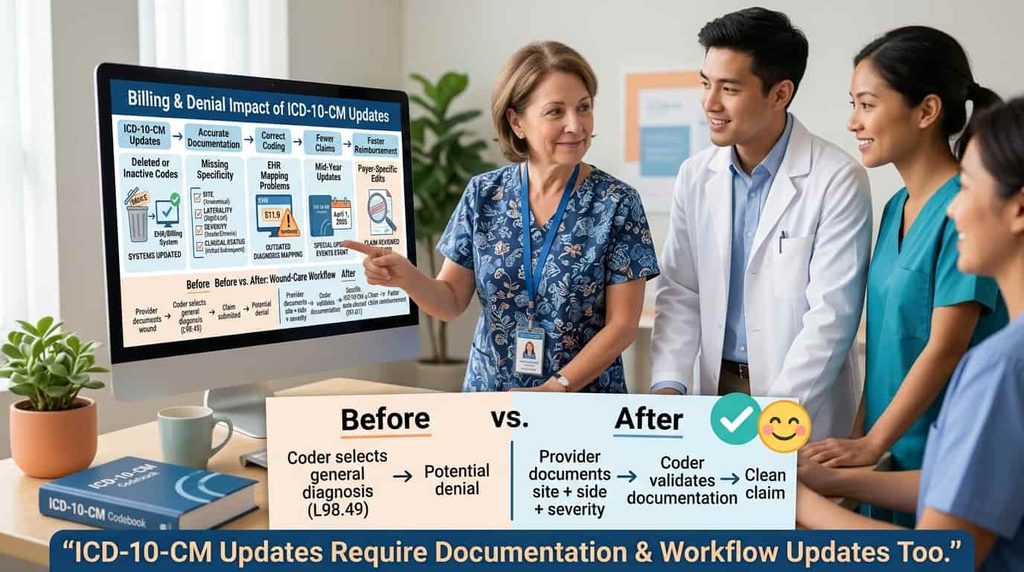
Let us consider the case of a wound care practice, where its EHR template used to record just the general description like “chronic wound.” Before the ICD-10-CM update, the workflow was as follows: Provider documents wound, coder selects diagnosis, claim is submitted. With an increase in specificity and additional requirements to provide the anatomical site, laterality and severity information, this workflow needs to change into the following: Provider documents site + laterality + severity, coder verifies the documentation, diagnosis is selected, claim is submitted. It is necessary to make sure that EHR prompts the provider to provide all this information. Otherwise, coder might be forced to query the provider or choose less specific code supported by the provided documentation.
Example of a Denial Prevention Solution
Take the example of a wound care procedure that utilizes an EHR template that has no site and side description but only general information about the wound.
Previously, before the FY ICD-10-CM 2026 code update, the process may be like:
Provider documents wound → Coder selects diagnosis → Claim submitted
However, with the introduction of a more precise code, the procedure now might be:
Provider documents wound + side + severity → Coding team validates documentation → Diagnosis selection → Claim submission
The implication here is that whenever there is a coding change, there will also be a requirement for changes in documentation workflow as well.
When did the FY 2026 ICD-10-CM update take effect?
The FY 2026 ICD-10-CM was made effective on October 1, 2025. The CMS and CDC also issued an update that will take effect on April 1, 2026, which pertains to the services provided from April 1 through September 30, 2026.
How many new ICD-10-CM codes were there for FY 2026?
There are 487 new codes in addition to those that were revised and deleted.
What is the percentage of the 553 listed codes that are new?
The new codes comprise about 88.1% of the total 553 codes.
Why are the ICD-10-CM codes revised yearly?
Codes are updated in order to incorporate updates in medical terminology, knowledge, classifications, and documentation.
Stop Losing Revenue to Preventable Denials
In-house handling of medical billing and denials is often costly and time-consuming. AllStars Medical Billing offers complete medical billing services to ensure that claims are accurate, payments are fast, and the administrative burden is minimized.