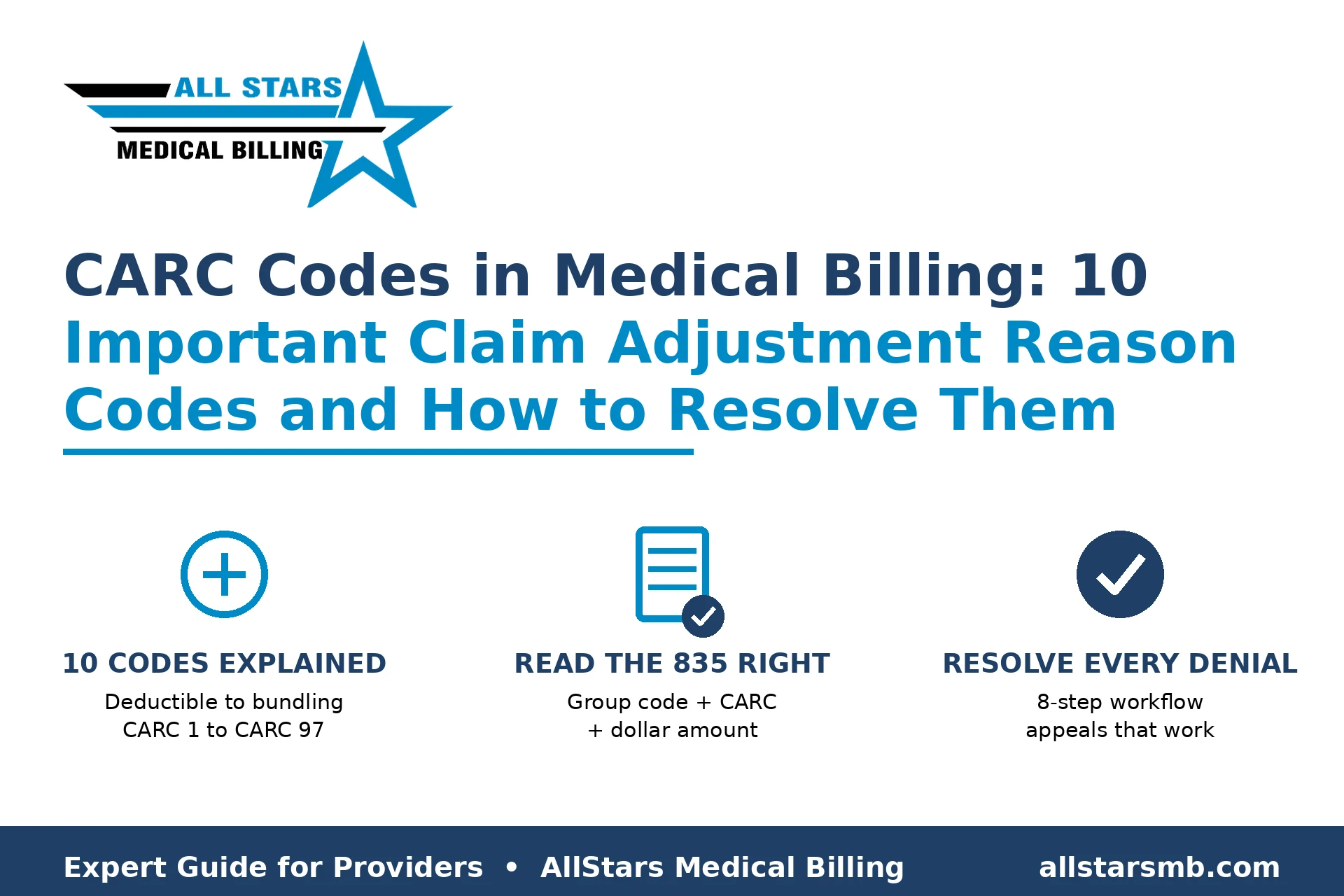
Every time an insurance payer processes a claim, it sends back a detailed explanation of how the payment was calculated. Buried inside that remittance data are small but powerful codes that tell your billing team exactly why a service was paid differently than it was billed. Those codes are called CARC codes, Claim Adjustment Reason Codes, and understanding them is one of the most practical skills a billing team can develop.
CARC codes in medical billing are the standardized language payers use to communicate adjustments. Without knowing how to read them, your team may rebill incorrectly, write off recoverable revenue, or miss trends that are quietly eroding your practice’s income. With the right knowledge, these codes become a roadmap for denial management, clean claim submission, and accurate payment posting.
What Are CARC Codes in Medical Billing?
Claim Adjustment Reason Codes (CARCs) are a standardized set of codes maintained by ASC X12 the organization responsible for the electronic data interchange standards used across U.S. healthcare. X12 updates the official CARC list three times each year, typically on or around March 1, July 1, and November 1.
Each code explains why the amount paid on a claim or service line differs from the amount billed. That difference might reflect a contractual write-off, a patient responsibility amount, a coverage limitation, or an outright denial.
Simple example: A family medicine practice bills $200 for an office visit with a commercial payer. The payer’s contracted rate is $140, so the ERA shows an adjustment of $60 with CARC 45. That $60 is a contractual write-off the practice agreed to accept the lower rate. No action is needed. But if that same ERA also shows $30 going to the patient with CARC 1 (deductible), the billing team needs to generate a patient statement.
One code tells you to write it off. The other tells you to collect from the patient. Getting that distinction right every time is what CARC codes are designed to support.
How Do CARC Codes Work in an 835 ERA?
The 835 Electronic Remittance Advice (ERA) is the HIPAA-standard transaction payers send to explain claim payment. It is transmitted electronically through a clearinghouse to your practice management system, where it can be auto-posted or reviewed manually.
Inside the 835, each claim and each service line can carry one or more adjustments. Each adjustment consists of three pieces working together:
- Claim Adjustment Group Code — Identifies who is financially responsible for the adjustment
- CARC Code — Explains the reason for the adjustment
- Dollar amount — The actual dollars being adjusted
Together, these three elements tell a complete story. A group code of CO (Contractual Obligation) with CARC 45 and $60 means the practice has contractually agreed to accept less than billed. A group code of PR (Patient Responsibility) with CARC 1 and $30 means the patient owes their deductible. A group code of CO with CARC 97 and the full billed amount means the service was denied because it was bundled into another paid procedure.
Understanding how these elements connect is essential for accurate payment posting and reconciliation.
CARC vs. RARC vs. Claim Adjustment Group Codes
These three code types are often confused but serve very different purposes.
| Code Type | Full Name | Purpose | Example |
|---|---|---|---|
| CARC | Claim Adjustment Reason Code | Explains why a payment adjustment occurred | CARC 16 — Claim lacks required information |
| RARC | Remittance Advice Remark Code | Provides additional detail about a CARC adjustment | M51 — Missing/incomplete procedure code |
| Group Code | Claim Adjustment Group Code | Identifies who is financially responsible | CO = Contractual Obligation, PR = Patient Responsibility, OA = Other Adjustment |
RARCs never appear alone, they always accompany a CARC to give billing staff more specific guidance on what to fix. For example, CARC 16 tells you the claim has missing information; the associated RARC M51 tells you the missing element is a procedure code. That combination points you directly to the correction needed.
10 Important CARC Codes Every Medical Biller Should Understand
CARC 1: Deductible Amount
Official Description: Deductible Amount
What it means: The patient has not yet met their annual deductible, and the payer is applying some or all of the allowed amount toward it.
Example: A patient’s $1,500 annual deductible has not been met. A claim for a specialist visit with an allowed amount of $180 is applied entirely to the deductible. The ERA shows CARC 1 under the PR group code for $180.
Why it occurs: Payers apply deductible amounts per the patient’s benefit plan. This is an expected, non-disputable adjustment.
Recommended action: Generate a patient statement or submit to a secondary insurer if one exists. No payer appeal is appropriate — this is a patient responsibility. Confirm the patient’s deductible status was verified before the visit using your eligibility and benefit verification process.
CARC 2: Coinsurance Amount
Official Description: Coinsurance Amount
What it means: The patient is responsible for their coinsurance percentage after the deductible and payer’s payment have been applied.
Example: After meeting their deductible, a patient with a 20% coinsurance plan owes $28 on a $140 allowed amount. The ERA shows CARC 2 under PR for $28.
Why it occurs: This is a standard patient cost-sharing mechanism under most commercial and Medicare plans.
Recommended action: Bill the patient for the coinsurance amount. If a secondary insurer exists, file the secondary claim with the primary EOB. No payer dispute is warranted.
CARC 4: The Procedure Code Is Inconsistent with the Modifier or a Required Modifier Is Missing
Official Description: The procedure code is inconsistent with the modifier used or a required modifier is missing.
What it means: The service was billed with either the wrong modifier or without a modifier that the payer requires to process the claim.
Example: A dermatology practice bills a destruction procedure without the required laterality modifier. The payer returns CARC 4 and denies the claim.
Why it occurs: Modifier requirements vary by payer and procedure. Commonly missed modifiers include 25 (significant, separately identifiable E/M on the same day as a procedure), 59 (distinct procedural service), and bilateral procedure modifiers.
Recommended action: Review the denied service line, identify the correct modifier based on payer guidelines or CPT rules, correct the claim, and resubmit. This is a correctable billing error, not a clinical denial, and does not require an appeal.
CARC 16: Claim/Service Lacks Information or Has Submission/Billing Error(s)
Official Description: Claim/service lacks information or has submission/billing error(s). At least one Remark Code must be provided (may be comprised of either the NCPDP Reject Reason Code, or Remittance Advice Remark Code that is not an ALERT.)
What it means: The claim is missing required data elements or contains errors that prevented adjudication. The accompanying RARC tells you exactly what is missing.
Example: A claim is submitted without the referring provider’s NPI number. CARC 16 is returned with RARC MA61, indicating a missing or invalid referral number or authorization.
Why it occurs: This is consistently one of the most frequently encountered denial codes across Medicare and commercial payers. It covers everything from missing modifiers to incorrect patient demographics, absent NPI numbers, and incomplete diagnosis coding.
Recommended action: Always read the RARC paired with CARC 16 — the CARC alone does not tell you what to fix. Correct the specific element identified, verify claim data against the patient’s insurance card and eligibility, and resubmit as a corrected claim.
CARC 18: Exact Duplicate Claim/Service
Official Description: Exact duplicate claim/service (use only with Group Code OA except where state workers’ compensation regulations require CO).
What it means: The payer has already received and adjudicated an identical claim for the same patient, service date, procedure code, and number of units.
Example: A claim for a physical therapy session on a specific date is submitted twice. The second submission returns CARC 18 under OA.
Why it occurs: This often happens when billing teams resubmit too quickly after the initial submission, or when claims are batched and accidentally duplicated.
Recommended action: Pull the original claim from your practice management system to confirm it was paid, denied, or is still pending. If the original was paid correctly, no action is needed — write off the duplicate adjustment. If the original was denied and you submitted a corrected claim, make sure it was submitted as a corrected claim (frequency code 7 on CMS-1500) rather than a new claim, which would trigger CARC 18 again. Allow at least 14–21 business days before resubmitting any claim.
CARC 22: This Care May Be Covered by Another Payer per Coordination of Benefits
Official Description: This care may be covered by another payer per coordination of benefits.
What it means: The payer believes another insurance plan may be primary and is requesting coordination of benefits (COB) information before processing.
Example: A patient carries both Medicare and a commercial plan. The commercial payer returns CARC 22 because it believes Medicare should pay first.
Why it occurs: COB order issues arise when payer records show a patient as having other coverage, the birthday rule applies in family plans, or the patient recently changed insurance and records have not been updated.
Recommended action: Verify the patient’s insurance priority order, obtain a copy of the other payer’s EOB if applicable, and resubmit the claim with the appropriate COB information. This situation is covered in detail in the AllStars guide to Coordination of Benefits in Medical Billing.
CARC 29: The Time Limit for Filing Has Expired
Official Description: The time limit for filing has expired.
What it means: The claim was submitted after the payer’s timely filing deadline and will not be processed.
Example: A commercial payer requires claims to be filed within 90 days of the date of service. A claim submitted on day 95 returns CARC 29.
Why it occurs: Timely filing denials result from delayed billing, lost claim tracking, slow clearinghouse transmission, or failure to verify the payer’s deadline before submitting.
Recommended action: Gather documentation proving the original claim was submitted within the filing window — clearinghouse reports, rejection notices, or payer acknowledgment records. Submit an appeal with that proof. If the original claim was never sent, review your practice’s claim tracking process. CARC 29 denials without proof of timely submission are rarely recoverable.
CARC 45: Charge Exceeds Fee Schedule/Maximum Allowable or Contracted/Legislated Fee Arrangement
Official Description: Charge exceeds fee schedule/maximum allowable or contracted/legislated fee arrangement.
What it means: The billed amount exceeds what the payer is contractually or legislatively obligated to pay. The difference is a contractual write-off.
Example: A primary care physician bills $275 for a 99214 office visit. The contracted rate with the payer is $160. CARC 45 appears under CO for the $115 difference.
Why it occurs: This is one of the most common and expected adjustments in medical billing. It reflects the discount a provider agreed to accept as part of their payer contract.
Recommended action: In most cases, no action is needed — the write-off is contractually required. However, if the payment appears significantly lower than the expected contracted rate, verify the claim was processed under the correct fee schedule and check for a possible underpayment. CARC 45 combined with unusual payment amounts may indicate contract compliance issues worth investigating.
CARC 50: These Are Non-Covered Services Because This Is Not Deemed a Medical Necessity by the Payer
Official Description: These are non-covered services because this is not deemed a ‘medical necessity’ by the payer.
What it means: The payer determined that the service does not meet their criteria for medical necessity based on the diagnosis, procedure, or lack of supporting documentation.
Example: A patient undergoes an MRI of the knee. The payer returns CARC 50 because the submitted diagnosis does not support the imaging study under their local coverage determination.
Why it occurs: Medical necessity denials occur when diagnosis codes do not support the procedure billed, documentation does not meet payer criteria, or prior authorization was required but not obtained.
Recommended action: Review the payer’s medical necessity criteria and local coverage determinations for the procedure. If clinical documentation supports the service, file an appeal with the supporting medical records, operative notes, or physician’s statement. If prior authorization was required, determine whether a retro-authorization is possible. This is one of the most appeal-worthy denial categories in revenue cycle management.
CARC 97: The Benefit for This Service Is Included in the Payment/Allowance for Another Service/Procedure That Has Already Been Adjudicated
Official Description: The benefit for this service is included in the payment/allowance for another service/procedure that has already been adjudicated. Note: Refer to the 835 Healthcare Policy Identification Segment (loop 2110 Service Payment Information REF), if present.
What it means: The payer considers this service to be bundled into another procedure that was already paid. The denied service is not separately reimbursable.
Example: A surgeon bills a primary procedure and an add-on code on the same claim. The payer bundles the add-on and returns CARC 97 under CO for the full billed amount.
Why it occurs: Bundling edits — including NCCI (National Correct Coding Initiative) edits — prohibit billing certain code combinations together. Services already included in a global surgical package also trigger CARC 97.
Recommended action: Verify whether the services are subject to an NCCI bundle. If a valid modifier (such as 59 or XS) supports unbundling and clinical documentation confirms the services were distinct, resubmit with the appropriate modifier. If the bundle is correct per coding guidelines, write off the adjustment and review your billing workflow to prevent the same pairing from being billed again.
How to Resolve CARC-Based Claim Adjustments
A systematic approach to CARC resolution prevents revenue leakage and reduces repeat denials.
Step 1: Review the ERA/EOB. Open the electronic remittance advice from your practice management system or clearinghouse portal and locate the denied or adjusted claim.
Step 2: Identify the adjustment group code. Determine whether the adjustment falls under CO (Contractual Obligation), PR (Patient Responsibility), or OA (Other Adjustment). This tells you who is financially responsible.
Step 3: Read the CARC description. Look up the specific reason code using the official X12 CARC list or your billing software’s code reference tool.
Step 4: Review any associated RARC. The remark code provides the specific detail — often pointing directly to the missing field, incorrect element, or coverage rule that caused the adjustment.
Step 5: Verify patient and insurance information. Confirm that the subscriber ID, group number, date of birth, and coverage dates are accurate in your system.
Step 6: Correct billing errors where applicable. If the denial resulted from a missing modifier, incomplete demographic, or wrong code, correct the claim and resubmit as a corrected claim — not a new claim.
Step 7: Contact the payer or submit an appeal when appropriate. Not every adjustment qualifies for an appeal. Focus appeal efforts on medical necessity denials with strong clinical documentation, claims with proof of timely filing, COB disputes with verified primary payer information, and bundling denials where a modifier legitimately supports unbundling.
Step 8: Track the claim until resolution. Document every action in your practice management system. Set follow-up reminders and monitor the claim through final adjudication.
Common Mistakes Medical Billers Should Avoid
Treating every adjustment as a denial to appeal. CARC 1, 2, and 45 are expected adjustments, not errors. Submitting appeals for contractual write-offs or patient responsibility amounts wastes time and can damage payer relationships.
Ignoring the RARC. CARC 16 without the accompanying remark code is an incomplete picture. Always read both before attempting a correction.
Resubmitting a denied claim as a new claim. When a claim needs correction and resubmission, it must be submitted as a corrected claim using frequency type code 7. Submitting as a new claim risks a CARC 18 duplicate denial.
Writing off timely filing denials without documenting proof. If a claim was originally filed on time, proof of that timely submission — a clearinghouse confirmation or rejection report — is the foundation of a successful CARC 29 appeal.
Failing to track denial patterns by CARC. A single CARC 50 denial is an individual claim issue. Ten CARC 50 denials from the same payer for the same procedure code is a systemic problem requiring a workflow or documentation change.
Best Practices for Preventing Recurring Claim Adjustments
Verify eligibility before every visit. Real-time eligibility checks catch deductible balances, COB issues, and inactive coverage before a claim is ever submitted — preventing CARC 1, 2, and 22 surprises after the fact.
Run pre-submission claim edits. Use your clearinghouse or billing software’s claim scrubbing tools to catch modifier issues, missing data, and code incompatibilities before the claim reaches the payer.
Know your payer-specific timely filing windows. Medicare allows 12 months from the date of service, but many commercial payers require submission within 90 or even 60 days. Build filing deadlines into your claim tracking workflow. The AllStars guide to medical billing timely filing limits is a useful reference for payer-specific deadlines.
Review NCCI edits before billing procedure combinations. Unbundling errors that trigger CARC 97 are preventable with the right coding tools and familiarity with current NCCI edit tables.
Build a denial trend report by CARC. Run monthly reports showing your most frequent CARC codes by payer and procedure code. Patterns in that data point to upstream process failures that can be fixed before they become revenue losses.
Document medical necessity at the point of care. The best defense against CARC 50 denials is detailed, diagnosis-specific clinical documentation that connects the patient’s condition directly to the services provided.
What is the difference between a CARC code and a RARC code?
A CARC (Claim Adjustment Reason Code) explains why a payment adjustment occurred. A RARC (Remittance Advice Remark Code) provides additional detail about that specific adjustment. CARC codes drive the financial posting; RARCs provide the context needed to correct or appeal the claim.
Can I appeal a CARC 45 contractual adjustment?
In most cases, no. CARC 45 reflects the difference between your billed charge and your contracted rate — a write-off you agreed to as part of your payer contract. However, if the payment is lower than expected based on your contract terms, that may indicate an underpayment worth investigating through your payer’s contract reconciliation process.
What group code should appear with CARC 18 for a duplicate claim?
CARC 18 should appear with the OA (Other Adjustment) group code in most situations. The exception is in certain workers’ compensation scenarios where individual state regulations require the CO group code
Is CARC 29 always unrecoverable?
Not always. If you have documentation proving the original claim was submitted within the payer’s timely filing window, such as a clearinghouse submission confirmation or a claim rejection notice from that original submission date, you have grounds to appeal. Without that proof, CARC 29 denials are generally not overturned.
Conclusion
CARC codes are not just denial reasons — they are instructions. Read the group code and the CARC together, find the root cause, fix it, and track every adjustment until it is resolved. If denials keep eating into your revenue, let AllStars Medical Billing handle it — our team manages denial management, payment posting and appeals for practices across the US. Get a free billing audit today.