Why CPT 2026 is not a routine annual update
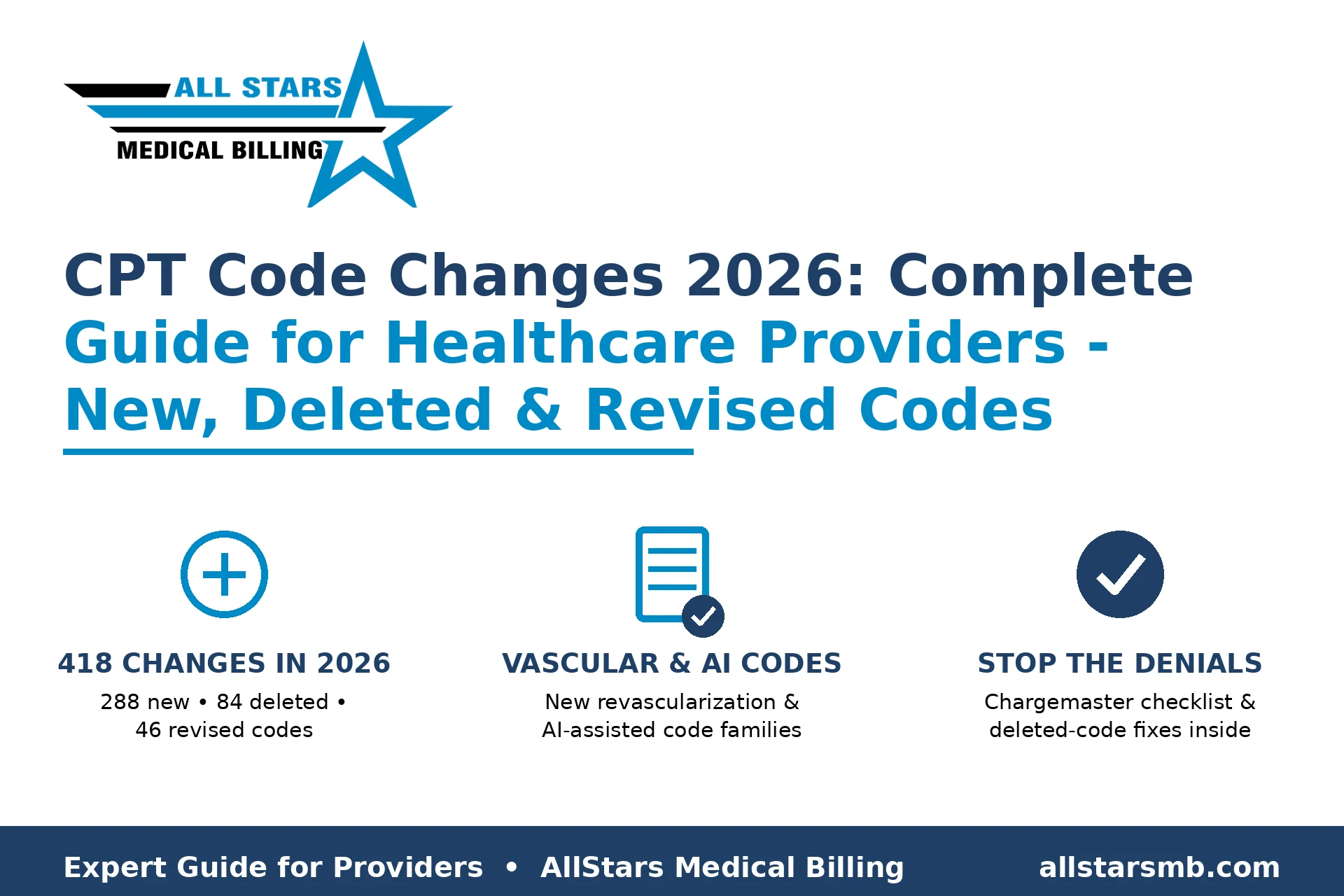
Every January, the American Medical Association (AMA) releases a new Current Procedural Terminology (CPT) code set. Most years, practices update a handful of codes and move on. CPT 2026 is different. Released on 11 September 2025 and effective for use on 1 January 2026, it contains 418 total changes: 288 new codes, 84 deletions, and 46 revisions. That is one of the largest single-year changes in recent memory, and several of the changes replace entire code families rather than single codes.
The risk is simple and immediate. A claim submitted with a deleted code after 1 January 2026 will not be paid at a lower rate — it will be denied. A claim submitted with an old code family, such as the former lower extremity revascularization codes, will fail payer edits before a human ever sees it. And a service that now has its own new code, such as a shorter remote monitoring period or an AI-assisted image analysis, will be underpaid or missed entirely if your team keeps billing the old, broader code.
This guide gives you the complete picture in one place: the headline numbers, the changes that matter by specialty, the deleted codes to remove from your chargemaster today, and a practical update checklist your coding and billing teams can finish in a week. For the code-level basics, start with our CPT codes in medical billing: complete guide 2026, and for last year's changes, see CPT code changes 2025. If your team would rather hand the whole update over, our medical billing services and the wider complete revenue cycle management process cover chargemaster updates, claim scrubbing, and denial follow-up as one workflow.
1. CPT 2026 at a glance
The headline figures come from the AMA's release of the CPT 2026 code set. Keep these four numbers on your coding desk until the update is complete.
| What changed | How many | What it means in practice |
| New codes | 288 | New services and technologies now have their own reportable codes — including digital health, AI-assisted services, and new procedures. |
| Deleted codes | 84 | These codes no longer exist. Any claim using one after 1 January 2026 will be denied. |
| Revised codes | 46 | The code number stays, but the descriptor, rules, or global period changed. Old documentation habits may no longer support the code. |
| Total changes | 418 | The full size of the 2026 update. Every specialty should check the sections that touch its own codes, not just the headline. |
Two patterns explain most of the 288 new codes. First, proprietary laboratory analyses (PLA) account for the largest share of new codes — 27% of the additions, according to the AMA — reflecting how fast molecular and genomic testing is growing. Second, more than a quarter of the new codes are Category III codes, the temporary codes for emerging technologies and services. Category III codes matter because they signal where permanent Category I codes, and payer coverage, are heading next.
The effective date is the same for the whole set: new Category I CPT codes are effective for use as of 1 January 2026. There is no grace period in the code set itself. Some payers may take time to load new codes into their systems, which is a separate problem — see the checklist in Section 8 for how to handle payer lag without losing claims.
2. The five changes that affect the most practices
Not every one of the 418 changes touches your practice. These five do, across the widest range of specialties. If you read nothing else, read this section and check whether any of these code families appear in your chargemaster.
2.1 Lower extremity revascularization — a complete rebuild
This is the single largest structural change in CPT 2026. The old lower extremity revascularization codes, CPT 37220–37235, have been deleted in full and replaced with 46 new codes, CPT 37254–37299. The new family is organized by arterial territory instead of by technique alone, and each code bundles vascular access, imaging supervision and interpretation, angioplasty, stenting, and atherectomy into a single reportable service where applicable.
| Territory | New codes | Vessels covered |
| Iliac | 37254–37262 | Common, external, and internal iliac arteries |
| Femoral / popliteal | 37263–37279 | Common femoral, profunda, superficial femoral, and popliteal arteries |
| Tibial / peroneal | 37280–37295 | Anterior tibial, posterior tibial, and peroneal arteries |
| Inframalleolar (new) | 37296–37299 | Dorsalis pedis and plantar arteries — angioplasty only |
What to do: remove 37220–37235 from every preference card, template, and chargemaster entry, and replace them with the territory-based codes. The new codes also distinguish straightforward lesions (stenosis) from complex lesions (occlusion), so the operative note must state the lesion type and the vessel treated clearly enough for the coder to select the right code. A note that says only 'revascularization performed' is no longer enough. Cardiology, vascular surgery, interventional radiology, and any practice that refers for these procedures should confirm the change with their proceduralists before the next case, not after the first denial.
2.2 Digital health and remote monitoring — shorter periods are now billable
CPT 2026 adds new codes for shorter-duration remote monitoring, continuing the direction set by the 2026 remote monitoring update. The headline additions for billing teams are CPT 99445, for remote physiologic monitoring device supply when data is collected on 2–15 days in a 30-day period, and CPT 99470, for remote physiologic monitoring treatment management for the first 10 minutes in a calendar month. Previously, many short monitoring periods and short management months generated clinical work and no billable claim.
The same update revises the existing setup and supply codes 99453 and 99454, and adds related remote therapeutic monitoring (RTM) supply codes for shorter periods. Do not assume the old thresholds still apply: a patient who previously qualified for 99454 on 16 days of data may now fall under 99445, and management time that previously needed 20 minutes may now be billable at 10 minutes under 99470. The full code table, Medicare rules, and denial patterns for remote monitoring are covered in detail in our companion guide — search the AllStars blog for the RPM Billing guide — and the consent, device, and documentation rules there apply here too.
2.3 AI-assisted services — the first CPT codes built for AI
CPT 2026 is the first code set with codes created specifically for AI-assisted services. The AMA draws a clear line here, and it decides whether a service is reportable at all: only assistive AI qualifies — where the clinician uses AI as a decision-support tool but retains final authority over the interpretation and the report. Autonomous AI systems, where software alone produces the result, do not qualify for these codes.
The codes to know are CPT 75577, for quantification and characterization of coronary atherosclerotic plaque using augmentative software analysis of coronary CT angiography data, with interpretation and report by a physician or other qualified health care professional. This code moves the service from Category III codes 0623T–0626T to permanent Category I status. Related Category III codes cover AI-assisted analysis of perivascular fat on CT to assess coronary inflammation and cardiac risk (0992T–0993T), quantitative MR cholangiopancreatography (0723T–0724T), and multispectral imaging for burn wound assessment (0972T).
Documentation is the deciding factor for AI codes. The note must separate what the software produced from what the clinician interpreted, and it must show the clinician's own interpretation and report. A report that only repeats the software output will not support the code, and it creates audit risk. Practices using AI imaging tools should agree the documentation wording with their radiologists and cardiologists now, and read our guide to AI in medical billing 2026 for how AI tools change the billing workflow around these codes.
2.4 Radiology — new bundles and Category I upgrades
Radiology has several changes that will trigger claim edits if they are missed. The most practical is the new CT angiography bundle: CPT 70471 covers CT angiography of the head and neck, with contrast, including noncontrast images when performed and image postprocessing, in a single code. Billing the old separate codes 70496 and 70498 together for a combined head-and-neck study in one session is now incorrect and will trigger edits — use 70471 instead.
CT cerebral perfusion also graduates in 2026. Previously reported under Category III code 0042T, it now has permanent Category I codes: add-on code 70472 for perfusion analysis performed with a concurrent CT or CTA of the head, and standalone code 70473 when performed without a concurrent CT or CTA of the head. Radiation treatment delivery coding also sees its biggest change in more than a decade, with a streamlined reporting structure and a new surface radiation therapy (SRT) family, CPT 77436–77439, clarifying planning, delivery, and energy-level distinctions. Radiology and radiation oncology teams should treat the perfusion and SRT changes as chargemaster updates, not as coding trivia — the old codes will deny, and the new codes have different documentation requirements.
2.5 Hearing device services — 12 new time-based codes
Hearing services are rebuilt around time. Twelve new codes, CPT 92628–92642, replace the former codes 92590–92595 and cover evaluation, fitting, and follow-up on a time basis. If your practice bills hearing services — audiology, ENT, or a hearing-device clinic — the old codes must come out of every template and the new time-based documentation must go in. The visit note now needs to support the time reported, not just the service performed. Confirm the new codes with your audiologists, and check credentialing and enrollment if a new hearing service line needs a payer enrollment update before you bill it.
3. What changed by specialty
Use this table to find your specialty fast, then read the matching subsection above. Every row is a starting point, not a substitute for checking the codebook for the codes you actually bill.
| Specialty | Main CPT 2026 changes | First check |
| Primary care | Shorter RPM codes 99445 and 99470; immunization counseling code 90482 | RPM thresholds and consent workflow |
| Cardiology | Plaque analysis 75577; perivascular fat AI codes 0992T–0993T; TEVAR codes 33880–33886 revised | AI documentation wording; TEVAR anatomy selection |
| Vascular surgery | Revascularization rebuild 37254–37299 replacing 37220–37235 | Remove old codes; lesion-type documentation |
| Radiology | CTA bundle 70471; perfusion codes 70472–70473; plaque code 75577 | Combined head-and-neck CTA billing |
| General surgery | Endoscopic sleeve gastroplasty 43889; liver ablation 47384; TEVAR changes | New procedure codes and global periods |
| Orthopedics | New and revised codes including sacroiliac joint arthrodesis 27278–27279 | Revised descriptors before the next case |
| ENT / audiology | Hearing codes 92628–92642 replacing 92590–92595 | Time-based documentation |
| Laboratory | PLA codes are 27% of all new codes | New PLA code list for your test menu |
| Radiation oncology | Radiation treatment delivery overhaul; SRT family 77436–77439 | New delivery and planning codes |
Surgery deserves a closer look. New code 43889 covers endoscopic sleeve gastroplasty, including argon plasma coagulation when performed, with a 90-day global period. New code 47384 covers percutaneous irreversible electroporation ablation of liver tumors, including imaging guidance — the former Category III code 0600T is deleted. Thoracic endovascular aortic repair (TEVAR) codes 33880–33886 are revised toward anatomy-based selection, accounting for coverage of the left subclavian artery and for branched or fenestrated endografts, including delayed proximal and distal extensions. Baroreflex activation therapy for resistant hypertension or heart failure also gains new codes. For all of these, the operative note and the global period matter as much as the code number: check the global period in the codebook before you schedule follow-up visits, and do not bill a separate visit that the global period already includes.
Two smaller additions are easy to miss and easy to bill wrong. Immunization counseling now has its own code, CPT 90482, for counseling by a physician or other qualified health care professional for 3 to 10 minutes when no immunization is administered by the provider on the same date. And new immunization codes, including 90631 for influenza virus vaccine (H5, pandemic formulation), enter the set. Billing counseling under a visit code when 90482 applies, or billing 90482 on a day the vaccine was given, will both create problems — pick the code that matches what actually happened on that date.
4. Deleted codes: stop using these on 1 January 2026
Deletion is the most expensive kind of change, because there is no partial payment for a deleted code. The table below lists the deletions your team is most likely to encounter. It is not the full list of 84 — for the complete list, use the AMA CPT 2026 codebook and your payer's deleted-code file — but every code in this table should be removed from your chargemaster, templates, and preference cards now.
| Deleted code(s) | What it was | Use instead |
| 37220–37235 | Lower extremity revascularization (old family) | 37254–37299, by territory and lesion type |
| 92590–92595 | Hearing device evaluation, fitting, and follow-up (old codes) | 92628–92642, time-based |
| 0042T | CT cerebral perfusion (Category III) | 70472 (add-on) or 70473 (standalone) |
| 0623T–0626T | Coronary plaque quantification (Category III) | 75577 (Category I) |
| 0600T | Irreversible electroporation, liver tumor (Category III) | 47384 (Category I) |
| 27445 | Hinge prosthesis knee arthroplasty | Do not bill — prosthesis off the market for decades; use the current arthroplasty code that matches the procedure performed |
A deleted code that stays in an EHR preference list is a denial waiting for a date of service. Search your EHR, chargemaster, superbills, and any paper templates for each code above, and for every other code your specialty bills that appears in the AMA's deleted list. Do the same search in your clearinghouse claim scrubber rules — a scrubber rule that still maps an old code to a payer will pass the claim through and let the payer deny it. This is also the right moment to run a medical billing audit checklist review: the audit will catch deleted codes, stale modifiers, and templates that were copied forward from 2025 without review.
5. Revised codes: same number, new rules
Revised codes are quieter than deletions, which is why they cause more underpayments. The number looks familiar, so nobody checks it — but the descriptor, the included services, or the global period has changed, and the old documentation no longer supports the code.
Examples from the 46 revisions include the TEVAR family (33880–33886), where code selection is now anatomy-based; sacroiliac joint arthrodesis codes 27278–27279, where the distinction between intra-articular and transarticular devices is now explicit; and the remote monitoring setup and supply codes 99453 and 99454, which are revised alongside the new shorter-duration codes. For each revised code you bill, read the new descriptor word by word and compare it with your current template. Ask three questions: does the note still contain every element the new descriptor requires, does the code still include the same services or are some now separately reportable, and has the global period changed? If any answer is no, update the template before the next patient, not after the next denial.
Revised codes also interact with downcoding risk. When a descriptor changes, payer algorithms and medical-necessity edits change with it, and a note that supported the old descriptor may be scored as insufficient under the new one. That is the same pattern as Medicare Advantage downcoding, where a payer pays a lower level than billed — except here the trigger is a code change your own team missed, not a payer algorithm. The fix is the same in both cases: a note that maps, element by element, to the code as it is written in 2026.
6. CPT 2026 vs. CPT 2025: how big is this year, really?
Context helps your team judge how much work the update deserves. CPT 2025 contained 420 updates: 270 new codes, 112 deletions, and 38 revisions. CPT 2026 contains 418 total changes: 288 new codes, 84 deletions, and 46 revisions. The totals look similar, but the shape is different — more new codes, fewer deletions, and more revisions in 2026, and the 2026 changes are concentrated in whole code families (revascularization, hearing, radiology bundles) rather than spread evenly across the book.
| CPT 2025 | CPT 2026 | |
| Total changes | 420 | 418 |
| New codes | 270 | 288 |
| Deleted codes | 112 | 84 |
| Revised codes | 38 | 46 |
| Effective date | 1 January 2025 | 1 January 2026 |
The practical conclusion is not that 2026 is smaller than 2025. It is that the work is different: fewer codes to delete, but more new families to learn and more descriptors to re-read. Practices that treated 2025 as a one-off project and never built a repeatable annual update process will feel 2026 more sharply than practices that did. Section 8 turns the update into that repeatable process.
7. How denials happen when codes change — and how to prevent them
Most CPT-change denials fall into four patterns. Each one is preventable, and each one has a different fix, so do not treat every denial the same way.
Deleted-code denials. The claim uses a code that no longer exists. The payer denies it outright, usually with a code-set or invalid-code reason. Fix: remove the code from the chargemaster and re-bill with the correct 2026 code, if the service is still billable and the filing deadline allows. For the full denial workflow, see why medical claims get denied and medical billing denial prevention.
Wrong-family denials. The claim uses a code from the old family — for example 37220 for a leg revascularization — when the new family requires a territory-specific code. The payer's edit rejects the claim before adjudication. Fix: correct the code selection, not just the charge amount, and check the operative note for the territory and lesion type the new code requires.
Bundling and edit denials. The claim bills two codes that CPT 2026 now bundles into one — for example, billing 70496 and 70498 together instead of 70471 for a combined head-and-neck CTA. The payer pays one line and denies the other as included. Fix: learn the new bundle, update the template, and do not appeal a bundling denial by resubmitting the same two codes.
Documentation denials. The code is correct, but the note does not support the new descriptor — the AI interpretation is missing, the time is not stated for a hearing code, or the lesion type is not documented for a revascularization code. Fix: update the template and the clinician's documentation habits, then appeal with a corrected note only where the underlying service genuinely supports the code. Appealing a documentation denial with the same note will fail, and repeated unsupported appeals damage credibility with the payer.
One more pattern is specific to the start of a new code year: payer lag. A payer's system may not have loaded a new code on 1 January, even though the code is valid. A denial in the first weeks of January is not always your error. Before you re-bill or appeal, check whether the payer has published a loading date for the new code, and hold the claim if the payer advises it — but diary the claim so it does not age past the timely filing limit. Timely filing limits are payer-specific and unforgiving; a claim held too long for a payer-system problem becomes a write-off. Confirm the limit for each payer in your contracts, and diary every held claim with its deadline.
8. Your CPT 2026 update checklist — finish it in one week
Work through this checklist in order. It is written for a practice manager and a lead coder to complete together, and it covers the systems, the people, and the claims — not just the codebook.
- Day 1 — Get the book and the list: obtain the CPT 2026 Professional Edition or the AMA CPT Standard Data File, and download the AMA's new, deleted, and revised code lists. Pull your own top 100 billed codes for the last 12 months from your billing system.
- Day 1 — Match your codes to the changes: flag every one of your top 100 codes that is new, deleted, or revised in 2026, and flag every code family you bill that was rebuilt (revascularization, hearing, radiology, RPM). Anything flagged goes on the update list; anything unflagged is checked again in the full list, not assumed safe.
- Day 2 — Update the chargemaster: remove all 84 deleted codes, add the new codes you will bill, and update the descriptors and global periods for all 46 revised codes. Record the date of each change and who made it.
- Day 2 — Update the EHR and templates: change preference cards, order sets, superbills, and documentation templates for every flagged code. Add the new required documentation elements — territory and lesion type, AI interpretation, time for hearing codes, days of data for RPM — as required fields, not as free text the clinician may forget.
- Day 3 — Update the claim scrubber and payer rules: load the new codes into your clearinghouse and scrubber, remove deleted-code mappings, and check National Correct Coding Initiative (NCCI) edits for the new families. Test the scrubber with a sample claim for each rebuilt family.
- Day 3 — Check payer loading dates: contact your top five payers and confirm when each has loaded the new CPT 2026 codes. Note any payer that will lag, and diary claims for those payers separately so they are not lost.
- Day 4 — Train the team: hold a 30-minute session for clinicians, coders, and billers covering the changes that touch your specialty, using the tables in Sections 2 and 3. Give coders the deleted-code list and give clinicians the new documentation requirements. Keep the session to your codes — a general lecture on all 418 changes will not be remembered.
- Day 5 — Test before you bill: submit test claims or pre-bill checks for one case in each rebuilt family, and review the scrubber and payer responses before the first live claim. Fix any edit that fires on a test claim the same day.
- Week 2 — Watch the first remittances: review every remittance for the first two weeks of January for deleted-code, bundling, and documentation denials. Log each denial by code, payer, and reason, and fix the template or the code selection that caused it — do not just re-bill the same claim. Use the RCM checklist for US medical practices 2026 to fold this review into your normal monthly revenue cycle routine.
- Ongoing — Keep a 2026 change log: one page, listing each code changed, the date it was updated in each system, and the person responsible. When a denial arrives in March, the log tells you in seconds whether the cause was a missed update or a payer problem.
If your practice does not have a lead coder, or if the update list is longer than your team can finish in a week, this is the point at which outsourcing the update pays for itself. A single week of deleted-code denials across a busy practice costs more than the update. Our medical billing services include chargemaster review and denial follow-up, and eligibility and benefit verification and prior authorization services cover the related checks — see authorization in healthcare 2026 — that also change when codes change.
9. Frequently asked questions
When do CPT 2026 codes take effect? New Category I CPT codes are effective for use on 1 January 2026. Use the 2026 code for any date of service on or after that date, and the 2025 code for dates of service before it. Do not use a 2026 code for a December 2025 date of service, even if the claim is submitted in January.
What happens if I bill a deleted CPT code in 2026? The claim will be denied. Deleted codes no longer exist in the code set, and payers will reject them. Correct the code to the 2026 replacement where one exists, check the timely filing deadline, and re-bill. If no replacement exists, the service may no longer be separately reportable — check the codebook before you bill anything in its place.
Do I need a new CPT codebook every year? Yes, in practice. The code set changes every January, and this guide covers only the changes most relevant to billing. The AMA CPT 2026 Professional Edition or the Standard Data File is the authoritative source for the full list, including the PLA and Category III codes that are too numerous to list in an article.
Are Category III codes payable? Sometimes. Category III codes are temporary codes for emerging technologies. Some payers cover specific Category III codes and some do not, and coverage can change during the year. Verify coverage with each payer before you bill a Category III code, and document the service exactly as the code descriptor requires. Do not bill a Category III code as if it were a Category I code.
Can I bill an AI-assisted code if the software did the whole analysis? No — not under the CPT 2026 AI codes. Only assistive AI qualifies, where the clinician uses AI as a decision-support tool and retains final authority. The note must show the clinician's own interpretation and report, separate from the software output.
What is the biggest single change in CPT 2026? By size, the lower extremity revascularization rebuild: 16 old codes deleted and 46 new territory-based codes added. By breadth, the 288 new codes across digital health, AI, laboratory, and surgery. By risk, the deleted codes — because a deleted code that stays in a template denies every claim that uses it.
How is CPT 2026 different from CPT code changes 2025? The totals are similar — 418 changes in 2026 against 420 in 2025 — but 2026 has more new codes (288 vs. 270), fewer deletions (84 vs. 112), and more revisions (46 vs. 38). The 2026 changes are also more concentrated in rebuilt code families. Read CPT code changes 2025 alongside this guide if you are comparing the two years for planning.
Where do ICD-10 and HCPCS fit in? CPT describes the procedure or service. Diagnosis coding and supply coding are separate systems that also update annually. Check the ICD-10 coding guide 2026 for diagnosis coding, and confirm HCPCS Level II updates separately — a CPT update does not update your diagnosis or supply codes for you.
What should I do if a payer denies a new 2026 code in January? First check whether the payer has loaded the code yet. If it has not, hold the claim and diary it against the timely filing deadline. If it has loaded the code and still denies it, work the denial reason on the remittance — it may be a documentation, bundling, or medical-necessity issue rather than a code-loading problem. Do not re-bill the same claim unchanged and expect a different result.
10. What to do next
CPT 2026 rewards practices that update once, properly, and punishes practices that update code by code as denials arrive. The order of work is: get the codebook, flag your own top codes, update the chargemaster and templates, train the people who document and code, test a claim in each rebuilt family, and watch the first remittances in January. Most practices can finish the core update in a week if they start with their own billed codes instead of trying to learn all 418 changes.
If you want the update handled without pulling your coders off live claims, AllStars Medical Billing can take it on. Start with our medical billing services, review plans and pricing, or talk to us about special services and the medical specialties we support. For the related 2026 updates that sit alongside CPT — remote monitoring, prior authorization, and denial prevention — the guides on this blog cover each one, and the medical billing KPIs 2027 guide will help you measure whether the update actually reduced denials in the months that follow. For quality reporting, see our MIPS billing guide.
One last check before you publish or file this guide away: confirm that HIPAA compliance in medical billing is covered for any new data flow the 2026 codes create — AI imaging analysis, remote monitoring data, and hearing-device data all move patient information outside the exam room, and the compliance rules travel with the data, not just with the code.