Why private duty nursing pays differently from every other home care service
Private duty nursing billing is the part of home health billing that most agencies get wrong first. The care is simple to describe: a licensed nurse stays with one patient at home for hours at a time, sometimes around the clock. The billing is not simple. One code carries almost every claim, the rate changes with the modifier, the hours need approval before the first shift, and a single wrong modifier can cost hundreds of dollars on one day of care.
This guide explains private duty nursing billing from the ground up: what the service is, who qualifies, the codes, the full Washington Apple Health fee schedule as a worked example, how the modifiers work, how to calculate a payment, the prior authorization process, the documentation that keeps claims paid, and the denials that come up most often. It also shows how adult rates and other states differ. Our medical billing services handle this work for agencies every day, and the steps below are the same ones our team follows.
1. What private duty nursing is
Private duty nursing is skilled nursing care given to one patient at a time, in the home, for hours at a stretch. Federal rules define it as nursing services for people who need more individual and continuous care than a visiting nurse can give, or more than the nursing staff of a hospital or skilled nursing facility routinely provides. The care must be given by a registered nurse or a licensed practical nurse, under the patient’s physician.
Private duty nursing billing starts with that definition, because it draws the line between this service and everything else an agency bills. A home health visit lasts an hour or two and then the nurse leaves. Private duty nursing means the nurse stays. Washington’s program puts a number on it: four or more hours of continuous skilled nursing in the home, for a patient whose complex needs cannot be managed with intermittent home health visits.
The patients are usually children or adults who depend on technology to stay alive at home, such as a child on a ventilator with a tracheostomy, who would otherwise need to live in an institution. The program exists so they can live at home instead.
Private duty nursing is a Medicaid benefit, not a Medicare benefit. It is an optional benefit under the Social Security Act, so each state decides whether to cover it and how to pay. For children under 21 it is part of the Early and Periodic Screening, Diagnostic and Treatment (EPSDT) benefit, so states must cover it when medically necessary. Medicare, by contrast, does not pay for 24-hour-a-day care at home: home health is limited to part-time or intermittent skilled care.
2. Private duty nursing vs home health, shift nursing and home health aide care
Agencies mix up four kinds of home care, and the billing follows the kind of care, not the name on the schedule. Getting the category right is the first step in private duty nursing billing, because each category has its own codes, limits and payer rules.
Home health is intermittent skilled care. A nurse visits for an hour or two, gives a treatment, checks a wound, teaches the family, and leaves. Medicare defines intermittent as care needed fewer than seven days a week, or daily for less than eight hours a day for up to 21 days, for short, intensive courses of treatment after a hospital stay or for a new diagnosis. The visit codes are different: registered nurse services are billed per 15 minutes under T1002 and licensed practical nurse services under T1003.
Private duty nursing is continuous skilled care. The nurse stays for a full shift, four hours or more, and the care is ongoing rather than a short course of treatment. Shift nursing is the same thing under a different name: when a family says they need a night shift nurse, or an agency schedules 12-hour shifts for a ventilator-dependent child, that is private duty nursing, billed under T1000 in 15-minute units for as many hours as the authorization allows.
One rule matters more than the rest: a patient getting private duty nursing cannot also get intermittent nursing visits for the same needs, and Washington’s billing guide says so plainly. If the patient needs more hours, the answer is a limitation extension, not a second kind of visit. Medicare Advantage plans have their own home health payment rules, and the same logic applies.
3. Who qualifies for private duty nursing
Qualification has two sides: the patient must need the care, and the agency must be allowed to give it. Both are checked before a single hour is approved.
For children, Washington runs the program through the Medically Intensive Children’s Program, known as MICP. A child qualifies when the child is age 17 or younger, meets Medicaid’s financial rules, needs four or more continuous hours of active skilled nursing each day with consecutive tasks that cannot be delegated, and needs two or more tasks of complex skilled nursing: systems assessments, complex respiratory treatment for ventilator or tracheostomy dependence, oxygen and ventilator management, intravenous medication and nutrition, and enteral nutrition and medication that needs multistep work every day. A trained family member or other informal caregiver must be able to provide designated care as well, because private duty nursing supports the family’s care rather than replacing it. The family must have prior authorization from the Developmental Disabilities Community Services division, known as DDCS, and must have used up all other funding sources first.
Adults qualify under a separate set of rules. In Washington, adult private duty nursing is governed by a different chapter of state rules, for people age 18 and older who can be cared for safely at home. The adult program is described in section 11, with its own rates.
For children under 21, the EPSDT benefit adds an important protection: it covers all medically necessary services, and published limits can be exceeded when medical necessity supports it. That is the legal basis for asking for more hours than the standard limit, through the limitation extension in section 8.
On the agency side, Washington requires three things before an agency can bill: an in-home services license from the state, a contract with the Department of Social and Health Services to provide private duty nursing, and a signed core provider agreement with the Health Care Authority. The discharging hospital and the receiving agency train the nurses and the family, and the agency carries the cost of training when a nurse leaves or a client changes agencies. Before the first shift, make sure your agency’s enrollment and credentialing are in order, because a gap there stops payment just as surely as a missing authorization. Our credentialing and enrollment team checks exactly that.
4. The codes you bill: T1000, T1030, S9123 and S9124
The codes at the center of private duty nursing billing are few, and that is part of the risk. With only one main code doing most of the work, the modifier decides the rate, and the modifier decides whether the claim pays.
T1000 is the code for private duty and independent nursing services, given by a licensed nurse, billed in units of up to 15 minutes. Almost every private duty nursing claim in the country uses T1000: one unit is 15 minutes, one hour is four units, and the modifiers set the rate. Washington Apple Health uses T1000 for all children’s private duty nursing in the home.
T1030 is nursing care in the home by a registered nurse, billed per day rather than per 15 minutes. It is used for children who live in a licensed group home for medically fragile children, not in their own family’s home. Washington pays a single daily rate under T1030, and only group homes that hold a contract with the Department of Children, Youth, and Families can bill it. T1031 is the matching per-day code for an LPN.
S9123 and S9124 are the codes private duty nursing billing uses outside the T1000 states, mostly for commercial payers and some state Medicaid programs. S9123 is nursing care in the home by a registered nurse, per hour. S9124 is the same for a licensed practical nurse. The code description for S9123 carries a warning: use it for general nursing care only, and do not use it when the home visit codes 99500 through 99602 can be used instead. Hawaii’s Medicaid program bills under S9123 and S9124 with its own modifiers. UnitedHealthcare’s Medicaid plans in Florida, Ohio and Louisiana list T1000 alongside S9123 and S9124, and the contract decides which one applies. The practical rule is simple: bill the code the payer’s own fee schedule and contract name. Never guess, and never bill T1000 to a payer that prices S9123.
Three more codes sit around the edges of a private duty claim. T1001 is a nursing assessment or evaluation. T1002 is registered nurse services up to 15 minutes, and T1003 is licensed practical nurse services up to 15 minutes, and these two are the home health skilled visit codes, not private duty codes. If your team is unsure which code a shift belongs under, check the payer’s code list before billing, and read our CPT codes complete guide for how code choice drives payment.
| Code | What it is | Unit | When to use it |
| T1000 | Private duty or independent nursing, licensed | Up to 15 minutes | Almost all private duty nursing, with modifiers |
| T1030 | Nursing care in the home by RN | Per day | Medically fragile children in a licensed group home |
| T1031 | Nursing care in the home by LPN | Per day | Group home care by an LPN, where the payer prices it |
| S9123 | Nursing care in the home by RN | Per hour | Commercial payers and some state Medicaid programs |
| S9124 | Nursing care in the home by LPN | Per hour | Commercial payers and some state Medicaid programs |
| T1001 | Nursing assessment or evaluation | Per visit | Assessment visits, not ongoing shifts |
| T1002 | RN services | Up to 15 minutes | Home health skilled visits, not private duty shifts |
| T1003 | LPN services | Up to 15 minutes | Home health skilled visits, not private duty shifts |
5. Washington Apple Health fee schedule: the worked example
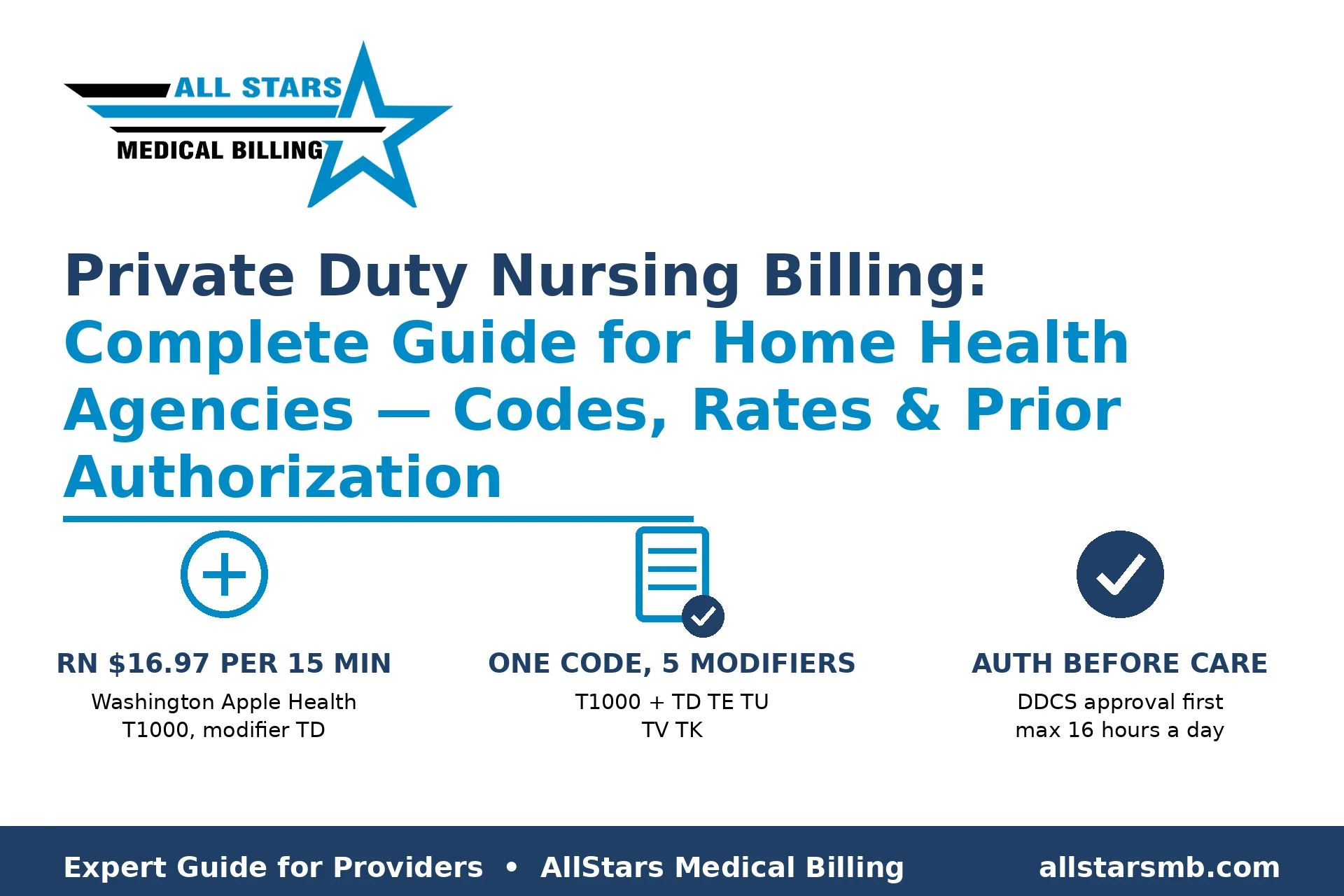
The Washington fee schedule is the clearest example in private duty nursing billing, because it shows every rate on one page. Washington Apple Health, the state’s name for Medicaid, publishes a private duty nursing fee schedule that has been in effect from January 1, 2025 to the present, with an update on January 9, 2025. These are the rates to bill in 2026 unless the Health Care Authority posts a new file.
The fee schedule lists a maximum allowable fee, not a set payment: bill your usual and customary fee, and Apple Health pays up to the maximum on the schedule.
Here is the full children’s fee schedule. Every T1000 rate is per 15 minutes, and the hourly amount is four units.
| Code and modifiers | Service | Rate per 15 minutes | Rate per hour |
| T1000 TD | RN, regular hours | $16.97 | $67.88 |
| T1000 TD TU | RN, overtime | $21.60 | $86.40 |
| T1000 TD TV | RN, holiday | $21.60 | $86.40 |
| T1000 TD TK | RN, second child in the same home | $10.35 | $41.40 |
| T1000 TD TK TV | RN, second child in the same home, holiday | $12.66 | $50.64 |
| T1000 TE | LPN, regular hours | $13.95 | $55.80 |
| T1000 TE TU | LPN, overtime | $17.50 | $70.00 |
| T1000 TE TK | LPN, second child in the same home | $8.84 | $35.36 |
| T1000 TE TK TV | LPN, second child in the same home, holiday | $10.63 | $42.52 |
| T1030 | Daily rate, DCYF contracted group home | $832.82 per day |
Two things stand out. First, the overtime and holiday rates are the same, so an RN earns $21.60 per 15 minutes whether the extra pay is for overtime or for a holiday. Second, the second-child rates are much lower, because one nurse is caring for two children at the same time. The agency still bills both children, on separate claims, and the two lines together pay more than one child alone. Individual nurses bill less, at $14.15 for an RN and $11.62 for an LPN per 15 minutes.
These rates came from Washington’s 2024 supplemental budget, which raised private duty nursing, home health and MICP group home rates by 7.5 percent, effective January 1, 2025. The fee schedule expresses the same rates as $16.97 and $13.95 per 15 minutes. Before that, the last increase had been a ten dollar per hour raise in July 2016, and rates had not moved since 2007. Managed care plans in Washington must pay no less than the fee-for-service schedule. If your agency bills Washington Medicaid, read our guide on how to bill Medicaid as a provider alongside this fee schedule.
6. Modifiers, overtime, holidays and second-child billing
Modifiers are where private duty nursing billing is won or lost. The code stays T1000 on almost every line. The modifiers tell the payer who gave the care, when it was given, and whether a second child shared the nurse. A wrong modifier can deny the line.
| Modifier | Meaning | Use it when |
| TD | Registered nurse | An RN gave the care |
| TE | Licensed practical nurse | An LPN gave the care |
| TU | Overtime | The hours are overtime hours |
| TV | Holiday | The shift falls on one of the 11 paid holidays |
| TK | Second child | One nurse cares for a second child in the same home |
Always put the nurse type first, TD or TE, and then add TU, TV or TK if it applies. A regular RN shift is T1000 TD. An RN overtime shift is T1000 TD TU. An LPN holiday shift is T1000 TE TV. A second child on a holiday, cared for by an RN, is T1000 TD TK TV.
The holiday rate applies only on the 11 paid holidays: New Year’s Day, Martin Luther King Day, Presidents’ Day, Memorial Day, Juneteenth, Independence Day, Labor Day, Veterans Day, Thanksgiving Day, Native American Heritage Day, and Christmas Day. A Sunday is not a holiday for billing, and neither is a birthday. If the shift falls on any other day, bill the regular rate.
Second-child billing has its own rules. Sometimes two children in the same home both qualify, and one nurse cares for both at the same time. Bill the first child at the regular rate and the second child with modifier TK at the lower second-child rate, on a separate claim for each child. Notice one gap: there is a holiday rate for a second child, TK TV, but no overtime rate for a second child. Do not create a TK TU line, because it is not on the fee schedule and it will not pay.
The most expensive modifier mistake is the simplest one: TD on a line where an LPN gave the care, or TE where an RN gave it. The payer checks the nurse’s license against the modifier, and the line comes back.
7. How to calculate a private duty nursing payment
The math of private duty nursing billing is simple once the unit is clear. One unit is 15 minutes. One hour is four units. The formula is hours worked times four, which gives units, and units times the rate, which gives the maximum payment.
Example one, a regular eight-hour RN shift: eight hours times four is 32 units, and 32 units times $16.97 is $543.04. Example two, a regular eight-hour LPN shift: 32 units times $13.95 is $446.40. Example three, a 12-hour RN shift on Thanksgiving Day: twelve hours times four is 48 units, and 48 units times the holiday rate of $21.60 is $1,036.80. Example four, one RN caring for two children in the same home for eight hours: the first child bills 32 units times $16.97, which is $543.04, and the second child bills 32 units times $10.35, which is $331.20. The total for both children is $874.24, billed on two separate claims.
The program can approve up to 16 hours a day. At the RN regular rate, that is 64 units times $16.97, or $1,086.08 per day. A full month at 12 hours a day, 30 days, is 360 hours, or 1,440 units, which at the RN regular rate is $24,436.80. That is why tracking hours against the approval is a daily job rather than a monthly one.
A mixed month is common, because RN and LPN hours can be combined as long as the total stays within the hours approved for the month. Take 22 days at eight RN hours and four LPN hours a day. The RN side is 176 hours, or 704 units, times $16.97, which is $11,946.88. The LPN side is 88 hours, or 352 units, times $13.95, which is $4,910.40. The month totals $16,857.28. A full month of private duty nursing billing like this is worth checking line by line before it goes out, because one wrong modifier moves the payment by hundreds of dollars.
8. Prior authorization: from referral to approval
Prior authorization is the first gate in private duty nursing billing, and it is the one that cannot be fixed after the fact. Private duty nursing always needs prior authorization. DDCS must approve the hours before the nurse starts care, and care given before approval is not paid.
The process starts with the DDCS case manager, who helps the family begin the referral. The agency then sends a complete referral, built around a signed MICP application, form DSHS 15-398. The packet also needs the consent form, the request for DDCS eligibility determination if the child is not already determined eligible, and the notice of practices for client medical information. The medical documents are the plan of care, current treatments, ventilator hours per day, a history and physical, a recent clinical summary, nursing notes from the past five to seven days, the nursing care plan, an emergency medical plan, and a family and social summary. If the child has private insurance or a managed care plan, the packet needs a letter showing that plan will not cover private duty nursing.
Once the packet is complete, the DDCS nursing care consultant, a registered nurse employed by the state, reviews it and decides whether the care is medically necessary. The consultant’s recommendation is entered as the authorization, usually for six months, and the agency must contact the consultant to get the authorization number and the approved hours before care starts. The agency must also confirm the approved hours at the start of each approved time period.
The consultant approves only the hours that are medically necessary, up to 16 hours per day, and the plan must be the least costly option that works equally well. RN and LPN hours can be mixed in one month, but the total cannot go above the approved hours. If the child needs more hours, the agency must ask for a limitation extension before giving the extra care, sending the child’s name, the authorization number, the medical reason, the months that need more hours, and a planned schedule to the DDCS case manager. Limitation extensions are part of private duty nursing billing that agencies forget until they need one, and the rule is strict: the extension must be approved before the extra hours are given, not after. Hours given above the approved amount may become the family’s cost.
Managed care changes the route but not the need for approval. Most Apple Health clients are enrolled in a managed care plan, and those claims go to the plan, not to the state. The agency must call the plan before care starts and follow the plan’s own authorization rules. Enrollment can change from month to month, so eligibility and the responsible payer must be checked before every service. Read our authorization in healthcare guide for the wider rules on getting approvals right the first time.
9. Documentation that keeps claims paid
Documentation is the backbone of private duty nursing billing, because the payer reviews the paper before it pays the claim, and again if it audits the agency later. The nursing notes and the plan of care must be kept in the client’s file and made available for the DDCS nurse to review on request. A claim with perfect codes and no notes behind it is a denial waiting to happen.
The plan of care, also called the plan of treatment, is the written plan for the patient: the physician’s order, the visits and disciplines, the certification period, the medications, and the reasons the services are needed. It is the document the authorization is built on, and the first thing a reviewer asks for. Keep it current, because a plan that no longer matches the child’s condition tells the reviewer the agency is not watching the case.
Daily nursing notes are the proof that the care happened. They must show what the nurse did, when, and what changed in the patient’s condition, and they must match the hours billed, shift by shift. If the notes show eight hours and the claim shows twelve, the extra four hours are not paid. If the notes are missing for a day, that day is not paid. Notes should record ventilator settings, oxygen levels, medication given, suctioning, feeding, seizures or any other event the plan of care lists.
Three more documents belong in every file. The emergency medical plan must explain how life-saving equipment stays running if the power fails, including notifying the electric and gas companies and the local fire department. The psychosocial summary must describe the family arrangement and the support available, with a statement that the home care plan is safe and agreed to by the parent or guardian. And the physician’s orders must be signed and current, because private duty nursing is given under the direction of the patient’s physician, and an unsigned or expired order breaks the chain from the doctor to the nurse to the claim.
Run a documentation check the same way you run a billing check. Once a month, pull a sample of files and compare the notes to the claims, the plan of care to the authorization, and the orders to the dates of service. Use a medical billing audit checklist so the review is the same every time, and keep the records private and secure, because HIPAA compliance in medical billing applies to every note, plan and claim your team touches.
10. How to bill a clean claim
A clean claim is the goal of private duty nursing billing, and it is built in a set order. Skip a step and the claim comes back, usually for a reason that was easy to prevent.
Check eligibility before every service, because Apple Health enrollment can change each month. Confirm the patient has Apple Health coverage for the date of service, and that the benefit package covers private duty nursing. If the patient is in a managed care plan, the claim goes to the plan and the agency must call the plan before care starts. If the patient is fee-for-service, the claim goes to the state through ProviderOne, and the DDCS authorization must be on file.
Use code T1000 with the right modifiers on every line: TD for an RN or TE for an LPN first, then TU, TV or TK if they apply. Bill in 15-minute units, four to the hour. Use place of service 12, which means home, on every line. It is the only place of service allowed for this program. Bill each month on its own line, and use a separate claim for each child, even when one nurse cares for two children in the same home.
Send the claim electronically. Washington requires electronic claims unless the agency is approved for paper billing. The claim must reach the state and receive a transaction control number within 365 days of the date of service. A timely claim can be resubmitted, modified or adjusted for up to 24 months. Medicare crossover claims follow a separate six-month clock from the date Medicare processes the claim. Private duty nursing billing has a hard deadline here: a claim that misses the 365 days is not paid.
11. Adult private duty nursing, and how rates differ by state and payer
Adult private duty nursing billing follows different rules from the children’s program, and the rates show it. In Washington, adults age 18 and older get private duty nursing under a separate set of state rules, and the program is run by the state’s long-term care administration rather than the children’s division. The care is the same kind of continuous skilled nursing, but the authorization, the rate sheet and the settings are different. Adults can receive care in their own home or in an adult family home, which is a small licensed home where a few adults live with a caregiver.
The adult rates went up on January 1, 2025, under State Plan Amendment 25-0011, approved by the federal government in May 2025. The amendment raised adult private duty nursing rates by 10 percent and the adult family home daily rate by 8 percent, to $898.95 a day. Agency hourly rates are $67.88 for an RN and $55.80 for an LPN, the same as the children’s agency rates. Holiday rates are higher: $101.84 an hour for an agency RN and $83.68 for an agency LPN, or $25.46 and $20.92 per 15 minutes. Individual nurses bill less, at $56.60 an hour for an RN and $46.48 for an LPN, with holiday rates of $84.88 and $69.76.
There is no national private duty nursing rate. Every state sets its own fee schedule, its own codes and its own authorization process, and commercial payers set their own on top of that. Washington uses T1000 for children’s care. Hawaii’s Medicaid program bills under S9123 for an RN and S9124 for an LPN, per hour, with its own modifiers. UnitedHealthcare’s Medicaid plans in Florida, Ohio and Louisiana list T1000 alongside S9123 and S9124, and the contract decides which code applies. Colorado caps Medicaid private duty nursing at 16 hours a day, the same as Washington, and allows one nurse to care for more than one client at a reduced rate.
To find any state’s rates, go to that state’s Medicaid agency website and look for the provider fee schedule and the private duty nursing billing guide. Check the effective date, whether the rate is per 15 minutes or per hour, and whether the schedule separates agency rates from individual nurse rates. Commercial payers need the same check against the payer’s contract, because a plan may pay S9123 per hour where Medicaid pays T1000 per 15 minutes. Our commercial insurance medical billing guide covers how to work with those contracts.
12. Denials and the monthly billing checklist
Most denials in private duty nursing billing come from a small set of mistakes, and every one of them is preventable. The payer explains each denial with a claim adjustment reason code on the remittance, and learning the handful that show up on private duty claims saves hours of rework.
| Denial reason | Reason code | What it means | Fix |
| No prior authorization on file | CO-197 | Precertification or authorization absent | Get authorization before the first shift |
| Hours beyond the authorization | CO-198 | Authorization exceeded | Request a limitation extension before giving extra hours |
| Service not covered | CO-96 | Non-covered charge | Confirm the benefit covers the service |
| Benefit maximum reached | CO-119 | Benefit maximum for the period reached | Check approved hours; request an extension with medical reasons |
| Claim sent to the wrong payer | CO-109 | Not covered by this payer; send to the correct payer | Check the managed care segment and rebill the plan |
| Missing or wrong information | CO-16 | Claim or service lacks information | Fix the modifier, units or place of service and resubmit |
The pattern is clear: authorization problems cause the most denials, and they are the hardest to fix after the fact. A claim denied for no authorization cannot be fixed by correcting a code. Hours beyond the authorization are the same story, and the limitation extension must be approved before the extra hours, not after. Wrong modifier, wrong payer and late filing are the other common denials, and the checklist below catches all three. Read our CARC codes guide for the full list of reason codes, and our why medical claims get denied guide for the root causes behind them.
Use this private duty nursing billing checklist every month. It covers the whole cycle, from authorization to payment, and it takes less than an hour when the records are in order.
- Confirm every active authorization, the approved hours, and the authorization number, at the start of the month.
- Check eligibility and the managed care segment for every patient, for the dates of service.
- Match every shift to a nurse, and match the modifier to that nurse’s license.
- Count units in 15-minute blocks and check the monthly total against the authorization.
- Check that holiday shifts fall on one of the 11 paid holidays, and that no TK TU line exists.
- Confirm place of service 12 on every line, a separate claim per child, and a separate line per month.
- Compare the nursing notes to the billed hours, shift by shift, before the claim goes out.
- File electronically and confirm the transaction control number is assigned inside the 365-day limit.
- Work the remittance the day it arrives, and log every denial with its reason code.
- Request limitation extensions before extra hours, never after.
Run the same review on your whole revenue cycle once a quarter. An RCM checklist keeps the billing, the authorizations and the follow-up in one routine, and our medical billing denial prevention guide shows how to stop the same denial from coming back twice.
What is the Medicaid rate for private duty nursing in Washington?
Apple Health pays $16.97 per 15 minutes for an RN and $13.95 for an LPN at the regular agency rate, from a fee schedule in effect from January 1, 2025 to the present. Overtime and holiday rates are $21.60 for an RN and $17.50 for an LPN. The group home daily rate is $832.82. Individual nurses bill less, at $14.15 for an RN and $11.62 for an LPN.
How many hours of private duty nursing will Medicaid approve?
In Washington, the nursing care consultant approves only the hours that are medically necessary, up to 16 hours per day, and the plan must be the least costly option that works equally well. RN and LPN hours can be mixed in one month, as long as the total stays within the approved hours. More hours need a limitation extension approved before the extra care is given.
Does Medicare cover private duty nursing?
No. Medicare does not pay for 24-hour-a-day care at home, and Medicare home health is limited to part-time or intermittent skilled care. Private duty nursing is a Medicaid benefit, and it is also covered by some commercial plans under their own rules.
What is the difference between private duty nursing and home health?
Home health is intermittent skilled care, with visits that last an hour or two for a short course of treatment. Private duty nursing is continuous skilled care, four or more hours at a time, for patients whose needs cannot be managed with intermittent visits. Home health visits use T1002 and T1003, while private duty nursing uses T1000 in 15-minute units.
Do you need prior authorization for private duty nursing?
Yes, always. In Washington, DDCS must approve the hours before the nurse starts care, through the MICP application, form DSHS 15-398, and the agency must get the authorization number and approved hours from the nursing care consultant before the first shift. Care given before approval is not paid.
How long do you have to file a private duty nursing claim in Washington?
A fee-for-service claim must reach the state and receive a transaction control number within 365 days of the date of service. A timely claim can be resubmitted, modified or adjusted for up to 24 months. Managed care plans set their own filing limits in their contracts, so check the plan’s rules for those claims.
The authorization is the payment
Private duty nursing billing rewards agencies that do the work before the care starts. The authorization, the plan of care, the right modifier and the right payer are all decided before the first shift, and the claim is only the record of decisions already made. An agency that checks eligibility every month, tracks hours against the approval every week, and files inside the deadline gets paid on time. An agency that treats the claim as the starting point spends its time fighting denials that should never have happened.
Start with the three numbers that matter most in your state: the regular rate, the overtime and holiday rate, and the daily maximum hours. In Washington, those are $16.97 per 15 minutes for an RN, $21.60 for overtime and holidays, and 16 hours a day. Then build the routine around them: authorization first, documentation every shift, and a monthly checklist that catches the errors before the payer does. If your team would rather hand the authorizations, the modifiers and the follow-up to specialists, explore our medical specialties or talk to us about taking on your private duty nursing billing as one workflow.