Why RPM billing changed in 2026 and why it matters now
Remote Patient Monitoring (RPM) has been billable under Medicare for years, but many practices left money on the table for one simple reason: the old thresholds did not match real patient behavior. A patient who sent readings on 12 days, or who needed only 12 minutes of management in a month, generated clinical work and device costs and no billable claim.
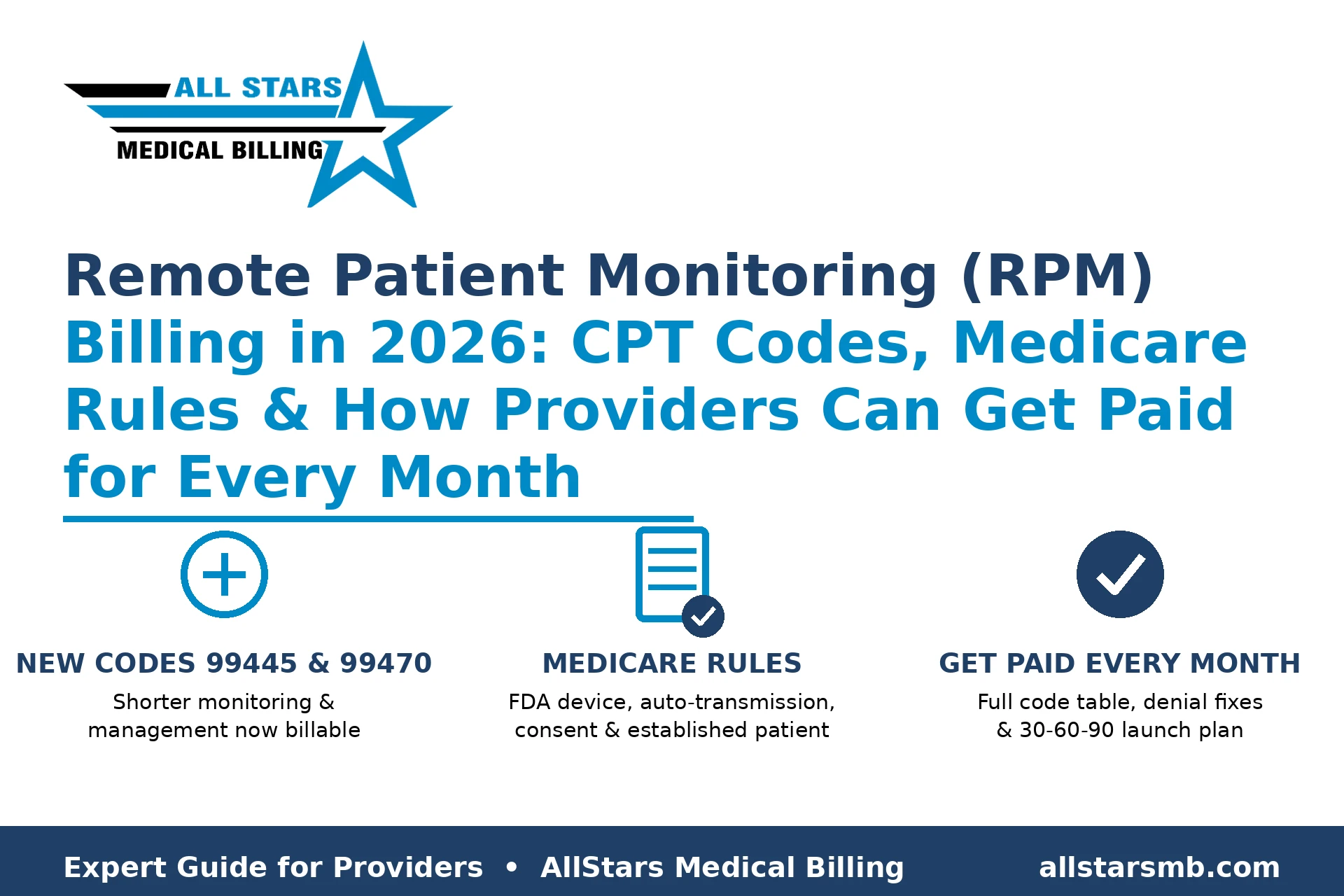
The Calendar Year 2026 Physician Fee Schedule changed that. Two new codes, CPT 99445 and CPT 99470, now cover shorter monitoring periods and shorter management time. Practices that update their workflows can get paid for months that previously paid nothing. Practices that keep billing the old way will keep seeing denials, underpayments, and audit risk.
This guide walks through the full 2026 code set, the rules that decide payment, the denial patterns to prevent, and a 30-60-90 day launch plan. If your team wants the billing handled end to end, start with our medical billing services and the wider complete revenue cycle management process so RPM fits into your existing claims workflow instead of becoming a side project.
1. What is RPM
RPM, formally called Remote Physiologic Monitoring, is the collection and interpretation of physiologic data from a patient outside the clinic, used to develop and manage a treatment plan. Blood pressure, weight, pulse oximetry, blood glucose, and similar measurements are common examples.
RPM counts only when all of these are true
- Physiologic data: data is physiologic data tied to the patient’s condition and treatment plan.
- FDA-cleared device: device meets the U.S. Food and Drug Administration (FDA) definition of a medical device. It must be FDA-cleared for its intended use where clearance applies.
- Automatic electronic transmission: device collects and transmits the data electronically on its own. The patient uses the device; the device sends the reading.
- Established patient: Medicare RPM is billed for an established patient — a patient with an existing relationship with the billing practitioner or practice. Document that relationship in the chart.
- Medical necessity and an order: monitoring is ordered by a physician or other qualified health care professional, is reasonable and necessary for the condition, and the data is actually reviewed and used in care. Monitoring with no clinical action is not billable care.
- Documented consent: patient agrees to RPM before billing begins, understands cost-sharing, and that consent is documented. See the consent section below.
What RPM is not
Patient self-reported readings do not count. A blood pressure value a patient reads aloud on the phone, types into a portal, writes in a notebook, or enters manually into an app is not RPM data for billing, even if the number is clinically useful. If the device did not automatically transmit it, do not count that day toward 99445 or 99454 and do not count time spent collecting it as RPM management time.
RPM is also not general check-in calls, appointment reminders, device connectivity troubleshooting, or time spent watching a dashboard with no patient-specific review or action. Those activities may support care, but they do not by themselves create billable management minutes.
Consent and cost-sharing: say it before you bill it
Get and document patient consent before the first billable service. The consent note should show that the practice explained what RPM is, that only one practitioner can bill RPM for the patient in a period, that the patient can stop the service, and — critically — that Medicare Part B cost-sharing applies. For most Medicare patients that means the annual Part B deductible and 20% coinsurance apply to RPM services, unless the patient has supplemental coverage that covers them. Patients who learn about cost-sharing from an explanation of benefits instead of from your team are the patients who withdraw and complain.
Confirm coverage and expected cost-sharing at enrollment with eligibility and benefit verification, and handle the data exactly as described in our guide to HIPAA compliance in medical billing, because RPM adds a continuous stream of patient data outside your office walls.
RPM vs. RTM vs. CCM: do not mix the three programs
RPM, Remote Therapeutic Monitoring (RTM), and Chronic Care Management (CCM) are often discussed together because all three pay for care delivered between visits. They are not interchangeable. Each has its own data type, code family, and billing logic, and mixing them is a common source of denials.
| Feature | RPM — Remote Physiologic Monitoring | RTM — Remote Therapeutic Monitoring | CCM — Chronic Care Management |
| What is monitored | Physiologic data: blood pressure, weight, glucose, pulse oximetry | Non-physiologic therapy data: therapy adherence, response, pain, musculoskeletal or respiratory status | No device data required; care coordination for chronic conditions |
| Main CPT codes | 99453, 99445, 99454, 99457, 99458, 99470 | 98975–98981 | 99490 (and related CCM codes) |
| Device required | Yes — FDA-cleared device with automatic transmission | Yes — device or software for therapeutic monitoring | No |
| Who can bill | Physicians and qualified health care professionals who can bill evaluation and management services; clinical staff time under general supervision | Physicians and qualified professionals; physical therapists, occupational therapists, and speech-language pathologists can bill RTM | Physicians and qualified professionals; clinical staff under general supervision |
| Core condition focus | Chronic or acute conditions needing physiologic monitoring | Therapy-related conditions, including musculoskeletal and respiratory therapy | 2 or more chronic conditions expected to last at least 12 months |
| Key billing trap | Counting self-reported data or billing RPM and RTM for the same patient in the same period | Billing RTM like RPM, or for a patient without a therapy-related plan | Double-counting minutes also counted toward RPM |
In short: if the data is physiologic, think RPM. If the data is about therapy response or adherence, think RTM. If there is no device data and the work is coordination, think CCM. Getting that first decision right depends on accurate medical coding at enrollment, not at claim correction after a denial.
Complete 2026 RPM CPT code table
The 2026 RPM family has six codes: one setup code, two device-supply codes, and three management codes. The table below is the complete set your chargemaster and billing system should contain. For the broader code context, see our CPT codes in medical billing: complete guide 2026 and what changed from CPT code changes 2025, and CPT code changes.
| CPT code | What it covers | Threshold / frequency | Approx. 2026 rate* |
| 99453 | Initial set-up and patient education on use of the equipment | Once per episode of care; requires at least 2 days of data in the period | ~$22 |
| 99445 — NEW in 2026 | Remote physiologic monitoring device supply with daily recording / programmed alert transmission | 2–15 days of data in a 30-day period | ~$52 |
| 99454 | Remote physiologic monitoring device supply with daily recording / programmed alert transmission | 16–30 days of data in a 30-day period | ~$52 |
| 99470 — NEW in 2026 | RPM treatment management — first 10 minutes, with interactive communication | 10–19 minutes in a calendar month | ~$26 |
| 99457 | RPM treatment management — first 20 minutes, with interactive communication | 20+ minutes in a calendar month | ~$52 |
| 99458 | RPM treatment management — each additional 20 minutes | Add-on to 99457 only; per additional 20 minutes in a calendar month | ~$41 |
* Rates are approximate 2026 national non-facility reference amounts, based on relative value units multiplied by the $33.40 conversion factor. They are provided for planning only. Actual payment varies by geographic locality, payer contract, and site of service. Verify every rate in the CMS Physician Fee Schedule Look-Up Tool before projecting revenue or quoting figures to leadership.
How to read the two new codes:
- 99445 — the short-month device code. 99445 pays at about the same level as 99454 even though it requires fewer days. That is intentional: a short monitoring month is no longer a zero-revenue month. Count the days first, then choose the one code that matches.
- 99470 — the short-month management code. 99470 covers the first 10 minutes when a full 20 minutes is not reached. If management time reaches 20 minutes, bill 99457 instead — never both for the same patient in the same month.
What a typical full month looks like (illustrative example only): a patient who transmits on 16 or more days and receives 20 minutes of management is billed as 99454 + 99457, about $99–$104 per patient for that month at national reference rates, before locality adjustment and before any additional 99458 time. A shorter month — for example, 10 days of data and 12 minutes of management — is billed as 99445 + 99470. Mark any internal forecast built on these figures as illustrative until you replace them with your locality-adjusted, payer-specific rates.
Pair every RPM code with the correct diagnosis coding. The diagnosis must support medical necessity for monitoring that specific physiologic parameter. Our ICD-10 coding guide 2026 helps coders keep the diagnosis, the device, and the treatment plan aligned.
The rules that decide payment
Most RPM denials are not about whether the patient needed monitoring. They are about one of the following rules being missed in the workflow. Build each rule into your enrollment, device, and time-tracking systems so the claim is correct before it is created.
- 99445 and 99454 are mutually exclusive. In the same 30-day period, bill one or the other — never both. Count transmitted days at the end of the period and select the code that matches the count.
- 99470 and 99457 are mutually exclusive. In the same calendar month, bill one or the other — never both. Track cumulative management minutes and select the code at month-end.
- Management codes need live interactive communication. 99457 and 99470 each require at least one live, real-time interactive communication with the patient or caregiver during the month — a two-way conversation by phone or video, not a text, portal message, voicemail, or automated alert alone. Document who participated, the date, and what was discussed.
- Only one practitioner per patient per period. Only one practitioner may bill RPM services for a patient in a given period. Confirm at enrollment that no other practice is billing RPM for the same patient, and document that check.
- RPM and RTM cannot overlap for the same patient. Do not bill RPM and RTM for the same patient in the same period. Choose the program that matches the data and the plan of care.
- Frequency limits still apply. 99453 is once per episode of care, not once per month. 99458 is an add-on to 99457 only and cannot be billed with 99470 or on its own.
- Count only qualifying management time. Management time is time spent reviewing patient-specific data, interpreting it, communicating interactively, and adjusting the treatment plan. Device connectivity checks, data transmission with no review, and administrative time do not count.
Some commercial and Medicaid plans add their own authorization or enrollment conditions on top of Medicare rules. Check plan requirements through prior authorization services and the plan logic explained in authorization in healthcare 2026 before you assume Medicare rules are the only rules that apply.
RPM + CCM in the same month: allowed, if no minute is counted twice
Yes — RPM and CCM can be billed for the same patient in the same month when the patient qualifies for both and each program’s requirements are met separately. A patient with hypertension and diabetes, for example, may need device monitoring under RPM and broader care coordination under CCM (CPT 99490) in the same month.
The condition is absolute: no minute may be counted toward both programs. Ten minutes spent reviewing blood pressure data and adjusting hypertension treatment is RPM time or CCM time — it cannot be 10 minutes in both logs. The same rule applies to any overlap with other time-based care management services.
- Use separate time logs for RPM and CCM, with start and stop times, activity descriptions, and the program name on every entry.
- Train staff to assign time at the moment the work is done, not from memory at month-end.
- Audit a sample of stacked patients every month before claims go out, and hold any claim where the logs overlap.
Use the discipline in our RCM checklist for U.S. medical practices 2026 to make the separate-log habit part of month-end close, not an extra task.
Who qualifies and which specialties fit RPM best
RPM fits conditions where a physiologic measurement, taken frequently at home, changes treatment decisions between visits. The patient must have a condition for which monitoring is medically necessary, an order from the billing practitioner, and a treatment plan that will actually use the data.
Conditions commonly monitored with RPM
- Hypertension — home blood pressure trends guide medication titration far better than isolated office readings.
- Diabetes — glucose data supports timely adjustment and early intervention.
- Heart failure — daily weight and other measurements can flag fluid retention early.
- Chronic obstructive pulmonary disease (COPD) — pulse oximetry and related data support exacerbation monitoring.
- Chronic kidney disease — blood pressure, weight, and related measurements support ongoing management.
- Other chronic conditions — any condition where the ordered physiologic data will be reviewed and acted on, and medical necessity is documented.
Best-fit specialties
Primary care and internal medicine are the natural home for RPM because they manage panels of patients with multiple chronic conditions. Cardiology, endocrinology, pulmonology, and nephrology are strong fits for condition-specific programs. Other specialties can succeed when the use case is narrow and the data clearly drives treatment. See how we support each specialty on our specialties page.
Who is not a good fit: patients without a qualifying condition or order, patients who cannot or will not use the device, patients already monitored by another practitioner for the same period, and patients enrolled only to generate device claims with no plan to review or act on the data. Enrolling the wrong patients creates denials and audit exposure, not revenue.
7. Top RPM denial reasons and how to fix each one
The denial patterns below account for most preventable RPM write-offs. Each fix belongs in the workflow before the claim, not in the appeal after it.
| Denial reason | Why it happens | Fix |
| Too few data days | 99454 billed with fewer than 16 days, or no code billed for a 2–15 day month | Count days at period-end; bill 99445 for 2–15 days, 99454 for 16–30 days |
| 99453 rebilled every month | Setup code treated as monthly | Bill 99453 once per episode only; block it in the billing system after first use |
| Connectivity counted as management time | Device checks logged as clinical management | Count only patient-specific review, interpretation, communication, and plan adjustment |
| No interactive communication | Management billed with no live conversation that month | Require and document at least one live interaction before billing 99470 or 99457 |
| 99458 billed without 99457 | Add-on billed alone or with 99470 | System edit: 99458 only with 99457, per additional full 20 minutes |
| RPM + RTM same period | Both programs billed for same patient and period | Choose one program per period at enrollment; add a pre-bill check |
| Missing consent or order | Enrollment paperwork incomplete | No device shipment and no billing until signed consent and order are in the chart |
| Overlapping RPM / CCM minutes | Same minutes in both time logs | Separate logs; pre-bill overlap audit for every stacked patient |
| Patient-reported data counted | Manual readings counted as transmitted days | Count only automatically transmitted device data; train staff on the distinction |
Build these edits into your standard medical billing denial prevention workflow and review the root causes in why medical claims get denied so the same denial does not repeat next month. When an appeal is needed, appeal only with evidence: day counts, transmission logs, time logs, the interactive communication note, consent, and the order.
Audit-proof documentation checklist
Before any RPM claim leaves your practice, confirm every item below is in the record. If an item is missing, hold the claim, a held claim can be fixed; a denied or paid-and-recouped claim costs far more.
- ☐ Patient consent documented before billing, including cost-sharing explanation (Part B deductible and 20% coinsurance) and the right to stop the service.
- ☐ Order from the billing physician or qualified health care professional, with the condition and physiologic parameter to be monitored.
- ☐ Established-patient relationship documented.
- ☐ Diagnosis coding supports medical necessity for the specific monitoring ordered.
- ☐ Device identified in the record; device is FDA-cleared and transmits data automatically and electronically.
- ☐ Day count for the 30-day period recorded, with transmission log available (2–15 days = 99445; 16–30 days = 99454).
- ☐ 99453 billed only once for the episode, if billed at all.
- ☐ Management time log with date, duration, staff name, activity, and patient-specific action taken.
- ☐ At least one live interactive communication documented for any month billed with 99470 or 99457.
- ☐ No overlapping minutes between RPM and CCM or other time-based services for stacked patients.
- ☐ Only one practitioner billing RPM for the patient in the period — checked and documented.
- ☐ No RPM and RTM billed for the same patient in the same period.
Run this checklist as part of your regular medical billing audit checklist review, not only when a payer asks for records.
8. What changes on January 1, 2027 plan for it in 2026
The CMS Calendar Year 2027 Physician Fee Schedule final rule, CMS-1848-F, released November 4, 2026, changes RPM enrollment and staffing rules from January 1, 2027. Practices launching RPM now should build these requirements into their workflows from the start instead of rebuilding them at year-end.
- Initiating visit required for new patients. From January 1, 2027, a new RPM patient needs an initiating visit — a face-to-face visit, in person or by telehealth, at which RPM is discussed — before the practice bills for that new patient. Patients already receiving RPM are grandfathered and do not need a new initiating visit to continue. Schedule and document the initiating visit as step one of every new enrollment in 2027.
- RTM limited to established patients. From 2027, RTM is limited to established patients. If your practice runs both programs, apply the established-patient check to RTM enrollments as strictly as you do to RPM.
- Direct-employee staffing requirement, finalized, delayed to January 1, 2029. CMS finalized a requirement that RPM and RTM clinical staff be direct employees of the billing practice, but delayed its effective date to January 1, 2029. Do not ignore it because it is delayed — review vendor and staffing contracts signed in 2026 and 2027 for how they will work when the requirement takes effect, and get advice before signing a long-term arrangement that assumes outsourced staffing will always be billable.
- Lower device and setup values in 2027. Device and setup code values are lower in 2027. Re-run your program economics with 2027 values before committing to device purchases or per-patient vendor fees based only on 2026 rates.
None of this changes 2026 billing. Bill 2026 services under 2026 rules, and use the rest of 2026 to make your consent, visit, documentation, and staffing workflows ready for 2027.
9. Your 30-60-90 day RPM launch plan
Days 1–30: Build it correctly
- Choose one or two conditions and one device type to start. Narrow beats broad at launch.
- Confirm the device is FDA-cleared and transmits automatically; test the full data flow into your record system.
- Load all six 2026 codes into the chargemaster with the mutual-exclusivity and add-on edits from Section 4.
- Create the consent form, order template, time log, and documentation checklist from Section 7.
- Verify eligibility, other-practitioner RPM status, and plan-specific rules for the first patient cohort before enrollment.
Days 31–60: Enroll and bill the first cohort
- Enroll a small first cohort of established patients who clearly qualify, obtain consent, and complete orders.
- Monitor day counts weekly so short months are billed as 99445 instead of being written off.
- Require the live interactive communication early in the month, not on the last day.
- Submit the first claims, track every denial by reason, and fix the workflow cause before enrolling more patients.
Explain cost-sharing clearly and manage balances through your patient billing and tracking system so RPM balances do not become a surprise for patients.
Days 61–90: Measure, audit, and expand
- Audit a sample of charts against the Section 7 checklist, including every stacked RPM + CCM patient.
- Review days-per-patient, minutes-per-patient, denial rate, and paid-per-patient against your locality-adjusted rates.
- Expand to the next condition or specialty only after the first cohort bills cleanly.
- Prepare the 2027 initiating-visit workflow so new enrollments in January 2027 need no rework.
Track the program with the measures in our guide to medical billing KPIs. Payer mix matters too: confirm how each plan treats RPM before expanding, including the guidance in how to bill Medicaid as a provider and commercial insurance medical billing.
10. How AllStars Medical Billing helps with RPM
RPM revenue is lost in the details: a missed day count, a missing consent, a time log that overlaps with CCM, or a new code that was never loaded into the billing system. AllStars Medical Billing builds those details into a repeatable workflow for your practice.
- Enrollment checks — eligibility, established-patient status, other-practitioner checks, and plan-specific RPM rules before the first claim.
- Coding accuracy — correct selection among 99445 / 99454 and 99470 / 99457 / 99458 on every claim, with the mutual-exclusivity edits applied before submission.
- Time-log and documentation review — claims held when consent, order, day count, time log, or interactive communication is missing, instead of denied after submission.
- Denial management and appeals — denial reasons tracked, workflow causes fixed, and appeals filed with transmission logs, time logs, and clinical notes as evidence.
- Stacking audits — RPM and CCM logs checked for overlapping minutes on every stacked patient, every month.
AllStars supports practices in all 50 states across more than 50 specialties. Explore our services, review plans and pricing, and see our special services for larger groups and multi-location practices. If you use technology to streamline intake and follow-up, also read our perspective on AI in medical billing 2026. For quality reporting, see our MIPS billing guide.
Before launching, make sure every billing practitioner is properly enrolled. Our credentialing services team can confirm enrollment status so RPM claims are not held by a credentialing gap.
Ready to get paid for every billable RPM month? Contact AllStars Medical Billing for a review of your RPM codes, workflows, and denied claims. We will identify which months should have been billed as 99445 or 99470, where your documentation is exposed, and what to fix before January 1, 2027.
Can I bill RPM for a patient who sent readings on only 8 days?
Yes, in 2026. Eight days of automatically transmitted data in a 30-day period is billed with CPT 99445, the new short-duration device-supply code. Before 2026 that month would not have met the 16-day threshold for 99454. The data must still come from an FDA-cleared device with automatic transmission — 8 days of self-reported readings do not qualify.
What is the difference between 99470 and 99457?
Both cover RPM treatment management with at least one live interactive communication in the month. CPT 99470 covers the first 10 minutes (10–19 minutes total). CPT 99457 covers the first 20 minutes (20 minutes or more). They are mutually exclusive in the same month: bill the one code that matches the total qualifying time.
Can I bill 99458 with 99470?
No. CPT 99458 is an add-on code to 99457 only. It covers each additional 20 minutes beyond the first 20 minutes billed as 99457. If total management time is under 20 minutes, bill 99470 and do not add 99458.
Can the same patient receive RPM and CCM in the same month?
Yes, if the patient qualifies for both, each program’s requirements are met, and no minute is counted toward both programs. Keep separate time logs and audit stacked patients before billing.
Does the patient have to pay anything for RPM?
For Medicare patients, RPM is subject to Part B cost-sharing — the annual deductible and 20% coinsurance — unless supplemental coverage applies. Explain this during consent, before billing begins, and document that the patient understood and agreed.
What do I need to change for January 1, 2027?
Add an initiating visit (face-to-face, in person or by telehealth, where RPM is discussed) before billing for any new RPM patient; current patients are grandfathered. Apply the established-patient limit to RTM, re-run program economics with lower 2027 device and setup values, and review staffing contracts with the direct-employee requirement in mind — it is finalized but delayed to January 1, 2029.
Conclusion: bill the month the patient actually had
The 2026 RPM changes reward practices that match the code to reality: 2–15 days is 99445, 16–30 days is 99454, 10–19 minutes is 99470, and 20 minutes is 99457. Document consent, the order, the day count, the time log, and the live conversation, and the claim follows. Skip any one of those, and even a clinically excellent program will struggle to get paid. Build the workflow once, audit it monthly, and prepare now for the January 1, 2027 initiating-visit rule.