Why MIPS decides 9% of your 2028 Medicare revenue, and why November is the moment
Medicare will pay you up to 9% less on every Part B claim in 2028, or a little more, based on what your practice did in 2026. That is what MIPS billing does: the Merit-based Incentive Payment System (MIPS) turns your 2026 performance into your 2028 payment rate. It is not a bonus program with a penalty attached. For most practices, the penalty is the part that matters, because the bonus is small and the penalty is automatic. The 2026 performance year ends on 31 December 2026, and what you do in the next five weeks decides whether 2028 starts with a pay cut.
MIPS billing is the largest track of the Quality Payment Program (QPP), the program the Centers for Medicare & Medicaid Services (CMS) runs under the Medicare Access and CHIP Reauthorization Act (MACRA) of 2015. CMS scores each eligible clinician or group on four categories, Quality, Cost, Promoting Interoperability, and Improvement Activities, and turns them into a final score out of 100. A score of 75 or higher avoids a penalty; below 75, a negative payment adjustment applies to every Medicare Part B claim for the whole of 2028, up to a full 9%.
This MIPS billing guide explains the 2026 rules in plain language: who must report, what each category requires, how the score turns into dollars, the deadlines still open, and the action plan for the rest of 2026 and the first quarter of 2027. If your team would rather hand the tracking and submission over, our medical billing services and the wider complete revenue cycle management process cover eligibility checks, measure tracking, and submission as one workflow.
1. What MIPS billing is, and who must report
MIPS billing applies to clinicians who bill Medicare Part B under the Physician Fee Schedule. Eligible clinician types include physicians, physician assistants, nurse practitioners, clinical nurse specialists, certified registered nurse anesthetists, therapists, audiologists, clinical psychologists, and dietitians. If you bill Part B, assume MIPS can apply to you until you have checked.
Not every eligible clinician must report. CMS applies a low-volume threshold: you must exceed all three parts before reporting becomes mandatory. Miss any one part and you are excluded from mandatory reporting for the year, although voluntary reporting is possible in some cases.
| Criterion | 2026 threshold | What it means in practice |
| Part B allowed charges | More than $90,000 | Your Medicare Part B allowed charges under the Physician Fee Schedule for the determination period. |
| Part B patients | More than 200 | The number of distinct Medicare Part B patients you saw. |
| Covered professional services | More than 200 | The number of covered professional services you furnished to Part B patients. |
The rule is all three, not any one. A clinician with $120,000 in Part B charges but only 150 Part B patients is below the threshold and is not required to report. CMS checks eligibility twice: an initial check before the performance year and a final check after it ends, using the full year's billing data. Check your own status rather than guessing. Section 7 shows how, in about two minutes, using your NPI number.
Two more groups are excluded. Clinicians who enrolled in Medicare for the first time during 2026 are generally excluded for that performance year, because CMS determines eligibility from billing data a new enrollee does not yet have. Make sure your Medicare enrollment is in order before you worry about reporting. Our credentialing and enrollment team can confirm enrollment status, because a credentialing gap can hold claims just as a missed MIPS deadline can. Clinicians who are Qualifying Participants in an Advanced Alternative Payment Model (APM) are also exempt; they report through the APM instead.
One boundary to keep clear: MIPS billing applies to Medicare Part B only. It does not change what Medicaid pays you, and it does not change commercial payer rates. Medicaid programs run their own quality and payment rules (see how to bill Medicaid as a provider), and commercial payers run theirs (see commercial insurance medical billing).
2. The four performance categories, and what each one asks for
Your MIPS billing score is built from four categories, with weights unchanged for 2026. Quality and Cost together are worth 60 of the 100 points, more than most practices expect.
| Category | Weight | Minimum performance period | What you submit |
| Quality | 30% | Full calendar year (Jan 1 – Dec 31, 2026) | 6 measures, including 1 outcome or high-priority measure |
| Cost | 30% | Full calendar year | Nothing, CMS calculates it from your claims |
| Promoting Interoperability | 25% | Any 180 continuous days in 2026 | EHR-based measures across four objectives, plus attestations |
| Improvement Activities | 15% | Any 90 continuous days in 2026 | Attestation to 2 activities (1 for small practices) |
2.1 Quality (30%), the category you control most
Quality is the only category where you choose what is measured. CMS has about 195 approved quality measures for the 2026 performance year, and you select six that fit the patients you actually see. At least one of the six must be an outcome measure, one that asks whether the patient actually improved, or a high-priority measure. Each measure needs a case minimum of 20 eligible patients, and you must report data for at least 75% of the patients eligible for each measure, across all payers, not just Medicare. Fall short on either rule and the measure scores zero.
Choosing the six measures is the decision that matters most in MIPS billing. Pick measures where you have enough eligible cases to clear the case minimum, where your performance has room to score above the national benchmark, and where your documentation already captures the data. Measures can be reported through your EHR, a qualified registry, a Qualified Clinical Data Registry (QCDR), or, for small practices, through Medicare Part B claims. Claims-based reporting uses the procedure codes on your claims, so check the CPT codes in medical billing: complete guide 2026 and last year's CPT code changes 2025 when you map a measure to its codes, and remember that accurate medical coding decides which patients count. Diagnosis coding matters too: the ICD-10 coding guide 2026 keeps the diagnosis behind the measure aligned with what was actually done.
2.2 Cost (30%), the category you do not submit
Cost is the easiest category to misunderstand and the hardest to influence at year-end. You submit nothing for it: CMS calculates your cost score from the Medicare claims you already submitted, using Total Per Capita Cost, Medicare Spending per Beneficiary, and episode-based measures. There is no form and no chance to correct a cost surprise during the submission window. What you can do is understand your cost drivers, such as unnecessary tests, avoidable emergency visits, and poor care coordination, and fix them, knowing the fix takes effect in the next performance year, not the current one. New cost measures start with a two-year informational-only feedback period before they affect your score.
2.3 Promoting Interoperability (25%), your EHR under examination
Promoting Interoperability (PI) measures how your practice uses certified EHR technology: e-prescribing, health information exchange, provider-to-patient exchange, and public health and clinical data exchange. You report PI measures for a minimum of 180 continuous days inside the year, plus required attestations. PI has a pass-or-fail gate: before any points are awarded, you must pass the security risk analysis and the information blocking and ONC direct review attestations. Miss any one of them and the whole category scores zero, all 25 points, gone, regardless of how well your EHR measures performed.
Second, the calendar: a 180-day period must start no later than 5 July 2026 to finish inside the year. If your practice had not started its PI period by that date, it cannot complete one in 2026. Plan for reweighting (Section 5) rather than reporting a partial period and hoping. Sharing patient data through your EHR also brings compliance duties: confirm that HIPAA compliance in medical billing is covered for every data flow the PI measures create.
2.4 Improvement Activities (15%), attestation, with evidence
Improvement Activities is the smallest category and the most straightforward to complete, if you start on time. CMS maintains a list of more than 100 approved activities, under headings such as care coordination, beneficiary engagement, and patient safety. Most practices attest to two activities; small practices attest to one. Each activity must run for a minimum of 90 continuous days inside the performance year, and the last 90-day period that fits inside 2026 had to begin by 3 October 2026. If your practice did not start one by then, it cannot complete one in 2026.
Attestation is a certification, not a formality. You attest that the activity happened, and CMS can validate it, so keep the evidence: the workflow document, the dates it ran, and the records that show it was real. Two common activities are extended clinic hours and improved care coordination, both easy to evidence from schedules and referral records. Pick activities your practice genuinely does; an attested activity with no evidence behind it is an audit finding waiting to happen.
3. How your MIPS billing score becomes dollars, the 75-point line
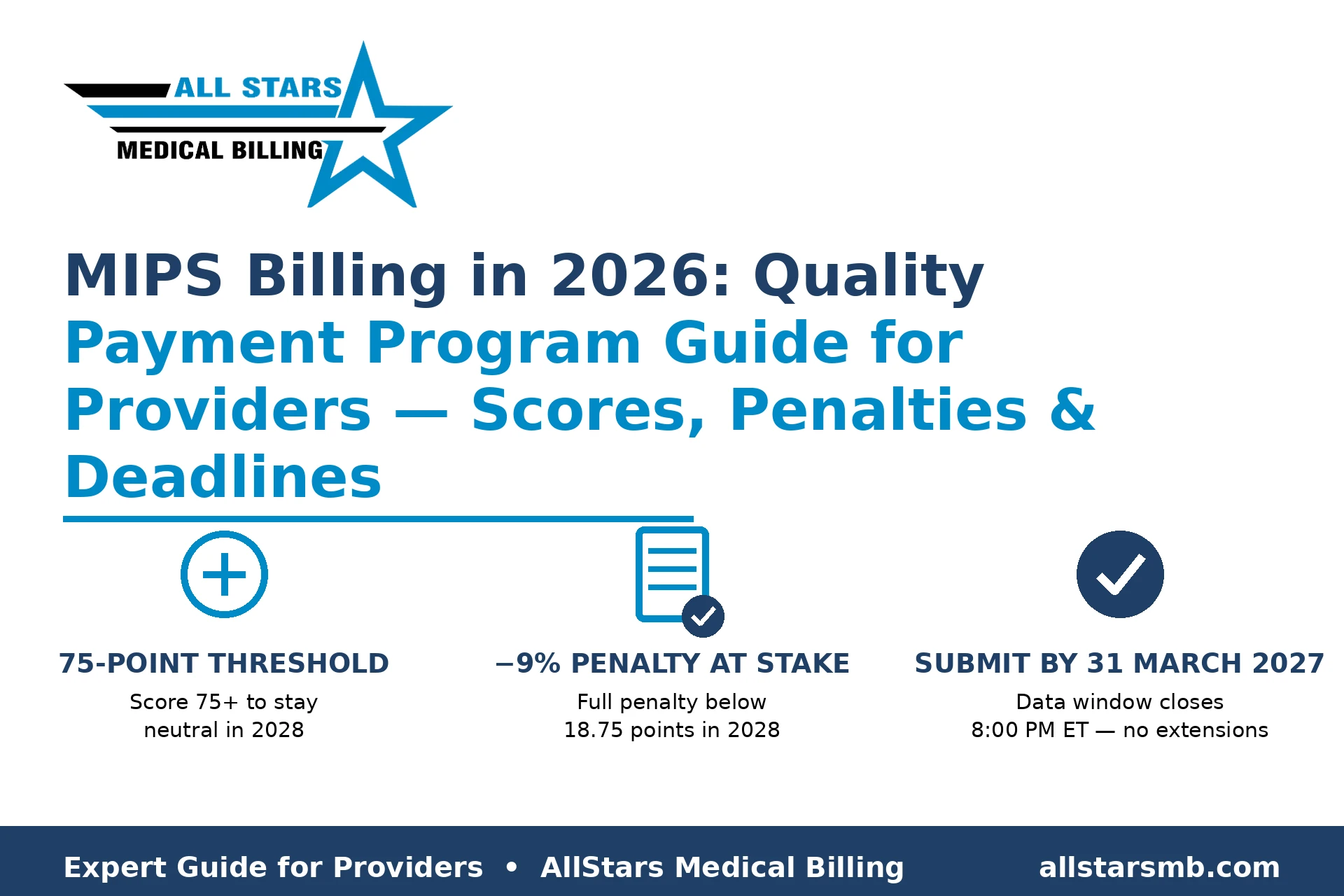
Your four category scores combine into a final score from 0 to 100. The number that matters most is 75: the performance threshold for 2026, unchanged since 2022 and finalized through the 2028 performance year. At exactly 75 points, your payment adjustment is zero, no penalty, no bonus. Above 75, you earn a positive adjustment. Below 75, the penalty grows the further below 75 you fall, reaching the full 9% at 18.75 or lower, one quarter of the threshold.
| Final score | 2028 payment adjustment |
| 100 | Positive, small, scaled by budget neutrality |
| 85 | Small positive |
| 75 | 0%, neutral |
| 70 | About -0.8% |
| 60 | About -2.4% |
| 50 | About -4.0% |
| 40 | About -5.6% |
| 30 | About -7.2% |
| 18.75 or below | Full penalty: -9% |
| 0 (required clinician reported nothing) | Full penalty: -9% |
Percentages between 75 and 18.75 are approximate, from the linear scale CMS uses (about 0.16 points per point below 75). The table is for planning. CMS applies the exact calculation to your own final score.
The dollars are easy to work out, and they are the reason the penalty matters more than the bonus. A practice with $500,000 in annual Medicare Part B revenue loses $45,000 to a full 9% penalty in 2028; a score of 50, worth about a 4% penalty, costs about $20,000. A solo clinician with $200,000 in Part B revenue faces a maximum of $18,000. The adjustment attaches to every Medicare Part B claim you bill during 2028, claim by claim, for the full year. And it repeats: ignore MIPS in 2026 and again in 2027, and you pay the penalty in 2028 and again in 2029.
The bonus side is the opposite story. Positive adjustments are funded only by the penalties collected, because MIPS is budget-neutral by law. In the 2026 payment year, the maximum positive adjustment was only 1.05%, the smallest in the program's history. Chasing a high score for the bonus is a poor return on effort; the realistic goal for most practices is the neutral band, 75 points or above, zero penalty. The pattern is familiar from Medicare Advantage downcoding: a different mechanism, the same lesson, money lost quietly, claim by claim, unless the workflow prevents it. A MIPS billing adjustment is not a claim denial, though: the claim is paid, at a reduced rate. If a claim is denied outright, work the denial reason on the remittance. See why medical claims get denied, because a denial and a payment adjustment need different fixes.
4. The MIPS timeline, three years, one score
MIPS billing runs on a three-year cycle, and mixing up the years is the most common planning mistake: the performance year is when you do the work, the submission year is when you send the data, and the payment year is when your Medicare payments change. For 2026, the cycle looks like this:
| Date | What happens |
| Jan 1 – Dec 31, 2026 | Performance year, collect Quality data all year; complete PI and IA periods inside the year |
| Nov 30, 2026 | MVP and subgroup registration closes |
| Dec 31, 2026 | Performance year ends |
| Jan 4, 2027 | Data submission window opens |
| Mar 31, 2027, 8:00 p.m. ET | Submission closes, no extensions, no late filing |
| Mid-2027 | CMS releases final scores; targeted review opens for about 30 days after payment information is released |
| Jan 1 – Dec 31, 2028 | Payment year, adjustments apply to every Medicare Part B claim |
Two notes on the dates. First, the submission window opening day: the CMS Quick Start Guides list 4 January 2027, while some CMS materials list 2 January 2027. Plan for early January and confirm the exact day on the Quality Payment Program website. The closing day is not in dispute, 31 March 2027 at 8:00 p.m. Eastern, with no extensions. Second, missing the deadline is the most expensive mistake in the program: a required clinician who submits nothing receives a score of zero and the full 9% penalty, with no recourse and no extension. Before you submit, run a medical billing audit checklist review, check the TIN and NPI pairing, the measure logic, and data completeness, because a measure pulled from the wrong denominator marks it as failed, and a failed measure counts zero.
5. Small practices: different weights, different rules
A small practice, for MIPS billing purposes, has 15 or fewer eligible clinicians under one Taxpayer Identification Number (TIN). Small practices get three breaks. First, Promoting Interoperability is reweighted to zero. You do not report it, and its weight moves to the other categories. Second, Improvement Activities requires only one activity instead of two. Third, Quality reporting earns small-practice bonus points, and small practices may report Quality measures through Medicare Part B claims.
Reweighting is automatic when a category cannot be scored. The most common scenarios for 2026 are:
| Scenario | Quality | Cost | Improvement Activities | Promoting Interoperability |
| All four categories scored | 30% | 30% | 15% | 25% |
| No Cost | 55% | 0% | 15% | 30% |
| No Promoting Interoperability | 55% | 30% | 15% | 0% |
| No Improvement Activities | 45% | 30% | 0% | 25% |
| No Cost and no Promoting Interoperability | 85% | 0% | 15% | 0% |
| Small practice, no Cost and no Promoting Interoperability | 50% | 0% | 50% | 0% |
Read the table as a planning tool, not a target: reweighting happens when a category cannot be scored, not something to aim for. A small practice that loses its Cost category to reweighting has 50% of its score riding on Quality alone, which makes measure selection and data completeness more important, not less. Small practices can also apply for a hardship exception for Promoting Interoperability, but it is not granted by default. If your practice has 15 or fewer clinicians and no dedicated MIPS staff, outside help pays for itself here: a single missed category can cost more than the support. See our services for what AllStars covers, and Section 11 for the MIPS-specific work.
6. Traditional MIPS vs. MVP vs. APP, which pathway fits
There are three ways to report MIPS billing. Traditional MIPS is the standard route described in this guide: the four categories, your choice of six Quality measures, and the full scoring rules. A MIPS Value Pathway (MVP) is a focused subset of measures built around a specialty or a clinical condition, fewer measures, more relevant to the way a particular specialty works. The APM Performance Pathway (APP) is the route for clinicians in an Alternative Payment Model; it uses a fixed, smaller set of measures.
MVPs are the direction the program is moving. For 2026, CMS expanded them from 21 to 27, adding pathways for podiatry, pathology, and four more specialties. Registration runs from 1 April to 30 November 2026; after that, traditional MIPS is your route for 2026, with no late registration. An MVP built for your specialty will usually ask for measures you already track; traditional MIPS asks you to choose six from about 195. Check the pathways for your specialty on our medical specialties page, then confirm the matching MVP on the Quality Payment Program website.
How to choose: if an MVP matches your specialty, your registry supports it, and you registered before the deadline, the MVP usually means less reporting work for a similar or better score. If no MVP fits, or your registry does not support the one you want, traditional MIPS is the right choice. It is not a worse choice; it is the general route. APP is only for APM participants. CMS has also proposed phasing out traditional MIPS (Section 9), so learning the MVP route now is learning the route the program is heading toward.
7. How to check your eligibility in two minutes
Do not guess whether MIPS billing applies to you. Check it, with your NPI number, on the Quality Payment Program website. The check takes about two minutes:
- Go to the QPP Participation Status Tool on the CMS Quality Payment Program website (qpp.cms.gov).
- Enter your 10-digit National Provider Identifier (NPI).
- Check your initial eligibility for 2026, required, opt-in eligible, or exempt, and whether you report as an individual, a group, or a virtual group.
- Check again after the performance year ends: CMS runs a final eligibility check on the full year's data, and your status can change between the two checks.
Before you check, confirm the basics: your Medicare enrollment status and the exact TIN and NPI pairing you bill under. A TIN/NPI mismatch is one of the most common validation failures in MIPS submissions. A measure pulled under the wrong pairing is marked as failed and counts zero. Confirm enrollment and eligibility through eligibility and benefit verification before you plan any reporting, and keep the pairing the same across your EHR, registry, and claims. If the tool says you are exempt, save the result with the date, so that a later question about why you did not report has a documented answer.
8. Seven mistakes that cost points
Most MIPS billing points are lost to process mistakes, not to poor clinical care. The seven below account for most avoidable score damage, and each has a different fix.
| Mistake | What it costs | Fix |
| Reporting nothing because the penalty felt small | Score 0, full -9% penalty | Report at least the minimum in every category; even a partial score beats zero |
| Choosing measures that do not fit your patients | Low benchmarks; topped-out measures capped | Pick 6 measures with enough eligible cases (case minimum 20) and room to score |
| Missing the PI pass/fail gate | Whole PI category scores 0, 25 points | Complete the security risk analysis and all attestations before submitting |
| Forgetting the 75% data completeness rule | Measure scores 0 | Report on at least 75% of eligible patients across all payers |
| Starting the 90-day or 180-day periods too late | Period cannot be completed in 2026 | Calendar the periods in January; last starts Jul 5 and Oct 3 |
| TIN/NPI mismatch or wrong reporting level | Measures fail validation and count zero | Confirm TIN/NPI pairing and individual vs. group status before submission |
| Missing the Mar 31, 2027 deadline | Zero score, full -9%, no extensions | Submit in February; treat Mar 31 as the last day, not the plan |
Two deserve emphasis because they are irreversible once the year ends. A performance period that was never started cannot be started retroactively. No 180-day PI period can be squeezed into December, and no 90-day improvement activity can be backdated. And a missed submission deadline has no appeal: the window closes on 31 March 2027 at 8:00 p.m. Eastern, and CMS does not grant extensions. Build these dates into your calendar the way you build timely filing deadlines into your claims workflow, and fold the checks into your standard medical billing denial prevention routine. When a problem is found, fix the workflow cause before the next cycle; see why medical claims get denied for the root-cause approach that works for denials and for MIPS gaps alike.
9. What changes in 2027, and what to plan for now
Three changes on the horizon matter for MIPS billing planning, and none of them changes what you must do for the 2026 performance year. First, CMS proposed in the Calendar Year 2027 Physician Fee Schedule proposed rule (CMS-1848-P, published July 2026) to phase out traditional MIPS for clinicians who do not participate in the APM Performance Pathway, beginning with the Calendar Year 2029 performance year and the 2031 payment year. This is a proposal, not a finalized change. Check the final rule on the Quality Payment Program website before you plan around it. Either way, MVPs and the APM pathway are where the program is heading.
Second, the Ambulatory Specialty Model launches on 1 January 2027. Participants are exempt from MIPS reporting in the years they must meet the model's requirements. If your specialty is covered, check participation before the 2027 performance year begins. An exemption you do not know about is as costly as a requirement you missed.
Third, a new Promoting Interoperability attestation requirement tied to the CMS interoperability rule (CMS-0057-F) takes effect for the 2027 performance year. Confirm the exact attestation on the Quality Payment Program website before the 2027 performance year starts, and read the wider changes in authorization in healthcare 2026. The same rule reshapes prior authorization timelines. Our prior authorization services cover the authorization side.
None of this changes the 2026 cycle. Report 2026 under 2026 rules, submit by 31 March 2027, and use 2027 to adopt whichever pathway, MVP, APP, or the Ambulatory Specialty Model, fits best.
10. Your Q4 2026 and Q1 2027 action plan
The performance year is nearly over, so this plan is honest about what can still be changed and what cannot. Work it in order. The items at the top still move your 2026 score.
- Rest of November 2026. Check eligibility today: run your NPI through the QPP Participation Status Tool and confirm your status and reporting level.
- By Nov 30, 2026. Register for an MVP if one fits your specialty. After that, traditional MIPS is the only route for this performance year.
- November-December 2026. Review your six Quality measures: confirm they still fit, check data completeness is on track for 75%, and fix any measure short of its 20-case minimum. Data collection runs through Dec 31, so this category can still improve.
- November-December 2026. Accept what is closed: PI and IA periods cannot be started now (last starts Jul 5 and Oct 3). If you missed them, plan for reweighting and document why; do not invent data to fill the gap.
- December 2026. Complete the PI pass/fail items if you ran a PI period: security risk analysis and all required attestations. Validate a sample of measures against benchmarks and audit the data you will submit, using your medical billing audit checklist and the RCM checklist for US medical practices 2026.
- Early January 2027. Confirm the submission window opening on the Quality Payment Program website (CMS Quick Start Guides list Jan 4, 2027) and choose your route: the QPP portal, your EHR, a qualified registry, or a QCDR.
- February 2027. Submit. Treat February as the deadline and March as the buffer: validation errors take weeks to fix, and the window does not extend.
- Mar 31, 2027, 8:00 p.m. ET. Hard deadline. A submission after this time is not accepted, and a required clinician who submits nothing scores zero.
- Mid-2027. Review your final score when CMS releases it. If it is wrong, request a targeted review within about 30 days, the window is short.
- 2028. Track the payment adjustment on your remittances through the year: record it using the medical billing KPIs 2027 guide, and your patient billing and tracking system to make sure reduced payments are posted correctly and not mistaken for denials.
If no one owns this plan, assign it now, with the dates above on their calendar. MIPS billing fails quietly: nobody notices a missed period until the score arrives, and by then it is too late.
11. How AllStars Medical Billing helps with MIPS billing
MIPS revenue is lost in the details: a measure chosen badly, a completeness percentage missed, an attestation forgotten, or a submission filed in the last week of March. AllStars builds those details into a repeatable workflow for your practice.
- Eligibility checks, QPP status lookup by NPI, low-volume threshold review, and confirmation of your reporting level.
- Measure selection, six Quality measures matched to your specialty and patient mix, checked against case minimums and data completeness, with codes verified against the CPT codes in medical billing: complete guide 2026.
- Data completeness and audit review, claims and EHR data checked against the 75% rule and the 20-case minimum, with gaps flagged while the year is open.
- Attestation tracking, PI pass/fail items and Improvement Activities evidence tracked to completion, so no category scores zero for a missed attestation.
- Submission support, registry, QCDR, EHR, or QPP portal submission prepared in February, not March, with errors fixed before the deadline.
- 2028 payment monitoring, adjustments tracked on remittances through the payment year, so a penalty is measured and explained, not discovered by accident.
AllStars supports practices in all 50 states across more than 50 specialties. Explore our medical billing services, review plans and pricing, or talk to us about special services and the medical specialties we support. If you use technology to streamline tracking, also read our perspective on AI in medical billing 2026. Before reporting, make sure every billing practitioner is properly enrolled. Our credentialing and enrollment team can confirm enrollment status so a credentialing gap does not become a MIPS problem.
Ready to protect your 2028 Medicare payments? Contact AllStars Medical Billing for a review of your MIPS eligibility, your six Quality measures, and your submission readiness.
12. Frequently asked questions
Do I have to report MIPS billing in 2026? Only if you are a MIPS-eligible clinician who exceeds the low-volume threshold, more than $90,000 in Part B charges, more than 200 Part B patients, and more than 200 covered services. Check your status with your NPI on the QPP Participation Status Tool; do not guess. Clinicians below the threshold, first-year Medicare enrollees, and Qualifying APM Participants are generally exempt.
What happens if my score is below 75? You receive a negative payment adjustment on every Medicare Part B claim in 2028. The penalty scales linearly from 0% at 75 points to the full 9% at 18.75 points or below. A score of 50 means about a 4% reduction for the year.
What happens if I report nothing at all? If you were required to report, you receive a final score of zero and the full 9% penalty in 2028. Reporting at least the minimum almost always produces a better result.
Is MIPS the same thing as MACRA? No. MACRA is the 2015 law that created the Quality Payment Program. MIPS is one track inside that program; the other is Advanced Alternative Payment Models. Most clinicians who bill Part B are in MIPS unless they qualify for an APM track.
Can a small practice skip Promoting Interoperability? A small practice, 15 or fewer eligible clinicians, has Promoting Interoperability reweighted to zero automatically, and the weight moves to Quality and Improvement Activities. Small practices also attest to only one Improvement Activity.
What is an MVP, and should I use one? A MIPS Value Pathway is a focused set of measures built around a specialty or condition. For 2026 there are 27 MVPs. If one matches your specialty and your registry supports it, it usually means fewer, more relevant measures. Registration closes Nov 30, 2026.
When do I find out my 2026 score? CMS releases final scores in mid-2027, after the window closes on Mar 31, 2027. If your score is wrong, you can request a targeted review within about 30 days of CMS releasing the payment information.
Conclusion: the score is decided by the workflow, not the clinic
MIPS billing does not reward the best clinicians. It rewards the practices whose workflows capture the data, complete the periods on time, pass the attestation gates, and submit before the deadline. The clinical work is already done. It happened in your exam rooms all year. The score depends on whether that work was recorded, measured, and submitted in the form CMS asks for. A practice that checks eligibility now, confirms its six measures, and submits in February keeps its full Medicare payment in 2028. A practice that waits until March discovers the gaps when there is no time left to fix them.
Start with the two-minute check: your NPI, the QPP Participation Status Tool, and the answer to whether MIPS applies to you. Then work the plan in Section 10. If you want the whole cycle handled, eligibility, measures, attestations, and submission, our medical billing services and the wider complete revenue cycle management process take it on as one workflow.