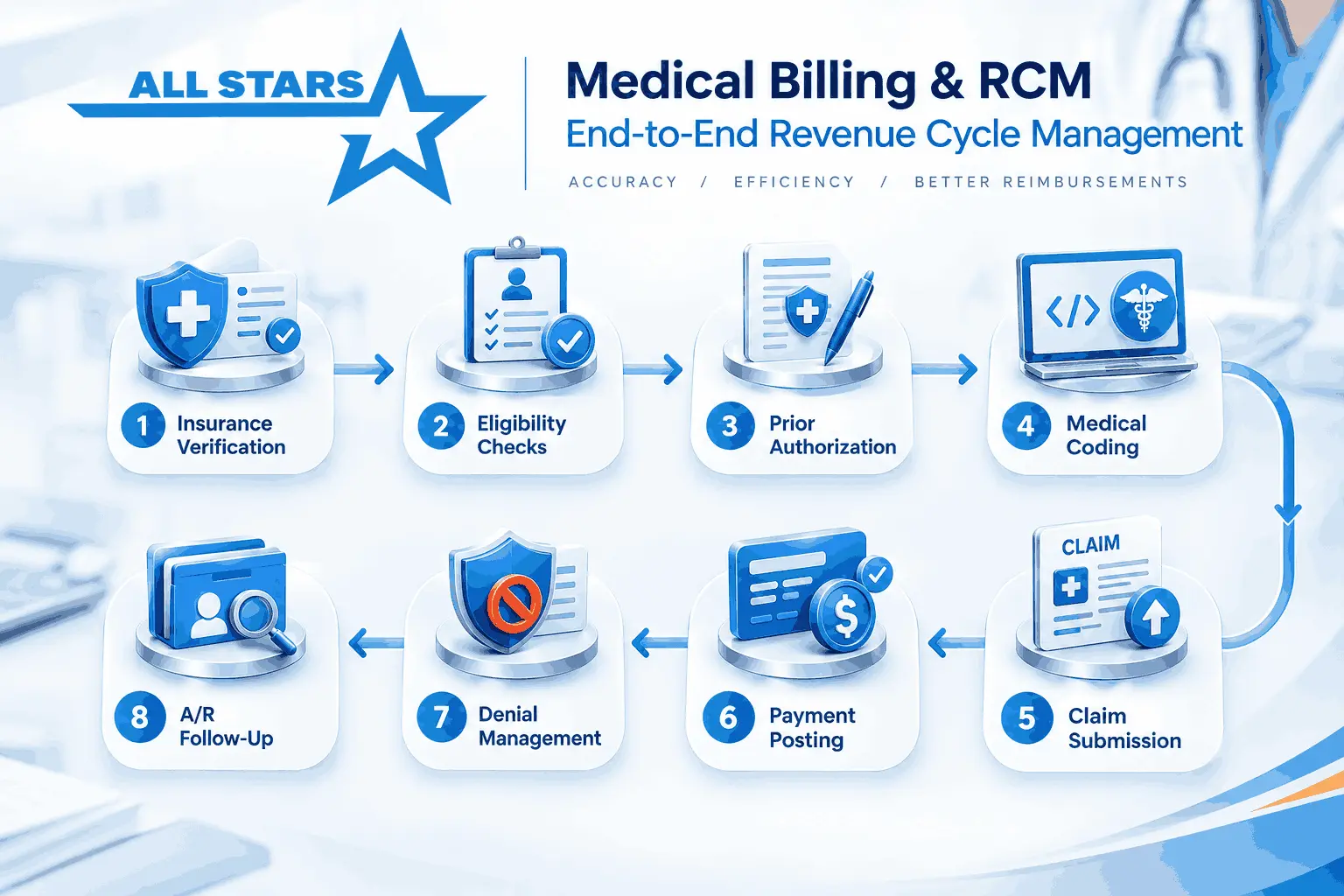

Having a lot of work does not always translate to good revenues. Healthcare practices that have a great patient population and file thousands of claims per month could still have their revenues suffer from errors in coding, billing, problems related to patient eligibility, claim denials, underbilling, and other reasons related to delays in A/R follow-up. Over time, these recurring problems could end up causing a lot of financial damage to the business.
What Is a Medical Billing Audit?
A medical billing audit is a systematic review of a practice’s billing and revenue cycle management (RCM) processes. It identifies errors, inefficiencies, compliance risks, missed revenue, and payment problems.
A comprehensive audit typically reviews:
- Patient registration and demographics
- Insurance eligibility and benefits verification
- Prior authorizations and referrals
- Medical coding and modifiers
- Charge capture
- Claim submission, rejections, and denials
- Payment posting and underpayments
- Accounts receivable (A/R) and timely filing
- Patient billing and collections
- Billing KPIs
Why Should Healthcare Practices Conduct a Medical Billing Audit?
Billing involves many steps, systems, staff members, and payer rules. A small error at the start can cause problems later:
Incorrect insurance information → claim rejection → delayed correction → delayed payment → higher A/R → extra staff work
Incorrect coding → payer denial → appeal or corrected claim → delayed reimbursement
Occasional errors are manageable. Repeated ones hurt cash flow. An audit helps you spot patterns instead of treating each problem as a one-off.
15 Things to Check in a Medical Billing Audit
A medical billing audit should look beyond whether claims were submitted and paid. A complete audit examines the entire revenue cycle, from patient registration and insurance verification to coding, claim submission, payment posting, accounts receivable, and patient collections.
The following 15 areas can help healthcare providers identify revenue leakage, preventable denials, billing errors, and process gaps.
Patient Demographics
Accurate patient information is the foundation of clean claims. Even a small error in a patient’s name, date of birth, address, or insurance information can result in claim rejection or payment delays.
During the audit, verify:
- Patient name, date of birth, address, and contact information
- Subscriber name and relationship to the patient
- Member ID and group number
- Patient and guarantor information
- Consistency of demographic information across visits
Insurance Eligibility Verification
Insurance eligibility verification is one of the most important front-end controls in the revenue cycle. A patient may have an insurance card, but that does not necessarily mean the coverage is active or that the specific service is covered.
Review whether staff are checking:
- Active coverage and effective or termination dates
- Copay, deductible, and coinsurance
- Out-of-pocket requirements
- Provider network participation
- Referral requirements
- Authorization requirements
- Coverage limitations and exclusions
Benefits and Patient Responsibility
Active insurance coverage does not automatically mean the insurance company will pay the entire bill. Patients may still be responsible for deductibles, copayments, coinsurance, or non-covered services.
An audit should determine whether the practice accurately identifies:
- Deductible amounts and remaining balances
- Copayments
- Coinsurance
- Out-of-pocket maximums
- Non-covered services
- Patient responsibility after insurance processing
Prior Authorization and Referrals
Authorization and referral requirements should be reviewed before services are performed whenever applicable. Missing or incorrect authorization information can turn an otherwise payable claim into a preventable denial.
Check:
- Authorization number
- Approved service or procedure
- Authorization effective and expiration dates
- Number of approved visits or units
- Ordering or referring provider
- Supporting clinical documentation
- Referral requirements
Charge Capture
Every billable service should be captured accurately and submitted for reimbursement. Missed charges can create significant revenue leakage, particularly in high-volume practices.
Compare clinical documentation, encounter records, charge tickets, and claims to identify:
- Missed charges
- Duplicate charges
- Incorrect quantities or units
- Incorrect service dates
- Unbilled encounters
- Delayed charge entry
- Services documented but not billed
Medical Coding Accuracy
Coding directly affects reimbursement, claim processing, and compliance. An audit should confirm that the codes submitted on claims are supported by the medical record.
Review:
- CPT codes
- HCPCS codes
- ICD-10-CM diagnosis codes
- Diagnosis-to-procedure relationships
- Code selection and documentation support
- Upcoding and downcoding risks
- Unbundling
- Missing or unsupported codes
- Coding consistency among providers
Modifier Usage
Modifiers provide additional information about how or why a service was performed. However, incorrect modifier use can result in claim denials, incorrect reimbursement, or compliance concerns.
During the audit, review commonly used modifiers for:
- Documentation support
- Correct application
- Payer-specific requirements
- Repeated modifier-related denials
- Patterns of inappropriate or unnecessary modifier use
Claim Submission Accuracy
Before a claim leaves the practice, important information should be accurate and complete. Review whether claims contain the correct:
- Patient information
- Provider information
- NPI
- Tax identification information
- Place of service
- CPT and HCPCS codes
- ICD-10-CM codes
- Modifiers
- Units
- Charges
- Payer information
Also review the claim submission timeline. Delays between the date of service and claim submission can affect cash flow and increase the risk of timely-filing problems.
Claim Rejections and Denials
Denials should be treated as data that can reveal weaknesses in the billing process.
Analyze denials by:
- Payer
- Provider
- Procedure
- Denial reason
- Location
- Frequency
- Dollar value
- Date of service
For example, repeated eligibility denials may indicate a front-end verification problem, while recurring coding denials may point to documentation or coding issues.
The objective is to identify the root cause, not simply resubmit the same claim repeatedly.
Payment Posting Accuracy
Accurate payment posting is essential for maintaining reliable accounts receivable records.
Review whether the billing team correctly posts:
- Insurance payments
- Patient payments
- Contractual adjustments
- Secondary insurance payments
- Refunds
- Recoupments and takebacks
- Credit balances
- Unapplied cash
Incorrect posting can make A/R reports unreliable and may cause staff to follow up on balances that have already been resolved.
Underpayments
A claim being paid does not necessarily mean it was paid correctly.
Compare payer payments against applicable contracted or expected reimbursement amounts. Look for:
- Incorrect allowed amounts
- Missing contractual adjustments
- Incorrect units
- Partial payments
- Unexpected reductions
- Incorrect patient responsibility
- Repeated payer payment discrepancies
Individual underpayments may appear small, but recurring discrepancies across hundreds or thousands of claims can represent meaningful lost revenue.
Accounts Receivable Aging
A/R aging shows how long unpaid balances have remained outstanding. Review balances across standard aging categories such as:
- 0–30 days
- 31–60 days
- 61–90 days
- 91–120 days
- 120+ days
Do not focus only on the total A/R balance. Determine why accounts are aging.
Look for unpaid claims, unresolved denials, missing documentation, payer delays, patient balances, credit issues, and timely-filing or appeal deadlines.
Older A/R generally requires closer attention because the opportunity to recover certain balances may decrease over time.
A/R Follow-Up and Claim Status
A/R only improves when outstanding balances are actively worked.
During the audit, determine whether staff are:
- Checking claim status with payers
- Following up on unpaid claims
- Working denials
- Filing appeals
- Submitting corrected claims when appropriate
- Documenting payer conversations
- Recording follow-up dates
- Tracking the next required action
Prioritize accounts based on factors such as age, balance, payer, denial reason, and potential recoverability.
Patient Billing and Collections
Patient balances should be based on accurate insurance processing and correctly posted payments.
Review whether patient statements are:
- Accurate
- Timely
- Easy to understand
- Sent to the correct address
- Consistent with insurance payment information
Also examine the practice’s handling of:
- Payment plans
- Credit balances
- Refunds
- Returned statements
- Patient billing questions
- Collection workflows
A well-organized patient billing process can improve collection efficiency while reducing confusion and unnecessary billing disputes.
Billing KPIs and Performance Trends
A medical billing audit should not end with individual claim errors. Providers should also evaluate performance trends across the revenue cycle.
Useful KPIs may include:
- Clean claim rate
- First-pass resolution rate
- Claim denial rate
- Denial recovery rate
- Days in A/R
- A/R over 90 days
- Gross collection rate
- Net collection rate
- Charge lag
- Coding error rate
- Patient collection rate
Compare these metrics over time rather than looking at a single reporting period. Trends can help identify whether billing processes are improving, remaining stable, or developing new problems.
Medical Billing Audit Checklist
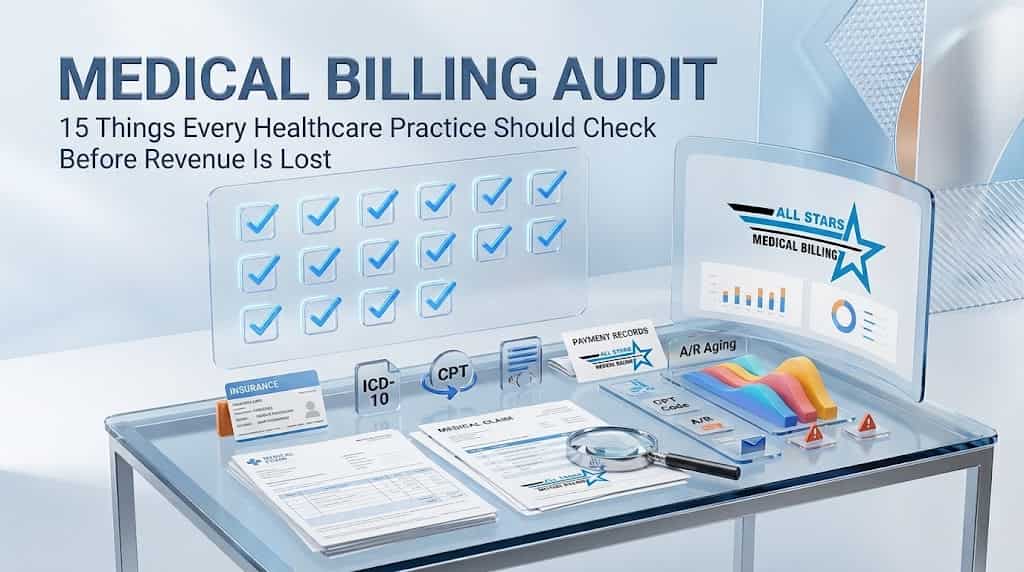
| Audit Area | What to Check |
|---|---|
| Patient Demographics | Accuracy and completeness |
| Eligibility | Active coverage and benefits |
| Authorization | Required approvals and referrals |
| Charge Capture | Missed or duplicate charges |
| Coding | CPT, HCPCS, ICD-10-CM, and modifiers |
| Claims | Accuracy and timely submission |
| Denials | Patterns and root causes |
| Payment Posting | Payments and adjustments |
| Underpayments | Contract reimbursement accuracy |
| A/R | Aging and outstanding balances |
| A/R Follow-Up | Claim status and recovery activity |
| Patient Billing | Statements and balances |
| KPIs | Revenue cycle performance |
How Often Should You Perform a Medical Billing Audit?
There’s no one-size-fits-all schedule. Frequency depends on practice size, patient and claim volume, number of providers, specialty, payer mix, denial rate, and past audit findings.
Many practices run smaller monthly reviews plus a comprehensive quarterly or annual audit. Consistency matters more than the exact schedule, so don’t wait until revenue problems become obvious.
What to Do After a Medical Billing Audit
An audit is only useful if it leads to an action plan. For each issue, document:
- What went wrong
- How often it happens
- How much revenue it affects
- The root cause
- Who is responsible for the fix
- What process needs to change
- How improvement will be measured
Example:
- Problem: Eligibility-related denials are rising.
- Likely cause: Eligibility is checked too early or not re-verified.
- Action: Strengthen the verification workflow.
- Measurement: Track eligibility denials monthly.
Common Medical Billing Audit Mistakes to Avoid
- Only reviewing denied claims. Denials are just one part of the revenue cycle.
- Ignoring front-end processes. Registration, eligibility, and authorization affect everything downstream.
- Looking only at percentages. A low denial rate can still mean large dollar losses at high volume.
- Focusing only on coding. Missed charges, underpayments, A/R, and posting errors also cost revenue.
- Skipping root-cause analysis. Fixing individual claims lets the same problem return.
- Not tracking results. Without measurement, you can’t tell if changes worked.
How a Medical Billing Audit Protects Practice Revenue
An audit can surface missed billable services, incorrect insurance data, authorization gaps, coding errors, repeated denials, posting mistakes, underpayments, aging A/R, weak follow-up, and patient billing errors.
More importantly, it connects them. Rising denials, for instance, may trace back to eligibility or authorization gaps. The fix isn’t to “work more denials” but to strengthen the step where the problem starts.
Need Help With Your Medical Billing Audit?
If your practice is dealing with rising denials, aging A/R, payment delays, or unexplained revenue gaps, an expert review can show where the process is breaking down.
At AllStars Medical Billing & IT Services, we help providers strengthen their revenue cycle, from eligibility verification and coding to claim management, denial follow-up, payment posting, and A/R recovery.
AllStars Simplifying Healthcare. Supporting Growth.