Medical claim denials remain one of the biggest challenges facing healthcare providers, medical practices, hospitals, ambulatory surgery centers, and other healthcare organizations in the United States, making medical billing denial prevention an essential part of an effective revenue cycle management strategy.
A denied claim does more than delay payment. It creates additional administrative work, increases accounts receivable, consumes staff time, delays cash flow, and can ultimately result in lost revenue when claims are not corrected or appealed within the payer’s required timeframe.
In 2026, denial prevention has become increasingly important because healthcare organizations are dealing with more complex payer policies, frequent coding changes, prior authorization requirements, electronic transactions, documentation requirements, and increasingly automated claim-review processes.
The most effective approach is no longer simply to work denials after they occur. High-performing organizations are moving toward a proactive denial prevention strategy that identifies problems before claims are submitted.
This guide explains what medical billing denials are, why they happen, how to prevent them, how to manage unavoidable denials, which KPIs to monitor, and how technology and artificial intelligence are changing denial prevention in 2026.
What is a Medical Billing Claim Denial?
A claim denial refers to a refusal by an insurance carrier to pay all or some of a health care claim based on evaluation of the claim against its guidelines, coding guidelines, authorizations, contracts, medical necessity and administrative requirements.
The denial may be issued prior to payment or even following initial processing of the claim by the payer.
Examples of common denials include:
- Insurance for patient has lapsed
- Patient details do not match those in payer’s database
- Required authorization not provided
- Authorization details mismatched
- CPT/HCPCS code is wrong
- ICD-10-CM code does not justify the service
- Modifier missing or wrong
- Provider not credentialed correctly
- Details do not meet medical necessity criteria
- Claims filed beyond filing period
- Non-covered service
- Duplicate claim
- Errors in coordination of benefits
- Policy limitation
A denial must not be taken as just an unpaid claim.
Denial Prevention vs. Denial Management
These terms are related but have different purposes.
Medical Billing Denial Prevention
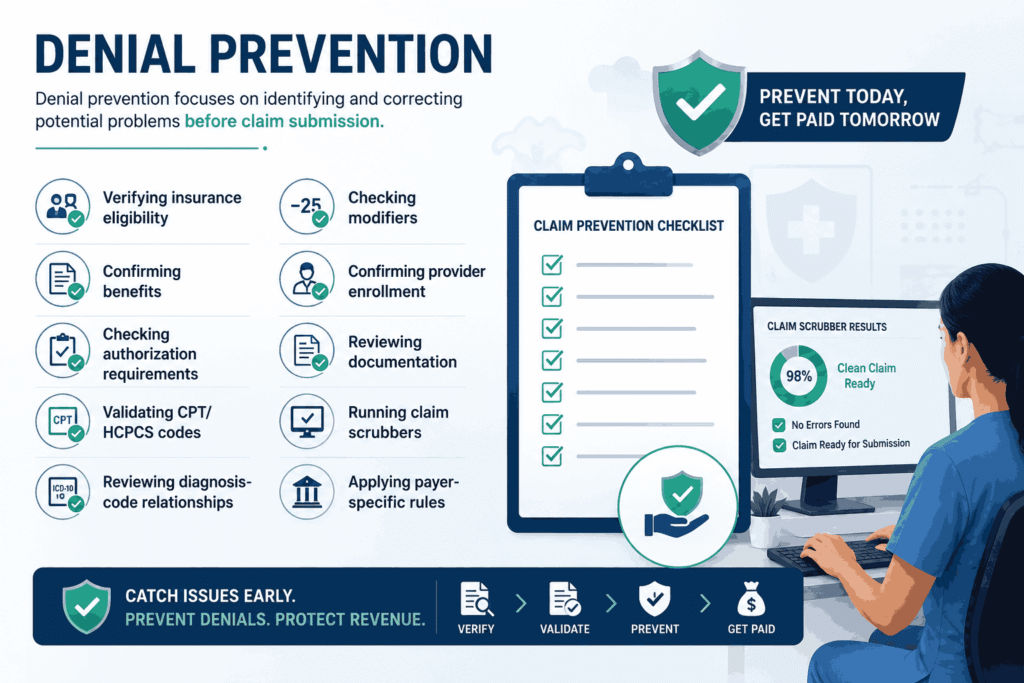
Denial prevention focuses on identifying and correcting potential problems before claim submission.
Examples include:
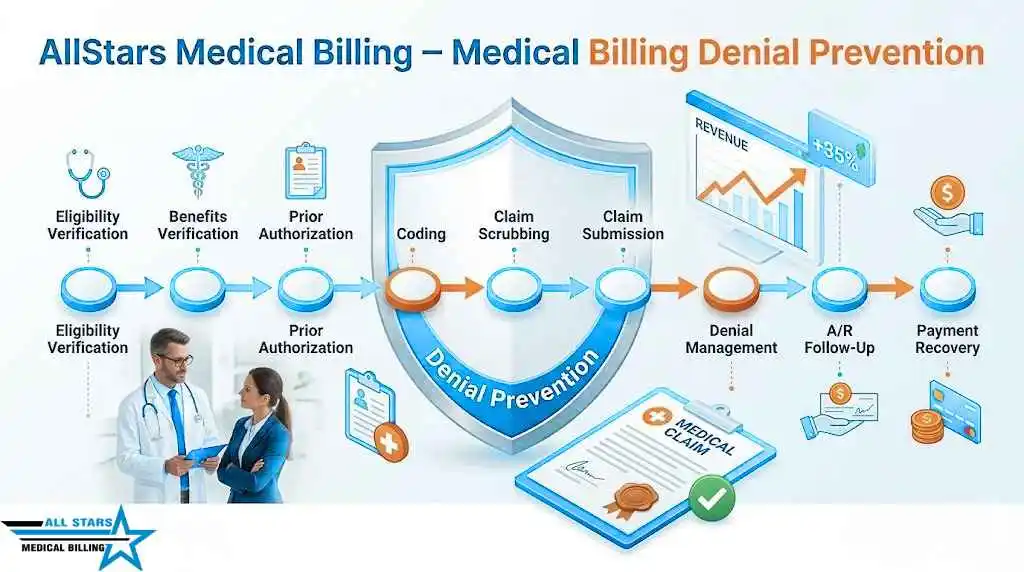
- Verifying insurance eligibility
- Confirming benefits
- Checking authorization requirements
- Validating CPT/HCPCS codes
- Reviewing diagnosis-code relationships
- Checking modifiers
- Confirming provider enrollment
- Reviewing documentation
- Running claim scrubbers
- Applying payer-specific rules
Medical Billing Denial Management
Denial management occurs after a payer has denied a claim.
It involves:
- Identifying the denial
- Reviewing payer explanation
- Determining root cause
- Correcting claim
- Obtaining documentation
- Filing appeals
- Resubmission
- Tracking outcome
- Preventing recurrence
Why Claim Denials Are a Major Problem for Healthcare Practices
A denial creates multiple financial consequences:
- Delayed Cash Flow
- Increased Administrative Work
- Higher Accounts Receivable
- Timely Filing Risk
- Staff Productivity Loss
- Revenue Leakage
- Patient Experience Issues
The Three Major Categories of Claim Problems
- Rejected Claims
Errors before payer adjudication (format, missing data, invalid IDs).
- Denied Claims
Payer processes claim but refuses payment.
- Underpaid Claims
Claim is paid incorrectly or below contract rate.
A strong revenue cycle monitors:
Rejections + Denials + Underpayments + Unpaid Claims
Most Common Causes of Medical Claim Denials in 2026
| NO# | Denial Cause | Common CARC Code(s) | Typical Meaning |
|---|---|---|---|
| 1 | Incorrect Patient Demographics | 16, 31 | Missing/incorrect information; patient cannot be identified |
| 2 | Insurance Eligibility Issues | 27, 31 | Coverage terminated or patient not eligible |
| 3 | Missing or Incorrect Prior Authorization | 197, 39 | Authorization/precertification absent or required |
| 4 | CPT/HCPCS Coding Errors | 4, 5, 97 | Procedure code/modifier issue or service included in another service |
| 5 | ICD-10-CM Coding Errors | 16, 50, 167 | Missing/invalid information or diagnosis does not support service |
| 6 | Modifier Errors | 4, 5, 97 | Incorrect/inappropriate modifier or procedure bundling |
| 7 | Medical Necessity Denials | 50, 55, 56 | Service does not meet payer medical-necessity criteria |
| 8 | Documentation Deficiencies | 16, 252 | Missing information or required documentation/attachment |
| 9 | Credentialing & Enrollment Issues | 16, 29, 170 | Provider information/enrollment issue or required information missing |
| 10 | Timely Filing | 29 | Claim submitted after the filing deadline |
| 11 | Duplicate Claims | 18 | Exact or suspected duplicate claim/service |
| 12 | Coordination of Benefits (COB) Errors | 22 | Care may be covered by another payer |
| 13 | Non-Covered Services | 96, 97 | Non-covered service or service included in another service |
| 14 | Place of Service (POS) Errors | 5, 16, 97 | Incorrect/incomplete billing information or service included/bundled |
| 15 | Payer-Specific Billing Rules | 16, 96, 97, 208 | Claim does not meet payer-specific billing/payment requirements |
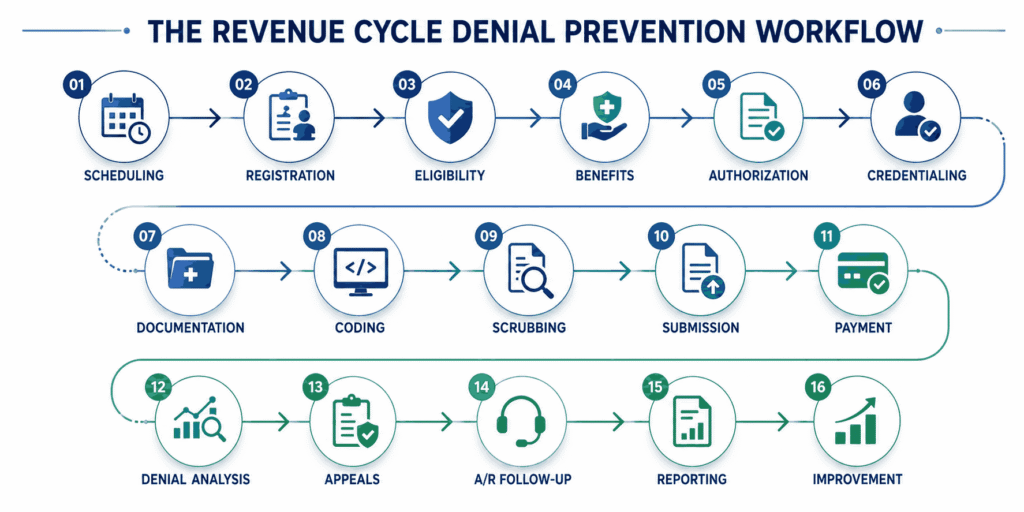
The Revenue Cycle Denial Prevention Workflow
How to Build a Strong Denial Prevention Program
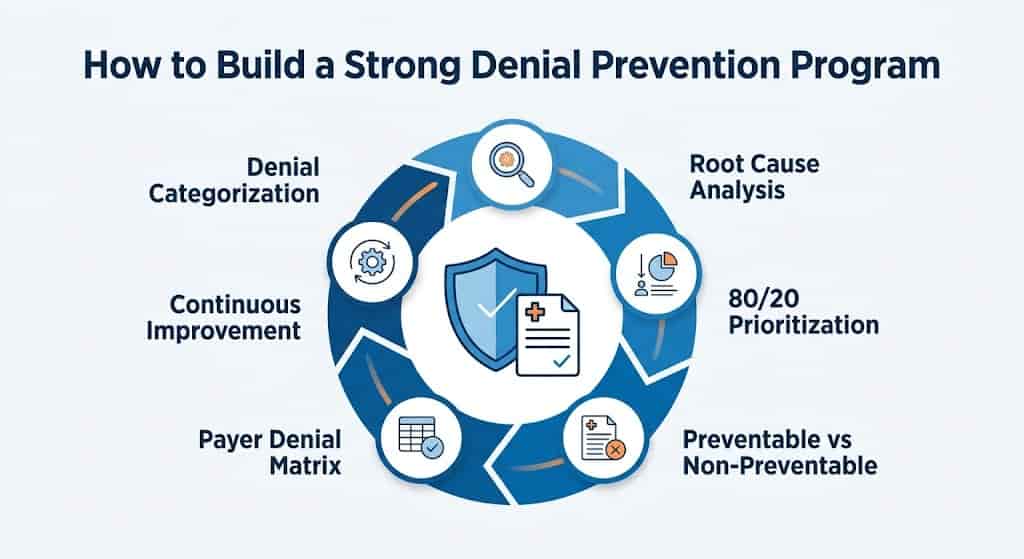
A successful medical billing denial prevention program requires a structured process that identifies problems, measures their financial impact, and addresses the root cause. Instead of simply correcting denied claims after payment has been rejected, healthcare organizations should establish preventive controls throughout the revenue cycle.
Step 1: Denial Categorization
Standardize denial types using categories such as eligibility, authorization, coding, medical necessity, documentation, timely filing, credentialing, duplicate claims, and coordination of benefits. Consistent categorization makes it easier to identify recurring problems and determine which areas require immediate attention.
Step 2: Root Cause Analysis
Identify why the denial happened rather than simply correcting the individual claim. For example, an authorization denial may result from a scheduling error, an eligibility verification problem, an incorrect CPT code, or an expired authorization. Understanding the underlying cause allows the practice to fix the workflow and prevent similar denials in the future.
Step 3: Apply the 80/20 Rule
Analyze denial data to identify the small number of denial categories responsible for a large percentage of lost revenue or administrative workload. Practices can then prioritize the highest-impact problems instead of treating every denial with the same level of urgency.
Step 4: Preventable vs. Non-Preventable Denials
Separate controllable denials from payer processing issues and other problems that may not have been reasonably preventable. Preventable denials can include incorrect patient information, eligibility errors, missing authorization, coding mistakes, and timely-filing problems.
Step 5: Create a Payer Denial Matrix
Track payer-specific denial patterns, including denial codes, claim types, CPT/HCPCS codes, authorization requirements, filing deadlines, and appeal procedures. A payer denial matrix gives billing teams a centralized reference for preventing recurring problems.
AI and Automation in Denial Prevention
Technology is becoming an important part of modern revenue cycle management. AI and automation can help billing teams identify potential problems before claims reach the payer.
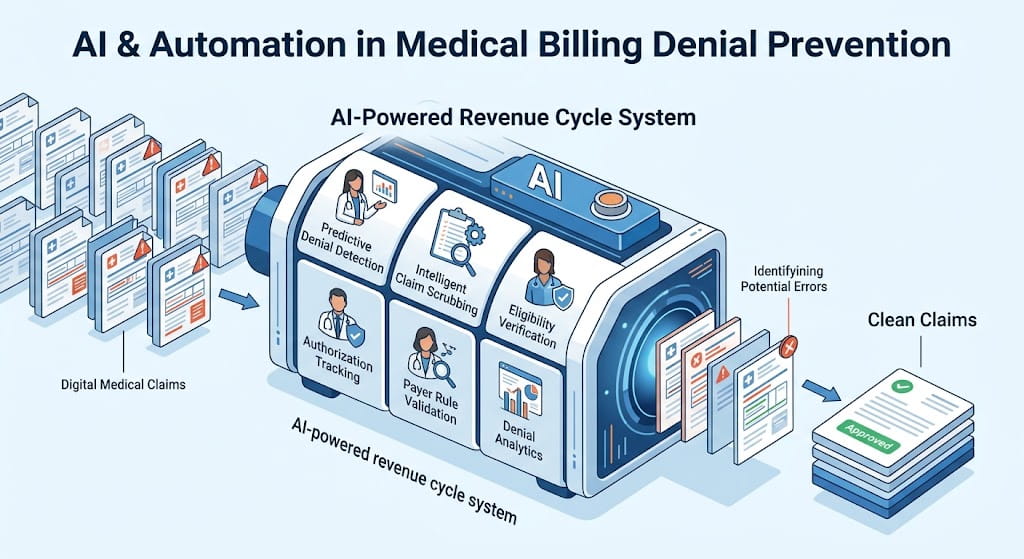
AI-supported denial prevention tools can analyze historical claims and identify patterns associated with eligibility problems, coding errors, authorization issues, documentation gaps, and payer-specific requirements.
AI can assist with:
- Predictive denial detection
- Intelligent claim scrubbing
- Eligibility verification
- Authorization tracking
- Payer-rule validation
- Pattern recognition
- Denial trend analysis
- Automated work queues
However, technology should complement experienced billing and coding professionals rather than completely replace human review. Complex claims often require clinical, coding, contractual, or payer-specific judgment.
Prior Authorization in 2026
Prior authorization remains a major challenge for healthcare organizations and an important area of denial prevention. Practices should not consider authorization a one-time administrative task. It should be managed throughout the patient’s revenue cycle.
Key Prior Authorization Lifecycle
- Identify whether authorization is required.
- Verify the payer’s requirements.
- Submit the authorization request.
- Provide required clinical documentation.
- Track approval or denial.
- Confirm the authorization number.
- Match the authorization to the CPT/HCPCS code.
- Verify the authorized dates and units.
- Monitor expiration.
- Match authorization information to the final claim.
- Appeal when appropriate.
An authorization may still result in a denial if the approved service, provider, facility, date, units, or procedure code does not match the claim. Therefore, authorization verification should continue through claim submission.
CPT 2026 & ICD-10 Updates
Coding updates are another important component of medical billing denial prevention. Outdated codes can result in claim rejections, denials, incorrect reimbursement, or medical-necessity issues.
The CPT 2026 update includes:
- 288 new CPT codes
- 84 deleted codes
- 46 revised codes
- 418 total changes
Medical practices should update their billing software, coding resources, claim scrubbers, charge masters, and payer-specific coding rules before implementing new codes.
The ICD-10-CM update effective October 1, 2026 should also be incorporated into the organization’s coding and billing workflow before the implementation date. Coding teams should review new, revised, and deleted diagnosis codes and complete appropriate staff training.
Specialty-Specific Denial Risks
Different specialties face different denial risks. A successful denial prevention strategy should therefore be customized according to specialty, payer mix, services provided, and claim volume.
Orthopedics
Common risks include surgery authorization, imaging authorization, medical necessity, modifier usage, and global surgery rules.
Physical Therapy
Common risks include authorization requirements, visit limits, units, medical necessity, documentation, and plan-of-care requirements.
Behavioral Health
Common risks include authorization, telehealth requirements, diagnosis coding, documentation, network restrictions, and benefit limitations.
Radiology
Common risks include imaging authorization, medical necessity, professional and technical components, modifiers, and place-of-service requirements
Ambulatory Surgery Centers
Common risks include authorization, site-of-service requirements, bundling, modifier usage, medical necessity, and facility/provider enrollment.
Because denial patterns vary between specialties, practices should analyze their own historical data instead of relying only on industry-wide benchmarks.
Denial KPIs
Tracking the right KPIs allows practice managers to determine whether their denial-prevention efforts are actually working.
Important metrics include:
- Denial Rate
- Clean Claim Rate
- Initial Denial Rate
- Appeal Success Rate
- Denial Recovery Rate
- A/R Days
- Timely Filing Losses
- Authorization Denial Rate
- Eligibility Denial Rate
- Coding Denial Rate
- Average Denial Resolution Time
- Preventable Denial Rate
- Denial Dollars
- Underpayment Rate
Management should monitor both claim volume and financial value. A small number of high-dollar denials may have a greater impact than hundreds of low-dollar claims.
AllStars Medical Billing Advantage
AllStars Medical Billing operates with a performance-driven revenue cycle model designed to help healthcare providers reduce administrative burden, improve collections, and strengthen their overall revenue cycle.
Denials Below 8% Monthly
AllStars actively monitors claim quality through proactive claim scrubbing, front-end verification, coding review, and denial analysis to work toward maintaining denial rates below 8%.
Old A/R Recovery & Follow-Up
Dedicated A/R teams follow up on aging accounts, investigate unpaid claims, and work to recover outstanding revenue before balances become difficult to collect.
Monthly Performance Reports
Clients receive detailed monthly analytics covering denial trends, collections, A/R performance, and key revenue cycle metrics. These reports help practices identify opportunities for improvement.
Free Coding Audit
AllStars provides complimentary coding audits to identify potential coding errors, compliance concerns, documentation gaps, and missed revenue opportunities.
Review of Underpaid Claims
Systematic underpayment reviews help identify situations where payer reimbursement may not align with applicable contractual expectations.
Down coding & Upcoding Analysis
Coding reviews can identify potential undercoding and overcoding risks while helping ensure that claims accurately reflect the documented services.
Patient Billing Services
Patient billing support can include statement management, patient follow-up, balance inquiries, and payment coordination.
Patient Balance Tracker
Patient balances can be monitored to improve visibility into outstanding amounts and support more consistent patient A/R follow-up.
Free Denial Tracking System
AllStars provides a structured denial tracking approach to categorize, monitor, analyze, and resolve denials while identifying recurring root causes.
denial prevention in medical billing is no longer simply a back-office billing function. It is an important component of a healthcare organization’s overall revenue strategy.
Why is denial prevention important for medical practices?
Effective denial prevention helps reduce lost revenue, minimize claim rework, improve cash flow, and make the revenue cycle more efficient.
What are the most common causes of medical billing claim denials?
Common causes include incorrect patient information, insurance eligibility issues, missing prior authorization, coding errors, incorrect modifiers, duplicate claims, missing documentation, and timely filing issues.
How can healthcare providers reduce claim denials?
Providers can reduce denials by verifying insurance eligibility, obtaining required authorizations, reviewing patient information, using accurate CPT and ICD-10 codes, checking modifiers, and conducting pre-submission claim reviews.
Can medical coding errors cause claim denials?
Yes. Incorrect CPT, HCPCS, or ICD-10 coding, missing modifiers, diagnosis-code mismatches, and unsupported services can result in claim denials or payment delays.
How does denial prevention improve revenue?
By reducing avoidable denials and accelerating clean claim payments, denial prevention can help practices improve collections, reduce administrative rework, and maintain healthier cash flow.
Conclusion
The most successful organizations focus on:
- Prevention before claim submission
- Accurate patient and insurance information
- Real-time eligibility and benefits verification
- Effective prior authorization management
- Accurate CPT, HCPCS, and ICD-10-CM coding
- Complete supporting documentation
- Payer-specific claim validation
- Intelligent claim scrubbing
- Continuous denial monitoring
- Root-cause analysis
- Timely appeals and A/R follow-up
- Regular performance reporting
At AllStars Medical Billing, our comprehensive revenue cycle services help healthcare providers strengthen billing operations, identify denial risks, improve A/R performance, and protect earned revenue.