In medical billing, submitting a claim is only one step toward receiving payment. Healthcare providers must ensure that claims contain accurate information, follow electronic submission requirements, and reach the correct insurance payer. This is where a medical billing clearinghouse plays an essential role. A clearinghouse acts as an intermediary between healthcare providers and insurance companies, helping validate electronic claims, identify common errors, and transmit claim information to the appropriate payer. Understanding how a medical billing clearinghouse works can help medical practices reduce avoidable claim rejections, streamline billing workflows, and improve revenue cycle management (RCM). In this guide, we’ll explain what a medical billing clearinghouse is, how claims move from providers to payers, and why it matters for efficient medical billing.
What Is a Medical Billing Clearinghouse?
A medical billing clearinghouse connects a healthcare practice’s electronic health record (EHR) or practice management system with insurance payers. It helps information move between these systems without requiring billing staff to manually enter the same claim into multiple payer portals.
For example, a physician completes a patient visit and documents the services provided in the EHR. The billing team reviews the documentation, assigns the appropriate diagnosis and procedure codes, and creates an electronic claim. The claim is then transmitted to the clearinghouse, which checks the data and routes it to the designated insurance payer.
The clearinghouse may also return reports showing whether the claim passed its initial edits, encountered a transmission problem, or was rejected before adjudication. Depending on the services and payer connections available, it may also support electronic remittance advice and claim-status transactions.A medical billing clearinghouse is a third-party intermediary that connects healthcare providers with insurance payers. It receives electronic claims from an EHR or practice management system, checks them for common errors, and routes them to the correct payer using the required electronic formats.
Think of a medical billing clearinghouse as a digital post office with a quality inspector. It helps practices submit claims to multiple insurance companies without managing separate submission processes for every payer.
For example, after a patient visit, the billing team prepares an electronic claim and sends it to the clearinghouse. The clearinghouse checks the information, identifies potential errors, and forwards the claim to the appropriate insurer. It may also provide claim acknowledgment reports, status updates, and electronic remittance information, depending on its services and payer connections.
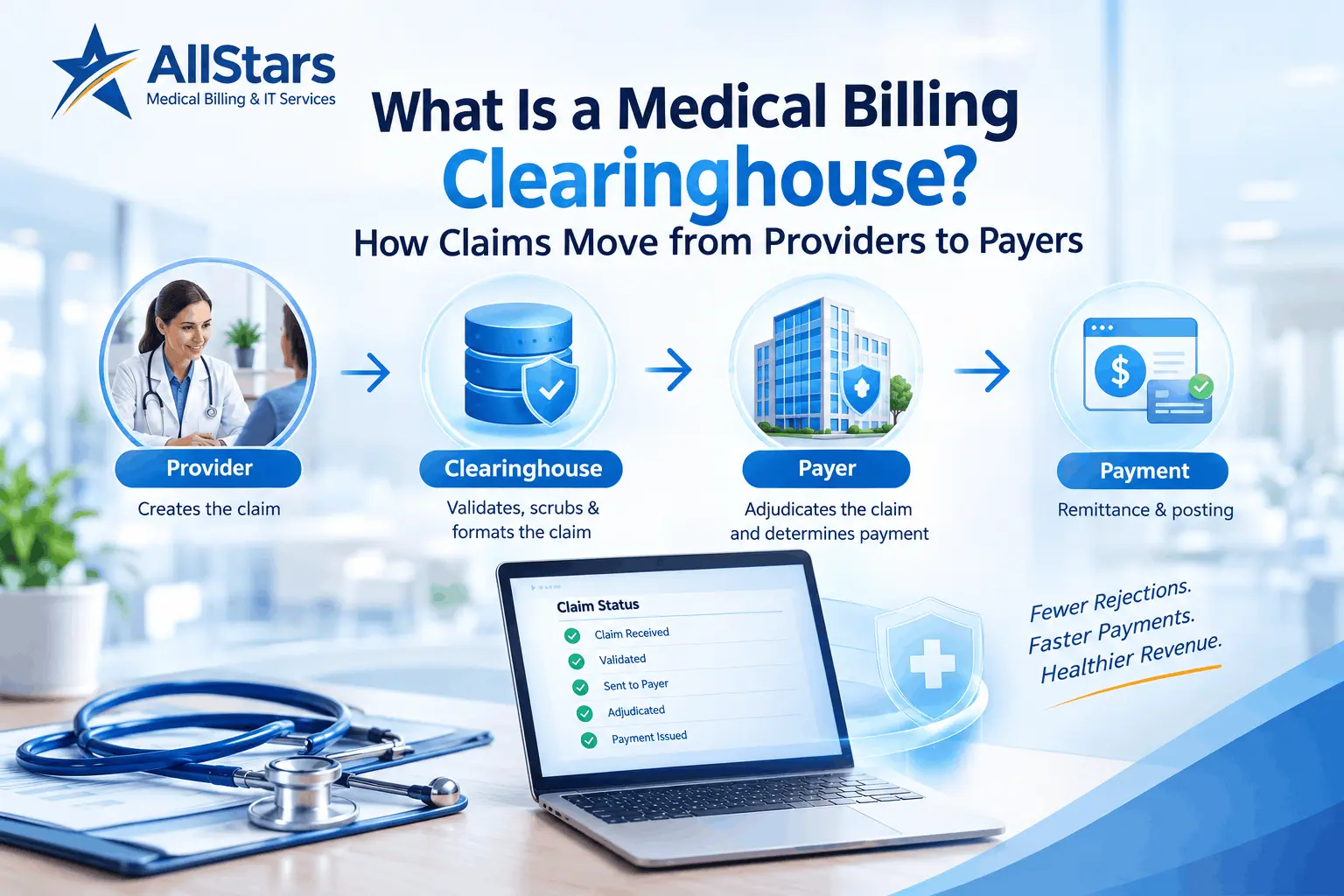
A typical workflow looks like this:
- EHR or practice management system: Creates the electronic claim using patient, provider, insurance, and service information.
- Medical billing clearinghouse: Checks claim data, applies applicable edits, and routes the transaction.
- Insurance payer: Receives the claim and evaluates it under the patient’s benefits and the payer’s policies.
- Clearinghouse and billing system: Return applicable acknowledgments, claim-status updates, and remittance information.
- Medical billing team: Reviews exceptions, posts payments, corrects rejections, and follows up on unpaid claims.
The exact workflow depends on the clearinghouse, software integration, payer, and transaction type. A clearinghouse can identify many submission errors, but it cannot guarantee that every claim will be paid.
Understanding Common Electronic Medical Billing Transactions
Electronic transactions help providers and payers exchange standardized information throughout the revenue cycle. Understanding the most common transaction types makes it easier for billing teams to interpret reports and respond to claim issues.
837: Electronic Healthcare Claim
The 837 transaction carries electronic claim information from a provider or billing service to a payer, usually through a clearinghouse.
- 837P: Used for professional claims, such as services provided by physicians and other healthcare professionals.
- 837I: Used for institutional claims, such as hospital and certain facility services.
The claim includes information such as patient demographics, subscriber details, provider identifiers, diagnosis codes, procedure codes, and charges.
999: Implementation Acknowledgment
The 999 acknowledgment reports whether an electronic transaction passed specified implementation and structural checks. It can identify errors that prevent a submitted file or transaction from being accepted at that level.
An accepted 999 does not mean every claim in the file has been approved for payment. Additional claim-level and payer-processing steps may follow.
277CA: Claim Acknowledgment
The 277CA provides claim-level acknowledgment information in response to claim submissions. It helps billing teams identify claims that have been accepted into the next stage of processing or rejected because of identified problems.
Staff should review these reports promptly so rejected claims can be corrected and resubmitted within applicable filing deadlines.
276 and 277: Claim Status Inquiry and Response
The 276 transaction is used to request information about a claim’s status, while the 277 transaction returns the status information.
These transactions help billing teams investigate claims that remain outstanding, determine whether additional action is needed, and prioritize follow-up work.
835: Electronic Remittance Advice
The 835 electronic remittance advice (ERA) explains how a payer processed claims and reports payment information, adjustments, and applicable reasons for nonpayment or reduced payment.
Billing staff use the ERA to reconcile claim outcomes, post payments, review contractual adjustments, and identify underpayments or denials that require further investigation.
Important: These transactions serve different purposes. A claim acknowledgment is not the same as a payment decision, and an ERA is not simply proof that every billed service was paid.
Key Benefits of Using a Medical Billing Clearinghouse
A medical billing clearinghouse can support a more organized revenue cycle by reducing manual work and helping billing teams identify problems earlier.
1. Reduced Avoidable Claim Rejections
Automated claim edits can identify common problems such as missing information, invalid identifiers, or incorrect payer routing before a claim reaches the payer’s adjudication process. Fixing these issues early can reduce avoidable delays.
2. More Efficient Claim Submission
Instead of maintaining separate submission processes for every insurance company, practices can use a clearinghouse to connect with multiple participating payers through an integrated workflow.
This can save staff time, particularly for practices that work with many commercial insurers and government programs.
3. Better Claim Tracking
Acknowledgment reports and supported status transactions help billing teams monitor claim progress. Staff can identify claims requiring correction or additional follow-up instead of waiting for an unexpected payment delay.
4. Improved Payment Reconciliation
When electronic remittance advice is supported, billing teams can use payer payment details to post payments and adjustments more efficiently. They can also identify discrepancies that need review.
5. Stronger Revenue Cycle Management
A clearinghouse supports the claims-submission portion of revenue cycle management (RCM). When combined with eligibility verification, accurate coding, authorization checks, payment posting, denial management, and accounts receivable follow-up, it can contribute to a more efficient billing process.
Common Reasons Medical Billing Clearinghouse Claims Get Rejected
Even when a practice uses a clearinghouse, claims can still fail initial edits. The most effective approach is to understand the common causes and build preventive checks into the billing workflow.
Incorrect Patient or Subscriber Information
A mismatch in the patient’s name, date of birth, member ID, or subscriber information can cause a claim to fail validation or payer matching.
How to prevent it: Verify insurance information during registration, confirm the correct subscriber relationship, and update records when a patient’s coverage changes.
Incorrect Payer ID
Electronic claims must be routed to the correct payer or designated destination. An incorrect payer identifier may cause a routing problem or rejection.
How to prevent it: Confirm the payer ID using current clearinghouse guidance and the relevant insurance plan’s submission instructions.
Missing Provider Identifiers
Missing or incorrect National Provider Identifier (NPI), taxonomy information, or other required provider details can trigger claim edits.
How to prevent it: Maintain accurate provider records and verify that billing software uses the appropriate identifiers for the provider, service location, and claim type.
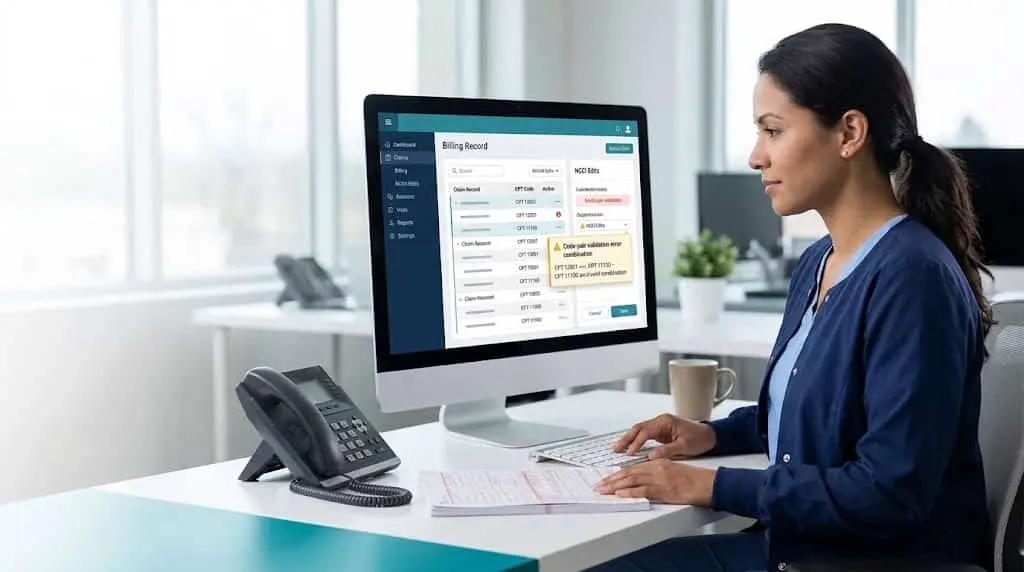
Invalid Diagnosis or Procedure Information
Incorrect codes, incomplete required data, or incompatible code combinations can cause claim errors. Other coding problems may only become apparent during payer adjudication.
How to prevent it: Follow current coding guidelines, review documentation, and use updated billing software and claim-edit rules.
Missing Authorization or Referral Information
Some services require prior authorization or referral information. A clearinghouse may identify a missing field, but a claim can still be denied if the required authorization was not obtained or the service falls outside its approved terms.
How to prevent it: Verify authorization requirements before providing services, document approval details, and confirm that the approved service matches the claim.
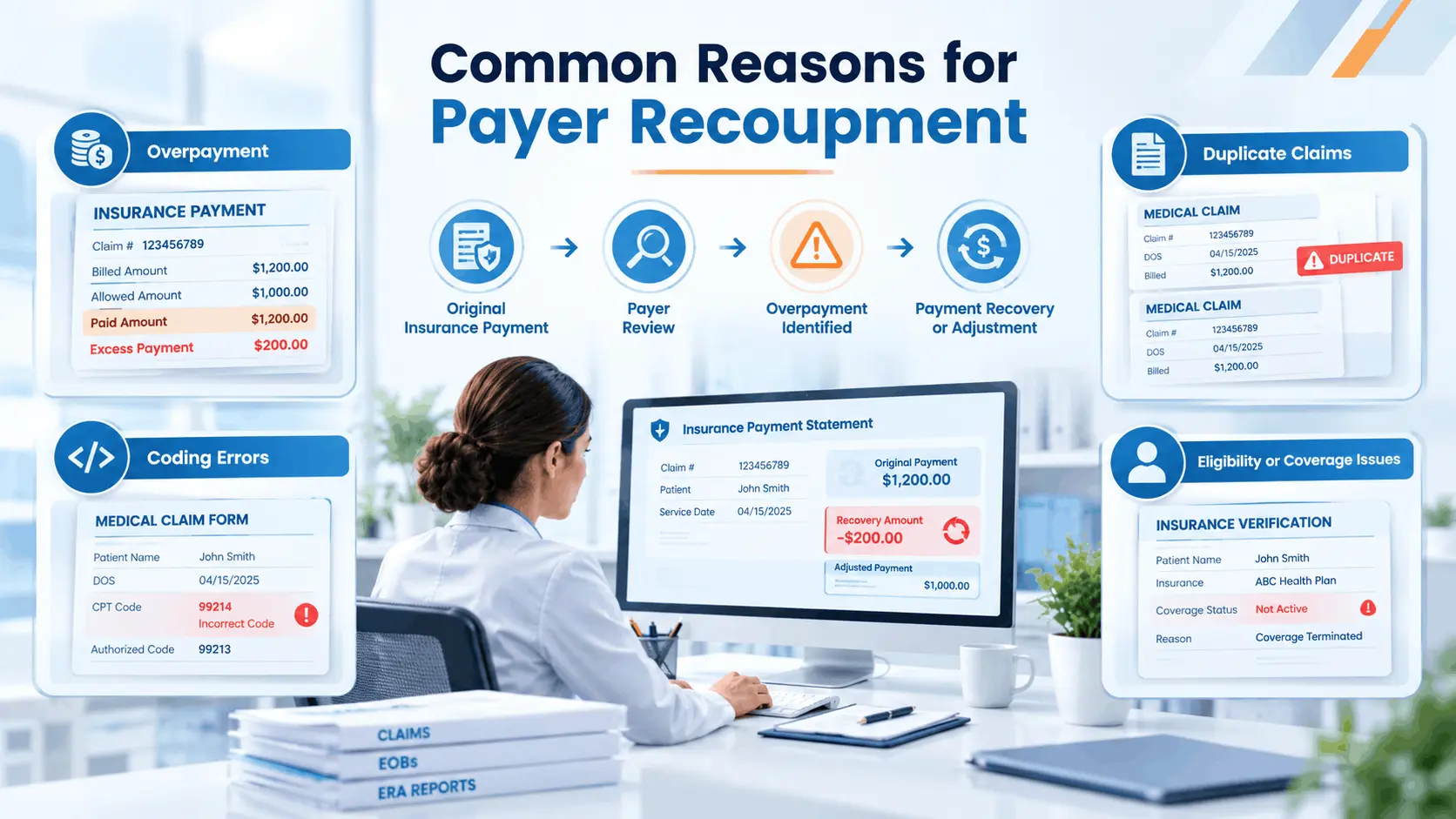
Duplicate Claims
Submitting the same claim more than once can trigger duplicate-claim edits or payer review.
How to prevent it: Check submission history and claim acknowledgments before resubmitting. If a claim appears delayed, verify its status rather than automatically sending another copy.
Incorrect or Outdated Insurance Coverage
A patient’s coverage may have changed, terminated, or become secondary to another plan.
How to prevent it: Perform eligibility and benefits verification before the visit and confirm coordination-of-benefits details when necessary.
Medical Billing Clearinghouse vs. Medical Billing Company
Although these services may work together, they have different responsibilities.
A medical billing clearinghouse primarily provides technology for electronic claim validation, transmission, routing, and related transaction reporting. A medical billing company can manage a much broader set of revenue cycle activities.
For example, a billing company may review charges, coordinate coding workflows, verify eligibility, monitor authorizations, submit claims through a clearinghouse, post payments, investigate denials, and follow up on outstanding accounts receivable.
A clearinghouse does not automatically replace a billing team. The practice still needs appropriate processes and trained staff to address errors, interpret payer responses, and resolve unpaid claims.
When comparing service providers, ask whether clearinghouse access is included in the billing service, which party handles rejected claims, how payment posting is managed, and who is responsible for denial appeals and A/R follow-up.
How to Choose the Right Medical Billing Clearinghouse
Selecting a clearinghouse requires more than comparing monthly fees. Practices should consider payer compatibility, reporting capabilities, data security, support, and integration with their existing software.
- Payer connectivity: Confirm that the service supports the insurance payers your practice bills regularly.
- Claim-edit capabilities: Ask which validation rules are included and how frequently they are updated.
- Reporting and alerts: Look for clear acknowledgment reports, rejection details, and claim-status visibility.
- EHR integration: Confirm compatibility with your current practice management or EHR system.
- ERA and payment workflows: Check whether electronic remittance and payment-related transactions are supported.
- Security and privacy: Evaluate access controls, encryption, incident response, and applicable HIPAA obligations. Where required, review the business associate agreement.
- Customer support: Ask how quickly the provider responds when a claim fails or a payer connection stops working.
- Transparent pricing: Review setup fees, per-claim charges, transaction fees, ERA services, and support costs.
Before signing a contract, request a demonstration using a typical claim workflow. Ask the vendor to show how a rejected claim is identified, corrected, resubmitted, and tracked.
How Clearinghouses Support the Medical Billing Revenue Cycle
A clearinghouse is one part of a larger revenue cycle workflow. Its value is greatest when the practice combines electronic claim submission with accurate front-end information and consistent back-end follow-up.
Front-end activities include patient registration, insurance eligibility verification, benefits review, and authorization checks.
Mid-cycle activities include documentation review, charge capture, coding, claim preparation, and claim validation.
Back-end activities include payer response monitoring, payment posting, denial management, underpayment review, and accounts receivable follow-up.
If a practice has frequent eligibility errors, incomplete documentation, or missing authorizations, a clearinghouse alone will not solve those underlying problems. Improving the entire workflow helps reduce preventable errors and makes it easier to identify where revenue is delayed.
Why Clearinghouses Matter
- Fewer rejections: Claims are scrubbed for missing or invalid data before they reach the payer.
- One connection, many payers: You don’t need direct links to hundreds of insurers.
- HIPAA-standard formatting: Claims are converted to the standard electronic transaction formats.
- Faster payments: Clean claims move through adjudication more quickly.
- Visibility: Status reports show where each claim is in the process.
What does a medical billing clearinghouse do?
It receives claims from providers, scrubs them for errors, converts them into HIPAA-compliant electronic formats, and routes them to the correct payer. It also returns status and remittance reports.
Is a clearinghouse required for medical billing?
Not legally, but most practices use one. Connecting directly to every payer is impractical, and a clearinghouse simplifies submission and reporting.
What’s the difference between a clearinghouse and a medical billing company?
A clearinghouse is a technology intermediary that transmits and validates claims. A medical billing company manages the full revenue cycle, including coding, submission, payment posting, denial management, and patient billing.
How long does it take for a claim to reach the payer?
Submission through a clearinghouse is typically fast, often within a day. Payer processing time then varies by payer and claim complexity.
What is claim scrubbing?
Automated software checks that identify errors, such as missing data, invalid codes, or payer rule violations, before the claim is sent.
Why was my claim rejected by the clearinghouse?
Usually a data or formatting problem, such as an incorrect payer ID, subscriber mismatch, or missing NPI. Review the rejection report, fix the issue, and resubmit.
Don’t Rely on the Clearinghouse Alone
A clearinghouse moves claims. It does not fix poor coding, missing authorizations, weak eligibility checks, or slow denial follow-up. Those gaps are where many practices lose revenue. A complete revenue cycle approach pairs clean submission with eligibility verification, accurate coding, payment posting, A/R follow-up, and denial management.
Let Allstars Medical Billing Handle the Claim Journey
Rejections, denials, and aging A/R shouldn’t take time away from patient care. Allstars Medical Billing helps U.S. practices manage the revenue cycle from claim submission to payment follow-up, so more of what you earn reaches your bank account.
👉 Visit Allstars Medical Billing to request a free consultation and see how a dedicated billing team can improve your clean-claim rate and cash flow.