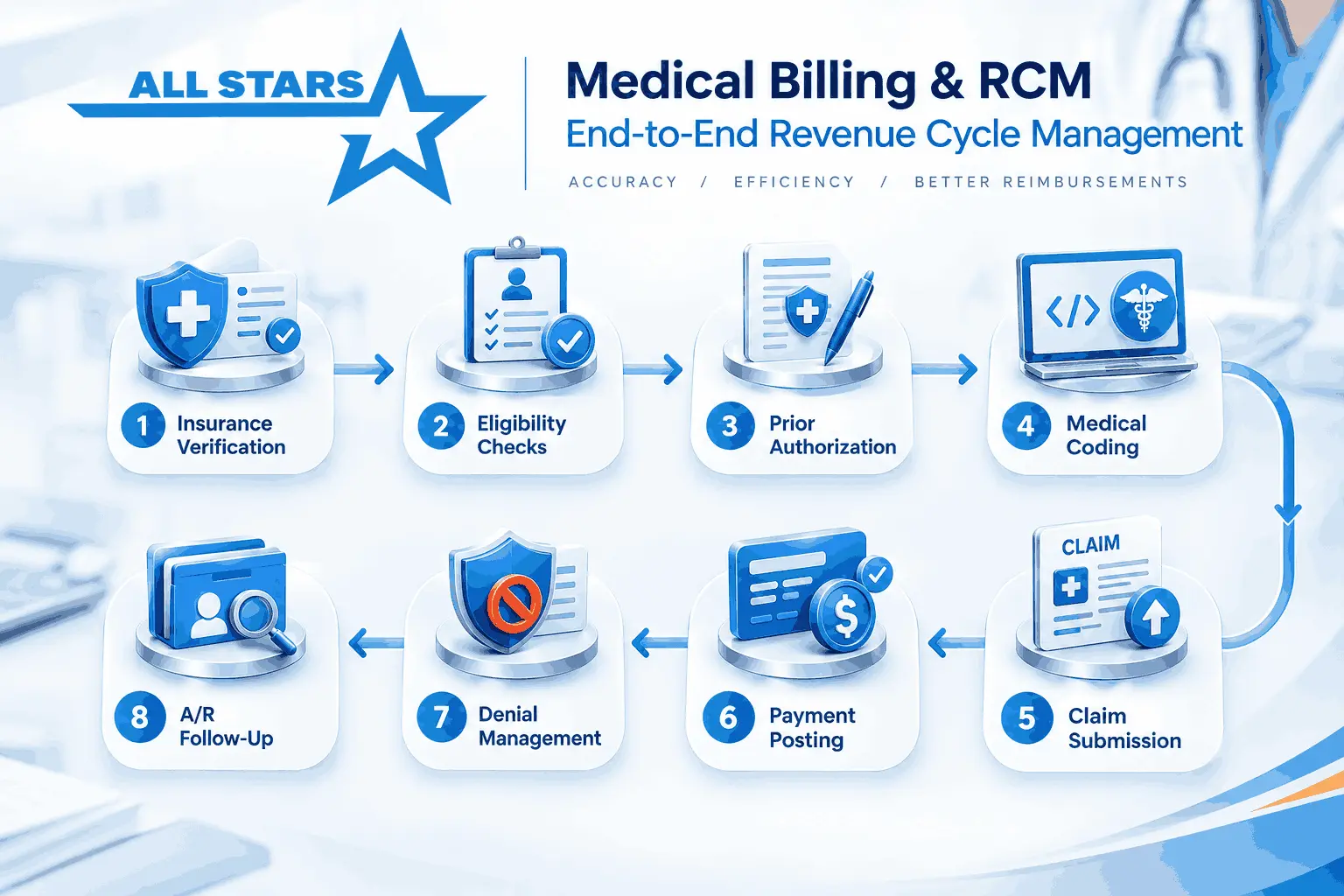

In healthcare, the financial journey of a patient involves many steps before a medical practice receives full payment for the services provided. From scheduling an appointment and verifying insurance coverage to submitting claims, resolving denials, and collecting outstanding balances, every stage contributes to the financial health of a practice.
Revenue Cycle Management (RCM) is the process healthcare organizations use to manage the financial journey of a patient from registration through final payment. A well-organized RCM process helps providers reduce billing errors, improve collections, minimize claim denials, and maintain a healthier cash flow.
A problem at any stage of the revenue cycle can affect the stages that follow. For example, incorrect patient information or an unsuccessful insurance verification may eventually result in a rejected or denied claim.
This guide explains the complete revenue cycle management process, including its major stages, important KPIs, common challenges, and strategies healthcare providers can use to improve financial performance.
What Is Revenue Cycle Management?
Revenue Cycle Management (RCM) is a comprehensive healthcare financial process that connects patient registration, insurance verification, clinical documentation, medical coding, billing, claims processing, payment posting, denial management, accounts receivable follow-up, and patient collections.
The main objective of RCM is to ensure that healthcare providers receive accurate and timely reimbursement for the services they deliver.
A typical healthcare revenue cycle management process includes:
- Patient registration
- Insurance eligibility verification
- Benefits verification
- Prior authorization
- Charge capture
- Medical coding
- Claim creation and submission
- Claim processing
- Denial management
- Payment posting
- Accounts receivable follow-up
- Patient billing and collections
Each step depends on the accuracy of the previous one. Strong RCM processes therefore focus not only on collecting payments but also on preventing financial problems before they occur.
Significance of Revenue Cycle Management in Healthcare
Revenue Cycle Management is an important part of the financial health of a medical practice, hospital, clinic, or other healthcare organization.
The U.S. healthcare system processes an enormous amount of financial activity every year. According to the Centers for Medicare & Medicaid Services (CMS), national healthcare spending reached approximately $5.3 trillion in 2024, representing about 18% of U.S. GDP. Medicare spending alone reached approximately $1.118 trillion in 2024.
CMS also reports that Medicare Administrative Contractors processed more than 1.1 billion Medicare fee-for-service claims during FY2024, with approximately $459.7 billion in Medicare fee-for-service benefits paid.
These numbers demonstrate why organized revenue cycle processes are important for healthcare providers.
Key Benefits of Effective RCM
1. Improves Cash Flow
Efficient billing and collection processes can help healthcare providers receive reimbursement more consistently.
Faster claim submission, effective denial management, accurate payment posting, and timely A/R follow-up can reduce unnecessary payment delays.
2. Helps Reduce Claim Denials
Many claim problems can be prevented by identifying issues before submission.
Eligibility verification, authorization checks, accurate coding, complete documentation, and claim scrubbing can help reduce avoidable denials.
3. Reduces Administrative Work
Manual billing processes can consume significant staff time.
Automation and organized workflows can reduce repetitive tasks and allow billing teams to focus on complex claims and accounts requiring additional attention.
4. Improves Billing Accuracy
Accurate demographic information, insurance data, coding, charges, and claim information help create a stronger billing process.
5. Strengthens Accounts Receivable Management
Consistent A/R follow-up helps identify unpaid claims, underpayments, denials, and aging balances before they become more difficult to resolve.
6. Creates a Better Patient Financial Experience
Clear statements, accurate balances, convenient payment options, and timely communication can make healthcare billing easier for patients to understand.
7. Supports Financial Decision-Making
RCM reports provide practice managers and healthcare organizations with information about collections, denials, A/R aging, reimbursement, and other financial indicators.
Complete Revenue Cycle Management Workflow
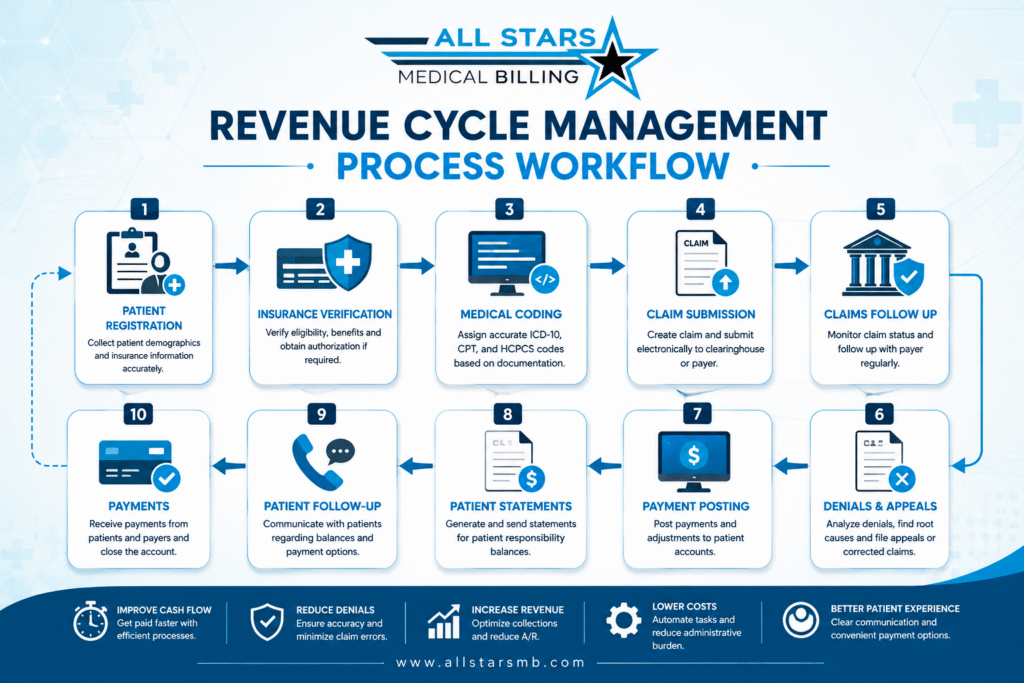
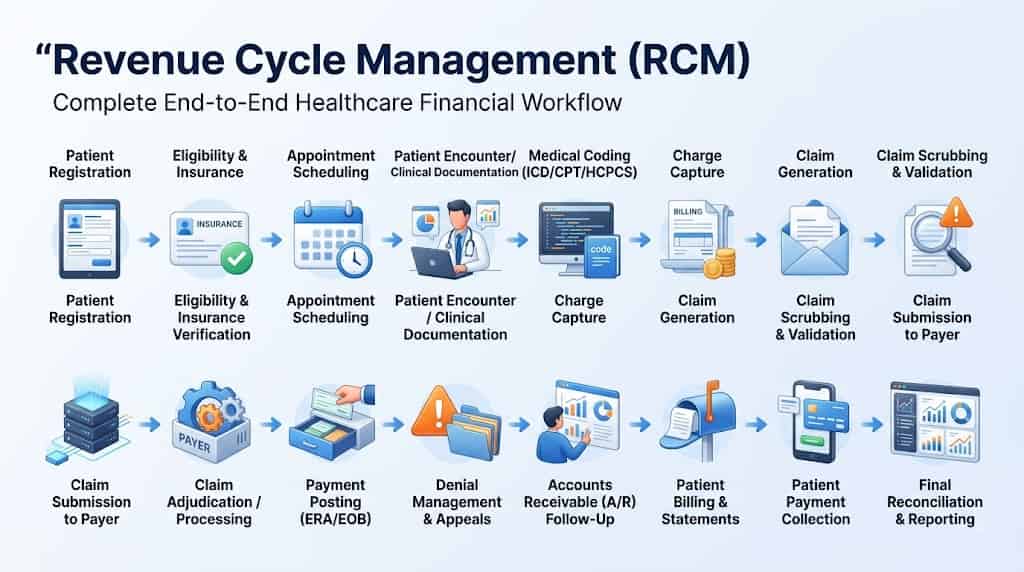
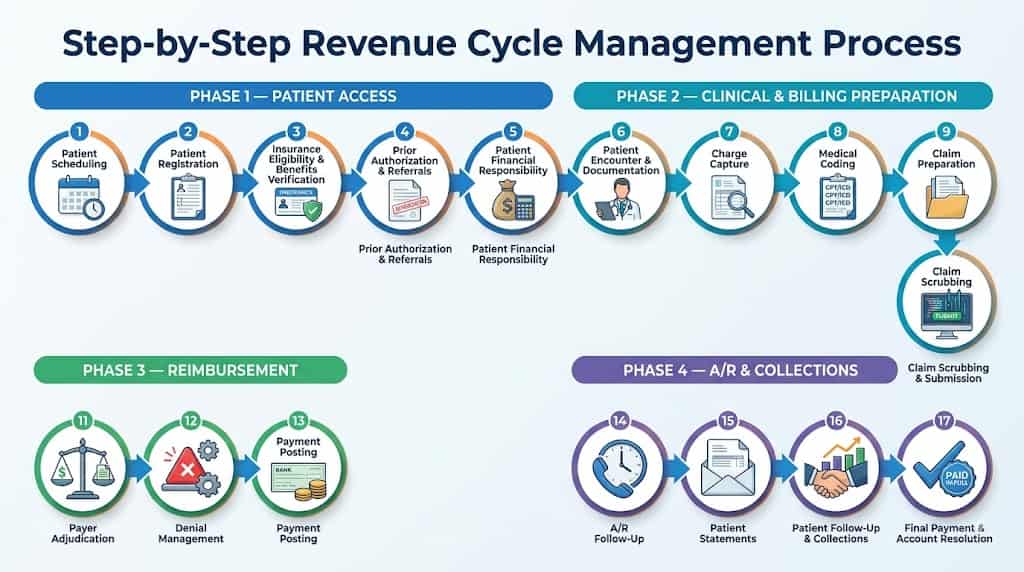
The Revenue Cycle Management (RCM) workflow is a continuous process that manages the financial journey of a patient from the initial appointment to the final account resolution. It begins with patient scheduling, registration, and insurance eligibility verification, followed by authorization and the patient encounter. After care is provided, accurate documentation and charge capture support medical coding and claim preparation. The claim is then reviewed, submitted to the appropriate payer, and processed through adjudication.
Depending on the outcome, the claim may result in payment or require additional action due to a denial. Payments are posted to the patient’s account, while denied or unpaid claims move through denial management, appeals, and A/R follow-up. Finally, patient billing and payment collection help resolve any remaining balance. By connecting each stage efficiently, healthcare providers can improve billing accuracy, reduce payment delays, manage outstanding accounts, and maintain a healthier revenue cycle.
Three Main Phases of the Healthcare Revenue Cycle
The complete Revenue Cycle Management (RCM) process can be divided into three major phases: Front-End RCM, Mid-Cycle RCM, and Back-End RCM. Each phase contains specific activities that help healthcare providers move efficiently from patient access to final payment.
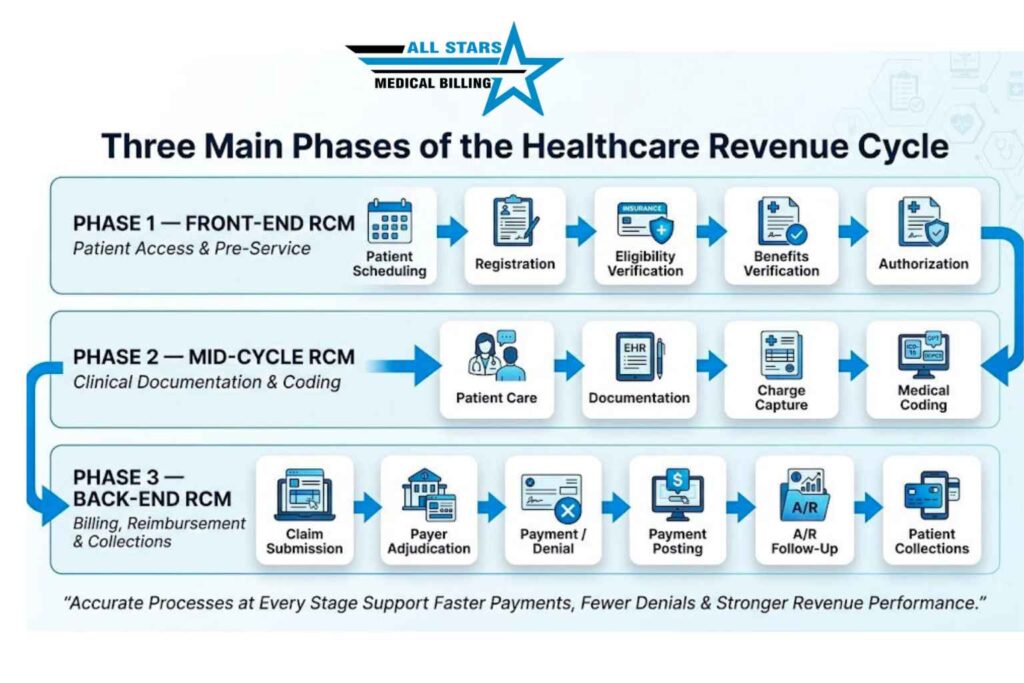
1. Front-End RCM (Patient Access)
The front-end phase includes activities that take place before or around the time of the patient’s visit. Accurate information at this stage helps prevent billing problems later.
- Patient Scheduling: Arranging the patient’s appointment and collecting basic information.
- Registration: Recording and confirming the patient’s demographic and insurance information.
- Eligibility Verification: Checking whether the patient’s insurance coverage is active.
- Benefits Verification: Reviewing copays, deductibles, coinsurance, and covered services.
- Authorization: Determining whether the planned service requires prior authorization and obtaining it when necessary.
2. Mid-Cycle RCM (Clinical Documentation & Coding)
The mid-cycle phase connects the patient’s healthcare services with the information required to create an accurate claim.
- Patient Care: The provider evaluates the patient and delivers the required healthcare services.
- Documentation: The provider records diagnoses, procedures, treatment, and other clinical details.
- Charge Capture: Identifying and recording the services and procedures that need to be billed.
- Medical Coding: Translating clinical documentation into appropriate diagnosis and procedure codes.
3. Back-End RCM (Billing & Collections)
The back-end phase begins after the patient’s services have been documented and coded. It focuses on submitting claims, receiving reimbursement, resolving denials, and collecting outstanding balances.
- Claim Submission: Sending the completed claim to the appropriate insurance payer.
- Payer Adjudication: The payer reviews the claim and determines the appropriate payment.
- Payment / Denial: The claim is either paid, partially paid, or denied.
- Payment Posting: Recording insurance payments, adjustments, and applicable balances in the billing system.
- A/R Follow-Up: Following up on unpaid or delayed claims and outstanding accounts.
- Patient Collections: Billing the patient and collecting any remaining financial responsibility.
Tips to Optimize Your Healthcare RCM
Effective Revenue Cycle Management (RCM) is essential for healthcare organizations that want to maintain financial stability, reduce administrative workload, and improve operational efficiency. A well-managed revenue cycle helps practices collect payments more efficiently, minimize billing errors, reduce claim delays, and improve the overall patient financial experience.
Optimizing RCM requires continuous attention to accuracy, technology, communication, staff training, and performance monitoring. Below are several practical strategies healthcare providers can use to improve their revenue cycle.
Ensure Accuracy and Timeliness
Healthcare providers should never underestimate the importance of accuracy and timely action throughout the revenue cycle. Even small errors in patient information, insurance details, coding, or claim submission can result in rejected claims and payment delays.
Practices should regularly identify weaknesses in their RCM processes and address them promptly. Accurate patient records, correct payment posting, timely claim submission, and consistent follow-up can help create a smoother billing workflow.
Maintaining both accuracy and timeliness can reduce unnecessary delays, improve reimbursement, support patient satisfaction, and contribute to stronger financial performance.
Make Payments Online
Offering secure online payment options can make the payment process more convenient for both patients and healthcare practices. Digital payment systems can reduce paperwork, simplify administrative tasks, and help practices process and record payments more efficiently.
Patient portals can also give patients convenient access to billing information, statements, payment options, and other important healthcare information.
According to the 2022 CAQH Index, electronic transactions can significantly reduce administrative costs across the healthcare system. Although many RCM processes may still involve manual tasks, adopting digital tools and software can help practices improve efficiency and strengthen revenue collection.
For a more efficient RCM workflow, healthcare providers should consider secure online payment systems and patient portals that make it easier for patients to review and pay their balances.
Automate Communications
Effective communication is an important part of a successful RCM process. Healthcare practices regularly communicate with patients, insurance companies, and other stakeholders regarding eligibility, claims, payments, outstanding balances, and billing issues.
Automating routine communications through practice management systems, patient portals, email, text messaging, and other digital tools can help reduce manual administrative work.
Automated reminders and notifications can help patients stay informed about appointments, outstanding balances, and payment requirements. At the same time, timely communication with insurance companies can help practices address claim-related issues and maintain a more organized revenue cycle.
Train Staff on RCM
A knowledgeable and well-trained billing team is critical to an efficient revenue cycle. Staff members should understand the different stages of RCM, from patient registration and insurance verification to coding, claim submission, denial management, payment posting, and A/R follow-up.
Regular training can help staff stay current with coding requirements, payer policies, billing procedures, compliance requirements, and changes in healthcare technology.
Training should also cover important areas such as HIPAA compliance, ICD-10-CM coding, CPT, HCPCS, payer guidelines, denial management, and electronic billing processes.
Investing in ongoing staff education can reduce errors, improve productivity, strengthen compliance, and support more consistent collections.
What are the main stages of the RCM process?
The main stages include patient scheduling, registration, insurance eligibility and benefits verification, prior authorization, patient care, documentation, charge capture, medical coding, claim submission, payer adjudication, payment posting, denial management, A/R follow-up, and patient collections.
What are the three phases of Revenue Cycle Management?
Healthcare RCM is commonly divided into three phases: front-end RCM, mid-cycle RCM, and back-end RCM. Front-end activities focus on patient access and insurance information, mid-cycle activities focus on documentation, charge capture, and coding, and back-end activities focus on billing, payments, denials, A/R, and collections.
What is the difference between rejected and denied claims?
A rejected claim is generally returned because it contains an error that prevents it from entering or completing the payer’s claims-processing workflow. A denied claim has typically been processed by the payer but payment was not approved for the submitted claim or service.
20. What is the goal of Revenue Cycle Management?
The primary goal of RCM is to ensure that healthcare organizations receive accurate, timely, and appropriate reimbursement for the services they provide while maintaining an efficient billing process and positive patient financial experience.
How does RCM affect a medical practice’s financial performance?
A well-managed RCM process can help a practice reduce payment delays, improve collections, control outstanding A/R, reduce avoidable denials, and make financial performance easier to monitor.