
A medical claim does not mean the revenue cycle is finished once the insurance company processes it. The next step is just as important: making sure the payment, adjustments, patient responsibility, and remaining balance are accurately recorded in the practice’s billing system.
This is where payment posting in medical billing comes into play.
What Is Payment Posting in Medical Billing?
Payment posting in medical billing is the process of recording insurance and patient payments against the corresponding medical claims or patient accounts.
The process typically involves reviewing payment information from sources such as:
- Electronic Remittance Advice (ERA)
- Explanation of Benefits (EOB)
- Electronic Funds Transfer (EFT)
- Insurance checks
- Patient payments
- Credit card or online payment systems
A payment poster compares the payment information with the original claim and updates the patient’s account accordingly.
This may include recording:
- Insurance payments
- Patient responsibility
- Contractual adjustments
- Deductibles
- Copayments
- Coinsurance
- Denials
- Non-covered amounts
- Recoupments or takebacks
- Remaining balances
The goal is simple: every payment should be accurately matched to the correct account and claim.
Why Is Payment Posting Important in Medical Billing?
Payment posting in medical billing may look like a routine billing task, but it directly affects the accuracy of a practice’s revenue cycle. When payments, adjustments, and patient balances are recorded correctly, billing teams have a clearer picture of what has been paid, what remains outstanding, and which accounts require additional action.
Improves A/R Accuracy
When payments and adjustments are posted correctly, accounts receivable reports become more reliable.
Incorrect posting can make an account appear unpaid when the payer has already issued payment, or it can hide a remaining balance that still requires follow-up.
Helps Identify Underpayments
Healthcare providers may receive payments that do not match expected reimbursement.
Accurate payment posting makes it easier to compare payer payments with contracted or expected amounts and identify potential underpayments for further review.
Supports Denial Management
Remittance information often reveals why a claim was not paid as expected.
By correctly recording denial codes, adjustment information, and payer responses, billing teams can route accounts for appropriate follow-up or appeals.If a payment has already been received but is not posted correctly, staff may mistakenly treat the account as unpaid.Accurate posting helps prevent unnecessary billing activity and reduces confusion for both staff and patients.
5. Improves Financial Reporting
Practice owners and administrators rely on accurate financial data to understand collections, outstanding balances, payer performance, and overall revenue cycle performance.Poor payment posting can make those reports misleading.
How Does the Payment posting in medical billing Process Work?
A structured payment posting workflow generally follows several steps.
Step 1: Receive Payment Information
The billing department receives payment information from insurance companies or patients. This may arrive electronically through an ERA/EFT process or through paper-based documents such as EOBs and checks.
Step 2: Review the Remittance
The payment poster reviews the remittance information to determine:
- Amount billed
- Allowed amount
- Amount paid
- Adjustments
- Patient responsibility
- Denial or remark codes
- Remaining balance
Step 3: Match the Payment to the Correct Account
The payment is matched to the appropriate patient, claim, date of service, and provider information. Accurate matching is essential because a payment posted to the wrong account can create problems throughout the revenue cycle.
Step 4: Post the Insurance Payment
The actual insurance payment is entered into the practice management or billing system. The payment should be allocated to the appropriate claim or service line whenever applicable.
Step 5: Post Adjustments
Contractual adjustments and other appropriate adjustments are recorded according to the payer’s remittance information and the practice’s established procedures.
Step 6: Record Patient Responsibility
If the remittance indicates that the patient owes a deductible, copayment, coinsurance, or other applicable balance, that amount is reflected on the patient account.
Step 7: Identify Unresolved Amounts
If the claim was denied, partially paid, underpaid, or otherwise requires additional action, the account should be routed to the appropriate billing or A/R workflow.
Step 8: Reconcile the Payment
The posted amount should be reconciled with the actual payment received. This helps identify discrepancies and supports accurate financial records.
ERA vs. EOB: What’s the Difference?
Two common payment-related documents are the ERA and EOB.
ERA: Electronic Remittance Advice
An ERA is an electronic document containing information about how a payer processed a claim. It can include payment amounts, adjustments, denial information, and patient responsibility.
EOB: Explanation of Benefits
An EOB is a statement from the health insurance company explaining how a claim was processed.
It generally shows information such as:
- Amount billed
- Allowed amount
- Insurance payment
- Adjustments
- Patient responsibility
- Claim processing information
An EOB is not itself a bill from the provider.
Common Payment Posting Errors
Even a small posting error can create downstream problems. Common issues include:
Incorrect Patient Account
A payment is posted to the wrong patient or account.
Incorrect Claim
A payment is applied to the wrong claim or date of service.
Incorrect Adjustment
An adjustment is entered incorrectly, affecting the remaining balance.
Missed Denial Information
Denial or remark information is overlooked, leaving an account without appropriate follow-up.
Duplicate Payment Posting
The same payment is posted more than once, creating an inaccurate account balance.
Unapplied Payments
A payment is received but cannot immediately be matched to the correct account or claim.
Delayed Payment Posting
Payments remain unposted for an extended period, reducing the accuracy of A/R reports and financial visibility.
How Payment Posting Affects A/R
Payment posting in medical billing and accounts receivable management are closely connected. When payments are posted promptly and accurately, billing teams can determine which accounts are:
- Paid in full
- Partially paid
- Denied
- Underpaid
- Pending
- Patient-responsibility balances
- Requiring additional follow-up
This allows the practice to focus its resources on accounts that actually require action. For example, if an insurance payment is received but not posted, an account may incorrectly remain in an outstanding A/R report. That can distort aging data and cause staff to spend time following up on an account that has already been paid.
Payment Posting and Denial Management
Payment posting in medical billing also plays an important role in identifying denial patterns. Suppose multiple claims from the same payer are being denied for a similar reason. Properly posted remittance information can help the billing team recognize the pattern.
The practice can then investigate whether the underlying issue involves:
- Eligibility
- Authorization
- Coding
- Documentation
- Claim information
- Timely filing
- Payer-specific requirements
This creates an important connection between payment posting and denial prevention.
Payment Posting and Underpayments
Not every problem is a complete claim denial. A claim can also be paid for less than expected. For this reason, Payment posting in medical billing teams should not focus only on whether a payment was received. They should also pay attention to whether the payment appears consistent with the applicable reimbursement expectations. Potential underpayments may require additional review and follow-up. A well-organized process can therefore help practices move beyond simply recording payments toward understanding whether claims are being reimbursed appropriately.
Best Practices for Accurate Payment Posting
Healthcare organizations can strengthen their payment posting workflow by establishing consistent procedures.
1. Post Payments Promptly
Avoid unnecessary delays between receiving payment information and posting it to the patient account.
2. Use ERA and EFT When Available
Electronic payment and remittance workflows can reduce manual handling and improve processing efficiency when properly implemented.
3. Reconcile Payments Regularly
Compare posted payments with actual deposits and remittance information.
4. Review Unapplied Payments
Create a process for investigating payments that cannot immediately be matched to an account.
5. Separate Posting from Follow-Up
When a payment reveals a denial, underpayment, or unresolved balance, route the account into the appropriate follow-up workflow.
6. Monitor Posting Accuracy
Regular audits can identify recurring errors and help improve staff training and workflow controls.
7. Track Key Revenue Cycle Metrics
Payment posting data can contribute to a broader understanding of:
- Collection performance
- A/R aging
- Denial trends
- Payment variance
- Payer performance
- Outstanding patient balances
Payment Posting Checklist
Use this basic checklist to support a consistent payment posting process:
- Verify the patient account
- Verify the claim and date of service
- Review ERA or EOB information
- Confirm the payment amount
- Record contractual adjustments correctly
- Record patient responsibility
- Review denial and remark codes
- Identify potential underpayments
- Review unapplied payments
- Reconcile deposits
- Route unresolved claims for follow-up
- Maintain accurate account records
When Should a Practice Outsource Payment Posting?
Some practices manage payment posting internally, while others outsource part or all of their revenue cycle operations.
Outsourcing may be considered when a practice is experiencing:
- Growing claim volume
- Payment posting backlogs
- Inaccurate A/R reports
- Limited billing staff
- Increasing denial volume
- Difficulty identifying underpayments
- Delayed reconciliation
- Administrative workload that is taking staff away from patient-facing responsibilities
The appropriate approach depends on the practice’s size, payer mix, claim volume, staffing, technology, and revenue cycle needs.
How AllStars Can Help With Payment Posting
Accurate payment posting is one part of a larger revenue cycle.
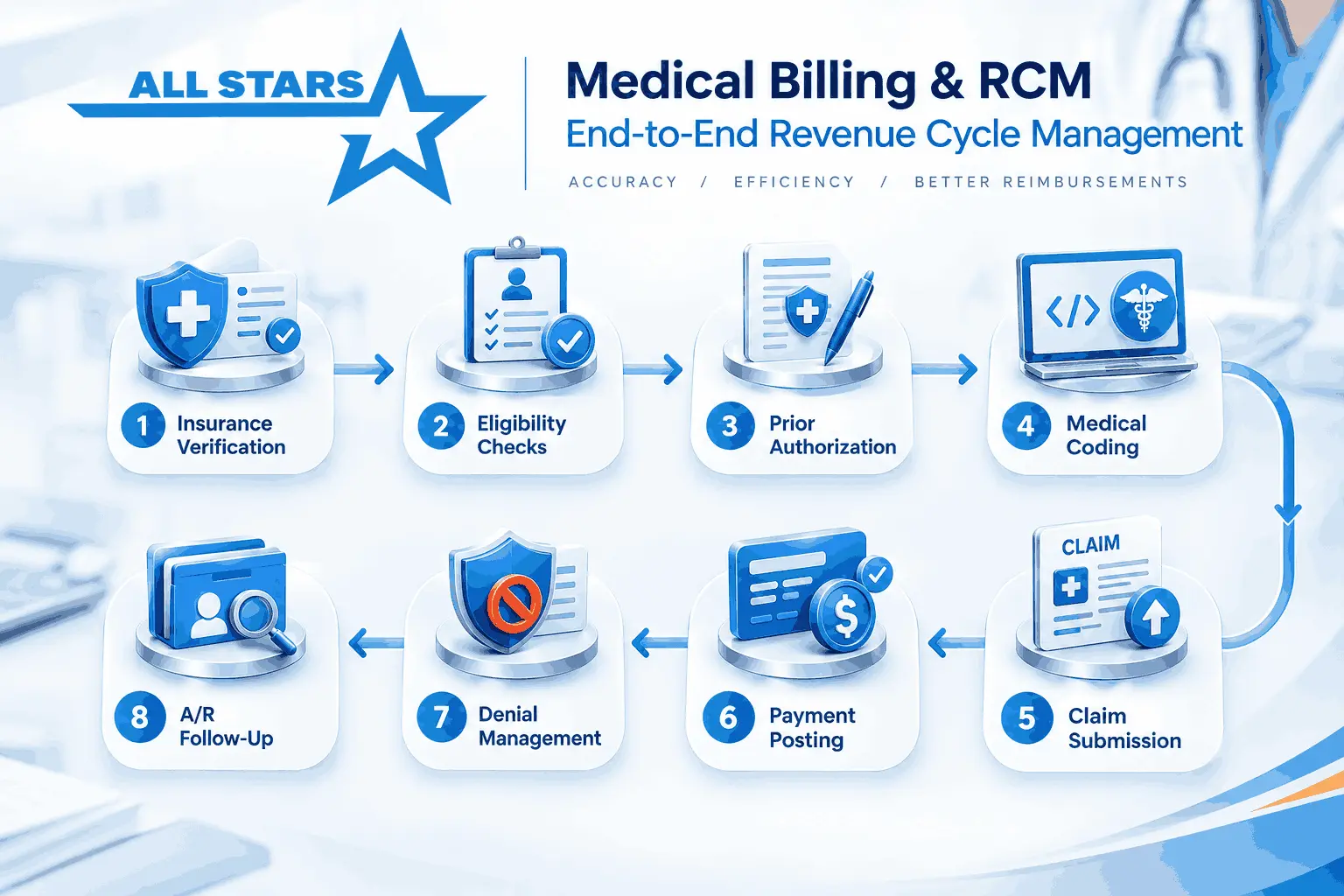
At AllStars Medical Billing & IT Services, payment posting can work alongside claim management, denial management, A/R follow-up, insurance verification, medical coding, credentialing, and other revenue cycle services.
Our goal is to help healthcare providers maintain a more organized billing operation while improving visibility into outstanding claims and payments.
Ready to strengthen your medical billing workflow?
Visit AllStars Medical Billing & IT Services to explore medical billing and revenue cycle solutions designed for U.S. healthcare providers.
Learn more: https://allstarsmb.com/